Popular vote compact nears critical 270 electoral votes
The popular vote compact holds 222 electoral votes and five new Democratic-led states could push it past 270, but legal and political hurdles still remain.
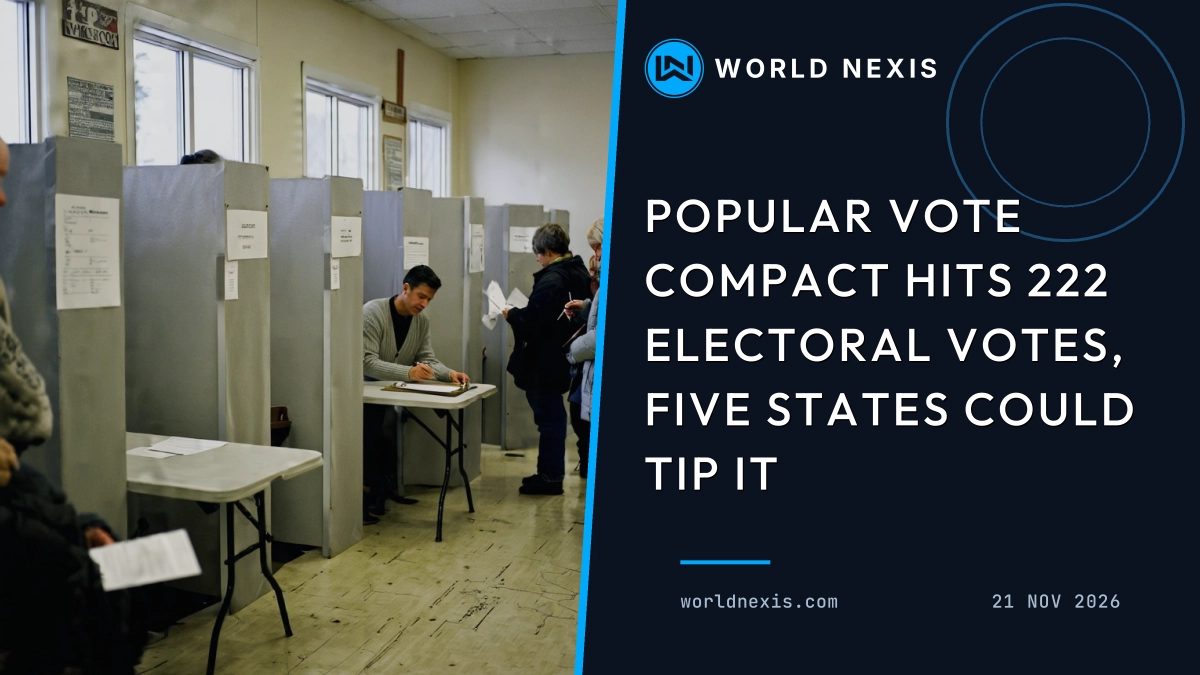
The popular vote compact now accounts for 222 electoral votes, and Democratic wins in this month’s midterm elections could soon push it past the 270 needed to take effect. Five presidential battlegrounds will be fully in Democratic hands next year: Arizona, Pennsylvania, Michigan, Nevada and Wisconsin, together worth 61 electoral votes.
Key points
- The National Popular Vote Interstate Compact commits member states to award their electors to the winner of the nationwide vote.
- Eighteen Democratic-led states and the District of Columbia have joined, holding 222 electoral votes.
- Any combination of at least four of the five newly Democratic states would carry the total beyond 270.
- No Republican-led state has joined, and unresolved legal questions hang over the arrangement.
How the popular vote compact would work
Under the agreement, a member state awards its presidential electors to the candidate who wins the most votes nationwide, even if that candidate loses the state itself. The switch only flips once states holding at least 270 electoral votes have signed on. At that point the national popular vote winner would be guaranteed the presidency.
Eighteen Democratic-led states and the District of Columbia are already inside the popular vote compact, giving it 222 electoral votes. The five states that moved fully into Democratic control this month add 61 more between them. Four of the five would be enough to clear the threshold.
Patrick Rosenstiel, a senior consultant to National Popular Vote, the group campaigning state by state, said the political weather has shifted in his favor. “I’ve never been more confident that 63% of American voters can get what they want in the 2028 presidential election, which is a national popular vote for president,” he said, citing Pew polling.
Why the popular vote compact stalls in the swing states
The arithmetic is not the obstacle. The politics is. Each of the five states is a place where presidential campaigns concentrate their money, their advertising and their attention, and joining the compact means trading that leverage for a share of a national tally.
Governors and incoming governors in Pennsylvania and Nevada have said they are open to signing legislation that would bring their states into the agreement. Other governors have yet to say publicly where they stand.
Arizona shows how quickly enthusiasm can cool. Governor Katie Hobbs previously supported the measure but has not commented recently on whether the state’s new Democratic majorities should sign on. Her office did not respond to a request for comment before publication.
State leaders must also decide whether they want to be the ones who tip the compact past 270 and change how America elects its presidents. That is a heavier decision than a routine floor vote, and it lands on legislatures with newly drawn majorities and untested priorities.
Constitutional and practical doubts shadow the popular vote compact
Legal scholars have warned that the arrangement could collide with the compact clause of the Constitution. It bars states from entering into agreements with one another without the consent of Congress.
Norman Miller, a constitutional law professor at Willamette University, sees practical trouble beyond the courtroom. US presidential elections are deliberately decentralized, with each state setting its own registration deadlines, ballot rules and recount procedures. Ordering electors in one state to follow a count built from another state’s rules creates friction, he said.
“We would want to have a standardized, uniform set of rules regarding who gets to vote for president, how they vote, how those votes are tabulated, and to have a federal election authority doing that tabulation.”
Supporters counter that states already decide how to award their electors, so coordinating that choice sits within powers they have long exercised. They also argue that a single national contest would force candidates to seek votes everywhere rather than in a handful of counties.
Why it matters
For ordinary voters, the change would be felt long before any election result. A national popular vote would make every ballot count the same whether it is cast in Phoenix, Milwaukee or rural Pennsylvania, and it would end the practice of candidates campaigning almost entirely in a few swing states.
It would also concentrate risk. If one state’s legislature reversed course after signing, or a court struck the arrangement down weeks before an election, the country could face a dispute over electors with no clear route out. The stakes for readers are simple: a structural change to how their president is chosen, decided by state legislatures rather than by a national vote.
Analysis
Having covered election data and constitutional law for World Nexis News for five years, I look first at whether a coalition can hold, not whether it can be assembled. On that test, I think the evidence favors the skeptics on timing. The compact’s supporters have the better diagnosis of what is wrong with the current system, but the weaker case on durability. A 270-vote coalition built entirely from one party is a coalition that one bad election can unwind, and the compact clause question remains unanswered by any court.
Miller’s practical objection is the one that should worry proponents most. The compact asks voters in one state to accept a count shaped by rules written in another, with no shared authority to audit or certify it. On this question I side with him, because the legitimacy of a result depends on voters trusting the process that produced it, and that trust is built state by state.
The strongest counter-argument is that states already hold near-total control over how they choose electors, so coordinating that choice is an ordinary exercise of power rather than a constitutional novelty. That deserves respect, and it is why I would not call the compact unlawful outright. But the burden sits with its backers to build safeguards first and majorities second.
What happens next
Attention now turns to legislative sessions in Arizona, Pennsylvania, Michigan, Nevada and Wisconsin next year, when the new Democratic majorities and governors take office. Proponents believe many of the political and legal obstacles can be cleared in time for the 2028 presidential election.
What we don’t know yet
It is unclear whether Governor Hobbs will back the push, or whether the remaining governors will follow Pennsylvania and Nevada. No court has yet ruled on whether the arrangement needs congressional consent, and no Republican-led state has signaled it would join.
Related coverage
- Midterms poll finds only 52% of Republicans trust vote count
- Trump crypto wealth nears $3bn as Democrats vow probes
- Permitting reform bill passes Senate in major 62-33 vote
Further reading
- An effort to circumvent the Electoral College may be within reach. But hurdles remain
- An effort to circumvent the Electoral College may be within reach. But hurdles remain
About the author: Ayesha Rahman is the Senior Political Correspondent & Columnist at World Nexis News (WNN), covering politics & opinion. The analysis section reflects the writer’s view.

Ayesha Rahman
Ayesha Rahman covers politics and opinion for World Nexis News from London, focusing on elections, legislatures and the policy choices that shape everyday life in the US and UK. She writes analysis and columns that separate what is confirmed from what is claimed, working from…



