Crawford murder trial: pilot guilty of staged mower death
Crawford murder trial: ex-RAAF pilot Robert John Crawford is guilty of murdering wife Frances and staging her death as a lawnmower accident in Queensland.
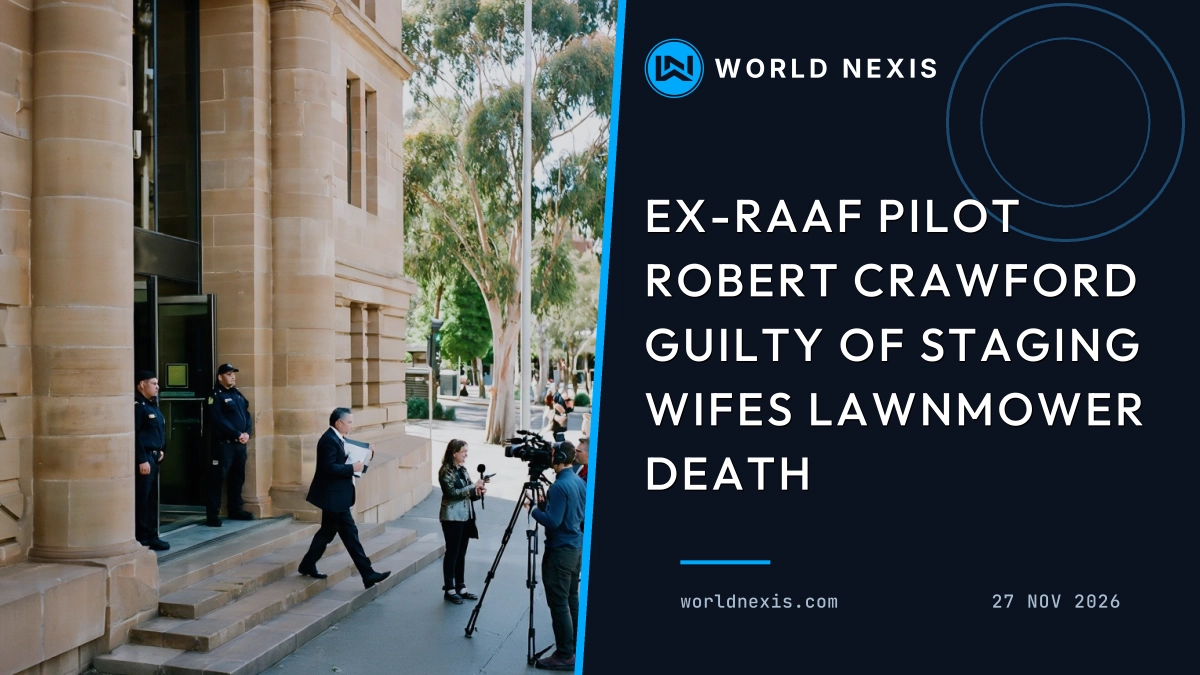
Updated 27 Nov 2026, 06:41 (UK time): Robert John Crawford was jailed for life for his wife’s murder after her daughter delivered a victim impact statement calling him a monster and the judge branded the killing brutal and selfish.
Robert John Crawford has been jailed for life for the murder of his wife Frances and for staging her death as a lawnmower accident. The sentence was imposed in the same Brisbane Supreme Court hearing as Friday’s guilty verdict, after victim impact statements were read. Justice Lincoln Crowley said Crawford had snapped late on 29 July, strangled his wife and thrown her off the retaining wall, telling him: “It was brutal … (and) selfish. You waited for hours while you calculated how you could get out of the situation, how you could lie your way out.”
Frances Crawford’s daughter, Jessie Skye Crawford, turned to address her father in court, saying all of Australia could now see what a monster he was and describing him as a weak, pathetic and insecure bully. “You made me afraid to exist in my own home, and even more afraid that no one would believe me if I tried to tell them what you were really like behind closed doors,” she said. “The violence, the rage. You scared our family into silence.”
Crown prosecutor Chris Cook told the court the killing was a cruel and brutal act by a remarkably selfish man who should serve more than 20 years without parole, saying Crawford had discarded his wife off a rock wall like garbage. Defence barrister Saul Holt KC noted in a brief submission that prosecutors had not formally sought more than Queensland’s mandatory 20-year non-parole period for murder. The court heard Crawford faked text messages to suggest his wife was moving the roughly 250kg mower away from sprinklers, and that a triple-zero call was made about 3.30am on 30 July.
The sentence answers the question the verdict left open, and the family’s statements did more to explain this case than any of the “love rat” headlines did. My reservation is the one the defence raised in mitigation: a life term in Queensland does not always mean a life inside, and the gap between the headline and the minimum term is where public trust in sentencing usually frays.
Robert John Crawford, the former RAAF pilot at the centre of the Crawford murder trial, has been found guilty of murdering his wife Frances and staging her death as a lawnmower accident. A Brisbane Supreme Court jury returned the verdict on Friday after deliberating since 10am on Tuesday, drawing gasps and sobs from the courtroom. Crawford, who was on bail throughout the trial, did not visibly react.
Key points
- Robert John Crawford was convicted of murdering his wife Frances by strangulation.
- Prosecutors alleged he moved her body to the foot of a retaining wall, then pushed a ride-on mower over the edge.
- The defence branded the case one of the weakest circumstantial prosecutions ever brought to court.
- Crawford now awaits sentencing.
Inside the Crawford murder trial: the accident story that unravelled
Frances Crawford’s body was found by paramedics at 4am at the bottom of a retaining wall close to an overturned ride-on lawnmower. Her husband was attempting to resuscitate her when they arrived at the couple’s property west of Brisbane.
Prosecutors told the Crawford murder trial that he strangled her in the early hours of 30 July 2024, or late on 29 July, and then set the scene. Jurors heard police forensic analysis of her injuries, text messages between the couple and evidence from a UK forensic physician called by the defence.
Jurors in the Crawford murder trial also travelled to the hilltop home, surrounded by bushland in the Lockyer Valley, to see the retaining wall for themselves. The trial ran for three-and-a-half weeks.
Why prosecutors argued a divorce would have cost him everything
The crown case was built on money and infidelity. Jurors were told Crawford was a serial philanderer who faced the loss of his $2 million home and his early retirement plans if his wife went ahead with a divorce.
“He knew he stood to lose out. That’s why he was telling his lovers all about it,” crown prosecutor Chris Cook said. Mr Cook described Crawford as a master manipulator who set out to make a killing look like a tragic farm accident.
“It was Mr Crawford who caused Mrs Crawford’s body to be at the bottom of the retaining wall of the property. It was Mr Crawford who also moved the lawnmower over the retaining wall.”
The prosecution also asked why a woman would walk outside in her pyjamas in zero-degree weather to shift an almost 250kg lawnmower that her children had never seen her use.
The defence: affairs, lies and a genuine accident
Barrister Saul Holt KC attacked the prosecution in the Crawford murder trial as a patchwork of gaps filled with speculation and wrongful suspicion. The defence accepted that Crawford had affairs and lied about them, but said he was trying to repair his marriage when his wife suffered an accident.
“It is one of the weakest circumstantial cases you will ever see in a criminal court.”
Crawford had been busy with work calls and had let his wife move the mower away from automated lawn sprinklers, Mr Holt told the jury.
Why it matters
A guilty verdict in the Frances Crawford murder case closes one of the most heavily reported domestic homicide prosecutions in Australia this year. It also shows how a killing inside the home can be dressed up as farm misadventure, and how much weight courts now place on injury analysis and the mechanics of an alleged accident.
The Crawford murder trial also carries an uncomfortable practical lesson for families. The first version of events at a sudden death is a story told by whoever is in the room, and it can take months of forensic work to test it.
Analysis
Having covered courts and breaking news for World Nexis News, I look first at what an accident story has to explain. This one had to account for a woman in pyjamas in near-freezing darkness, an almost 250kg machine and a body at the foot of a retaining wall. Each element is possible on its own; together they form exactly the sort of chain a jury is entitled to reject, and I think this verdict is the right one.
What I would push back on is the “love rat” framing that has followed the Crawford murder trial since the first day. It turns a killing into a soap opera and makes motive the main event, when the evidence that actually mattered was forensic. A motive explains why someone might act; it never proves how, and juries should convict on the second question.
The fairest counter-argument is the one Mr Holt pressed: circumstantial cases can persuade a jury of a narrative rather than a fact, and his warning that this was among the weakest such prosecutions deserves to be remembered. In my view it failed because the crown needed only one thing to be true, while the defence needed every detail of a midnight mower accident to hold.
What happens next
Crawford now awaits sentencing. He had been on bail for the duration of the trial, and for anyone who followed the Crawford murder trial closely, the remaining question is the sentence.
What we don’t know yet
No sentencing date has been confirmed. It is also unclear whether the defence will mount a challenge to the verdict, or whether Crawford will remain on bail until he learns his sentence.
Related coverage
- Chloe Mitchell murder trial: jury sworn in over 2023 death
- Huntingdon train attack: Anthony Williams guilty on all 14 counts
- Watford fire attack: woman, 80, dies as murder probe opened
Further reading
- ‘Love rat’ guilty of staging wife’s lawnmower death
- ‘Love rat’ guilty of staging wife’s lawnmower death
About the author: Tariq Al-Mansoori is the Breaking News Reporter at World Nexis News (WNN), covering breaking news. The analysis section reflects the writer’s view.

Tariq Al-Mansoori
Tariq Al-Mansoori is a Breaking News Reporter at World Nexis News, covering major incidents, official statements and developing stories across the UK, US and internationally. Based in London, he works to confirm details before publication, attributes information to named sources where possible and updates stories…



