Troubles prosecutions: 2002 Act safeguard faces Lords test
Ellie Reeves says there will be no political interference in Troubles prosecutions, but Amnesty warns a consent clause undermines independence.
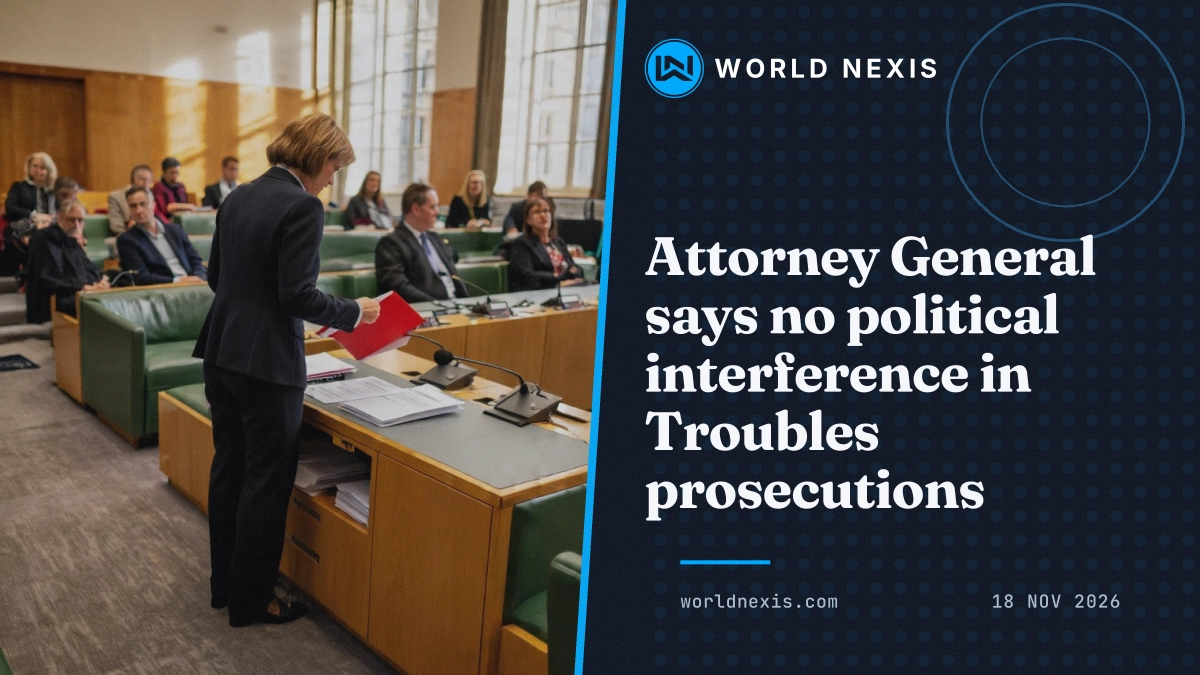
Ellie Reeves has told the Commons there will be no political interference in Troubles prosecutions, saying any future decision on whether to charge someone over a Troubles-related crime would be taken “independent of Government”. The Attorney General said the process would be “quasi-judicial”, as she defended a clause in the Northern Ireland Troubles Bill that peers will debate at second reading on December 2.
She was responding to Labour MP Andy McDonald, who warned the legislation risked “rolling back” safeguards built to protect the independence of prosecution decisions. The exchange, reported by the Northern Echo and other regional titles, has focused attention on how the Bill treats the most serious legacy offences.
Key points
- Ellie Reeves said decisions on Troubles prosecutions would be made “quasi-judicially and independent of Government”.
- Troubles prosecutions of indictable-only offences would be blocked unless the Advocate General for Northern Ireland or the Attorney General for England and Wales consents.
- Andy McDonald said the requirement risks rolling back the independence guarantee in the Justice (Northern Ireland) Act 2002.
- Amnesty International UK wants the clause removed before the Bill becomes law, with the Lords second reading set for December 2.
Troubles prosecutions: what the consent clause would do
The Bill contains a clause that would prevent indictable-only Troubles-related crimes from being prosecuted unless the Advocate General for Northern Ireland or the Attorney General for England and Wales has given consent. Ms Reeves holds both offices. Indictable-only offences, which include murder, rape and robbery, can only be tried in the Crown Court.
The provision sits at the sharp end of the Bill’s approach to Troubles prosecutions. Because it covers offences serious enough for the Crown Court alone, a decision on consent would settle whether a case proceeds at all.
Both the Northern Ireland and the England and Wales routes sit with the same minister. In practice, one office-holder would stand in the chain of decision-making on the gravest Troubles prosecutions.
The 2002 safeguard at the centre of the row
Mr McDonald, the MP for Middlesbrough and Thornaby East, pointed to the Justice (Northern Ireland) Act 2002. It states that the functions of the Director of Public Prosecutions in Northern Ireland “shall be exercised by him independently of any other person”. He called that one of the “key safeguards ensuring the independence of prosecution decisions free from political interference”.
He asked whether requiring the Attorney General’s consent for serious Troubles-related prosecutions risked rolling back that safeguard. He also asked whether she would reconsider the provision, to protect the independence of Northern Ireland’s justice system and public confidence in it.
Reeves: decisions would be quasi-judicial
“I want to give (Mr McDonald) the assurance that there will be no political interference with decision making,” Ms Reeves replied. “All decisions would be made quasi-judicially and independent of Government.” She added that there are a number of offences for which Attorney General consent is already required.
Those existing requirements include causing an explosion likely to endanger life or property, and most spying offences under the Official Secrets Act 1989. Both examples sit in England and Wales, and she cited them as evidence that consent requirements already operate alongside independent prosecution decisions.
Amnesty: remove the Attorney General consent clause
Gráinne Teggart, Amnesty International UK’s Northern Ireland deputy director, called on the Westminster Government to “remove the Attorney General consent clause” before it becomes law. She said an “assurance” that decisions would be made “quasi-judicially” does not resolve concerns about prosecutorial independence or public confidence.
Ms Teggart described the independence of prosecution decisions as “a vital safeguard, rooted in reforms that followed the Good Friday Agreement”, signed in 1998. Applied to Troubles prosecutions, her argument turns on structure rather than intent: the question is what the statute permits, not how a particular minister says she would behave.
For readers outside the legal world, the practical effect is easy to miss. A consent requirement does not change the test a prosecutor applies, but it can decide whether that test is ever reached. On legacy cases, that difference is the whole argument.
Analysis
Having covered Northern Ireland’s justice arrangements for WNN, I look first at who holds the pen rather than what they promise. On the evidence of this exchange, Mr McDonald and Amnesty have the better of it. The 2002 Act was drafted so that the decision to prosecute rests with the Director of Public Prosecutions, yet this clause would park a consent decision with a politician.
The strongest counter-argument is that this is not a novel power. Attorney General consent already applies to explosions likely to endanger life and to most spying offences under the Official Secrets Act 1989, which shows ministerial sign-off and prosecutorial independence can coexist on the statute book. Ms Reeves is extending a familiar mechanism, not inventing one.
In my view, familiarity does not settle it. A Commons assurance binds nobody who follows, while the 2002 Act’s guarantee is written down, so ministers should show in the Bill’s text how the two fit together. Until they do, I side with Amnesty and Mr McDonald in thinking the clause governing Troubles prosecutions should be reconsidered.
What happens next
The Northern Ireland Troubles Bill has cleared the Commons and passed to the Lords for further scrutiny. It is listed for a second reading debate on December 2. Ms Reeves offered an assurance in her answer rather than a change to the wording, while Amnesty International UK wants the clause stripped from Troubles prosecutions before the Bill becomes law.
Related coverage
- Stormont brake: DUP request rejected as 30 MLA test not met
- Marlon Davis Heathrow: comedian fined £180 for breach
- EV mandate: Flynn warns watering down 2030 plan unacceptable
Sources
- No political interference in Troubles-linked prosecutions, Attorney General says (thenorthernecho.co.uk)
- No political interference in Troubles-linked prosecutions, Attorney General says (sthelensstar.co.uk)
- No political interference in Troubles-linked prosecutions, Attorney General says (somersetcountygazette.co.uk)
- No political interference in Troubles-linked prosecutions, Attorney General says (thewestmorlandgazette.co.uk)
- No political interference in Troubles-linked prosecutions, Attorney General says (theboltonnews.co.uk)
About the author: Liam O’Connor is WNN World Nexis’s UK Politics Reporter, covering uk politics. The analysis section reflects the writer’s view.

Liam O'Connor
Liam O'Connor is UK Politics Reporter at World Nexis News, covering Westminster, devolved politics and the issues that matter to voters across England, Scotland, Wales and Northern Ireland. Based in London, he reports from primary sources — Hansard, official statements, published data — and explains…



