Troubles official history gets £3.6m in major archives study
A £3.6m Troubles official history has been launched, with five independent historians granted access to closed state archives and 5,000 new records online.
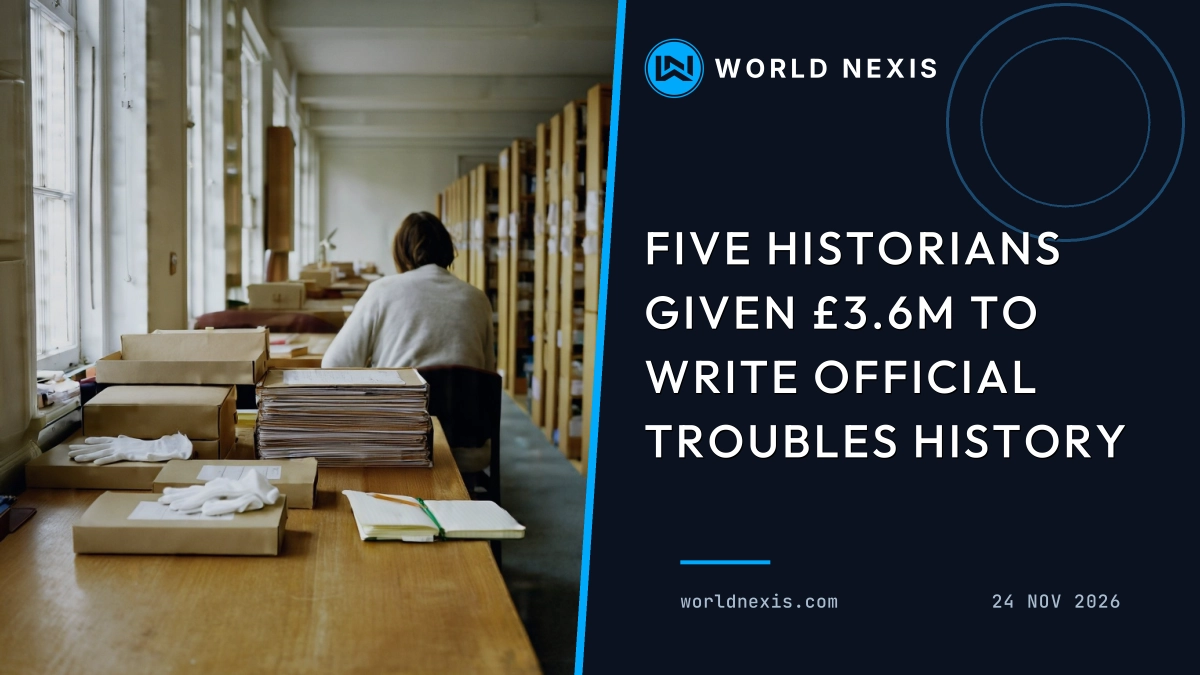
An independent Troubles official history has been launched, with five historians granted a £3.6 million budget and privileged access to closed government files. The five-year project, formally titled Official History Of UK Government Policy During The Northern Ireland Conflict, gives its authors the freedom to publish independent conclusions. The announcement came as nearly 5,000 further government records from the conflict were made available free online by The National Archives.
Key points
- Five independent historians will write the Troubles official history, four from UK universities and one from University College Dublin.
- The project carries a £3.6 million budget over a five-year commitment.
- The authors can read closed and redacted state files and will publish their own findings.
- Almost 5,000 digitised records have been released, with further batches scheduled across the next four years.
What the Troubles official history will cover
The remit of the Troubles official history is deliberately narrow. Sir Chris Bryant, the Secretary of State for Northern Ireland, said the historians are not being asked to write a full account of the conflict, but to examine how UK ministers and officials reached decisions.
“Their job will not be to produce a comprehensive history of the Troubles but rather a specific official history of the UK government’s decision making during that period,” he said.
Bryant argued that a rigorous understanding of the past is a precondition for dealing with the conflict and for building “a stable foundation for the future”. He also stressed the importance of unfettered archive access, saying it was needed to explore UK policy “meaningfully”.
Independence was central to his case. Bryant, who has published historical work himself, said the autonomy of the appointees mattered to him personally.
“As a published historian, it is really important to me that the historians we have appointed are totally independent and can carry out their work without fear or favour,” he said.
Thousands of records opened to the public
The National Archives has digitised and published a further tranche of almost 5,000 UK government records at no cost to users. The release sits alongside the Troubles official history rather than replacing it. The material covers the early stages of the Troubles, security responses, the Sunningdale Agreement and the collapse of the 1974 Executive, with more batches to follow over the next four years.
Bryant said the online release means students, academics and the wider public will be able to read important information for themselves. Baroness Ruth Anderson, the parliamentary under-secretary of state for Northern Ireland, tied both strands of the announcement to reconciliation.
“True reconciliation is built on understanding,” she said, adding that independent examination of the historical record alongside wider digital access would provide “crucial context”.
Who is overseeing the project
An expert advisory panel jointly chaired by Professor Caoimhe Nic Dháibhéid and Lord Paul Bew will oversee the Troubles official history and support the team’s access to material. Nic Dháibhéid said the historians were chosen through an open, competitive and rigorous process and described them as being of “the highest calibre”.
She added that the panel will share findings with public and academic audiences. Bew said the five appointees come from very different backgrounds but share “an unflinching determination to reveal historical truth to be found in the archives”.
Why it matters
For families and communities shaped by the conflict, the central question is whether records that have stayed shut for decades now become readable. The digital releases put primary documents in front of anyone with an internet connection, not just academics with reading-room access, which changes the terms of the Northern Ireland legacy debate.
The Troubles official history also carries a price tag of £3.6 million and a five-year timetable. How far it changes public understanding will depend on how much sensitive material is actually opened and how quickly conclusions reach the people most affected.
Analysis
Covering Northern Ireland politics for World Nexis News, I look first at the wording of the remit, because it shapes everything that follows. The government has not commissioned a sweeping narrative of the Troubles; it has commissioned an audit of how Whitehall made decisions. That is the right call. A tightly defined official history has a realistic chance of being finished, and it concentrates on the paper trail ministers and civil servants actually created.
I think the independence arrangements are stronger than sceptics will allow. There was an open competition, a panel with two respected chairs, a guarantee of access to redacted files and an explicit right to publish unwelcome conclusions. The counter-argument is real: a history funded by the state, using state archives and staffed by historians who need those files, can never be wholly detached from the institution it examines. Even so, unfettered access paired with a duty to publish is a better settlement than another process that protects the file and delays the finding.
My concern is sequencing rather than intent. The value of this Troubles official history will be judged on whether closed files genuinely open as the work proceeds, not simply at the end of five years. It also matters whether interim findings appear while people who lived through the period can still read them. If everything lands as one set of volumes at the close of the decade, £3.6 million will look like an archive exercise rather than a reckoning.
What happens next
Work on the Troubles official history begins with a five-year window and a budget of £3.6 million. The National Archives will keep releasing digitised batches of government records over the next four years, with the historians reading as the files arrive.
What we don’t know yet
The five appointees have not been named in the announcement, so their track records and any earlier published work on the conflict are not yet in the public domain. Nor is it clear whether conclusions will appear progressively or only when the project ends, or how many files will remain redacted after the historians have seen them.
Related coverage
- Burnham TikTok row sparks major backlash over No 10 stunt
- Winter Fuel Payment: DWP confirms who gets £100, £200 or £300
- PIP review: 4.09m claimants face major welfare overhaul
Further reading
- Study launched into UK government policy during the Troubles
- Study launched into UK government policy during the Troubles
About the author: Liam O’Connor is the UK Politics Reporter at World Nexis News (WNN), covering uk politics. The analysis section reflects the writer’s view.

Liam O'Connor
Liam O'Connor is UK Politics Reporter at World Nexis News, covering Westminster, devolved politics and the issues that matter to voters across England, Scotland, Wales and Northern Ireland. Based in London, he reports from primary sources — Hansard, official statements, published data — and explains…



