Third-party consent law change urged after four convictions
Four men are convicted over the Joanne Young case, and third-party consent is the focus as ministers face calls to rewrite the Sexual Offences Act 2003.
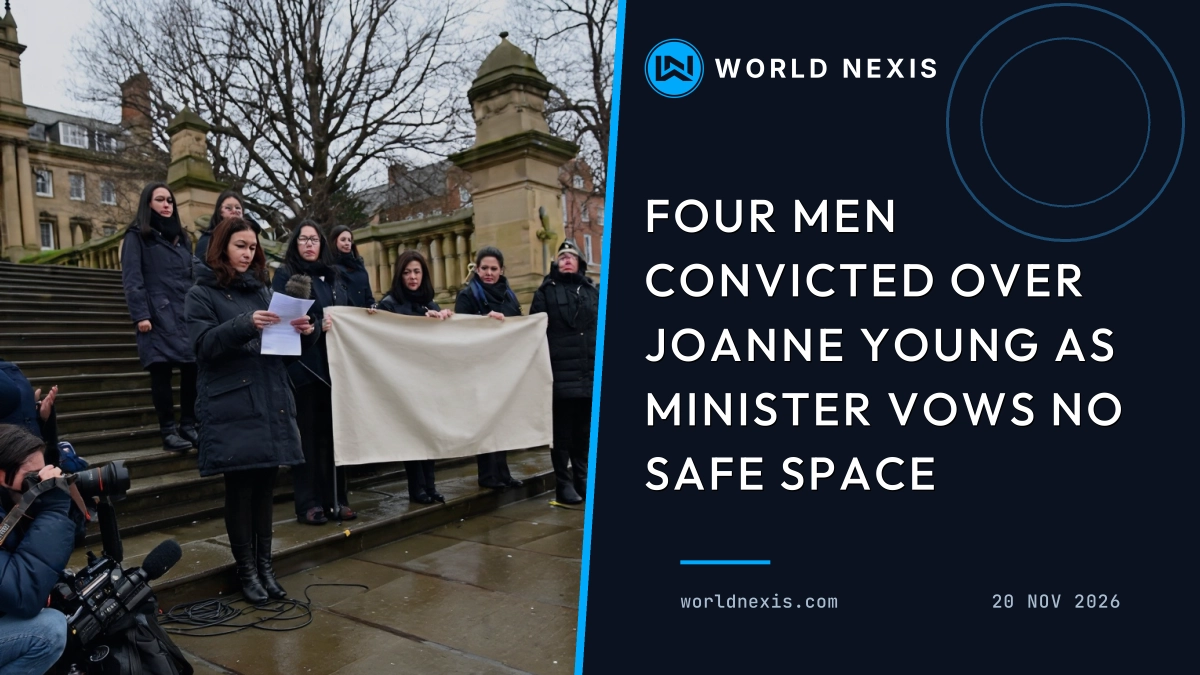
Third-party consent is back at the centre of Westminster after four men were convicted of sexual offences against Joanne Young, a woman her husband drugged, raped and advertised online over a 13-year period. The safeguarding minister has vowed there will be ‘no safe space’ for predators who drug and abuse women, while Mrs Young and her daughter press ministers to rewrite the Sexual Offences Act 2003.
Key points
- Four men were convicted at Winchester Crown Court on Thursday of sexual offences against Joanne Young. All four were strangers to one another.
- Her husband, Philip Young, drugged and abused her over 13 years and used websites and apps to invite men to the family home without her knowledge.
- Mrs Young waived her lifelong anonymity to speak outside court and asked the government to treat consent law as a priority.
- Her daughter, Alex Young, wants the Act updated so no defendant can argue third-party consent on the victim’s behalf.
Why third-party consent is at the heart of the Joanne Young case
The four defendants told the jury they had been duped by Philip Young and believed his wife was consenting. Prosecutors said none of them sought her consent before sexual activity took place.
There is no defined law in England and Wales making third-party consent a valid defence, and no statute allows a husband, a partner or anyone else to agree on another person’s behalf. The Sexual Offences Act 2003 defines consent as agreeing by choice, with the freedom and capacity to make that choice.
Kate Parker, a criminal barrister and founder of the Schools Consent Project, said the legal position is clear and that the argument advanced for the four men ‘doesn’t make sense legally’. A person who has been drugged into unconsciousness has no capacity to agree, she said.
Alex Young argues the statute is still open to misuse. In a post on LinkedIn, she wrote: ‘We live in a world where there is debate over whether third-party consent is enough to have sex with someone.’
Her mother, speaking on the steps of Winchester Crown Court, was blunt. ‘I urge the government to look at this as a priority so that women are properly protected in the future,’ Mrs Young said, adding that nobody should be able to give consent on someone else’s behalf.
Minister vows ‘no safe space’ as online pressure builds
The safeguarding minister called drug-facilitated sexual abuse ‘sickening’ and described the facts of this case as ‘particularly horrifying’. She paid tribute to Mrs Young’s bravery after the verdicts.
The domestic abuse commissioner said the case must be ‘a turning point’ and that the verdicts ‘send a clear signal’ that such abuse ‘will no longer be allowed to thrive in the shadows’. She challenged ministers to ‘rise to the threat posed by online harms’.
Jess Phillips, the former safeguarding minister and Labour MP for Birmingham Yardley, said online safety rules should be updated to stop men finding one another on sites used to arrange abuse. ‘The ability of these men to find each other on websites that you and I could just log on to now – it just means that these cases are going to keep on coming,’ she said.
Laura Bishop, who waived her anonymity after her ex-husband was jailed for 14 years for drugging and raping her, said the platforms involved are still trading. ‘The sites my husband used to advertise me are still active and are known by the police to not provide evidence and forensics when asked,’ she said.
Women’s rights groups praised Mrs Young for coming forward. Farah Nazeer of Women’s Aid said chemical coercion ‘leaves women questioning their own sense of reality and sanity’. The judge also commended her courage, and her decision to waive anonymity has drawn comparisons with Gisèle Pelicot in France throughout the trial.
Why it matters
For survivors of sexual abuse, the practical question is whether a court will again hear a defendant claim that somebody else supplied the victim’s agreement. Campaigners say writing the ban on third-party consent into statute would shut a route that should never have been open.
For the wider public, the case shows how quickly strangers can be pulled into abuse through apps and adult websites, with no check that the person advertised has agreed to anything. It also puts fresh pressure on ministers to act against the platforms where such arrangements are arranged and advertised.
Analysis
Having covered public services and local democracy for World Nexis News, I look first at the distance between a ministerial vow and a legislative slot. ‘No safe space’ is a strong phrase, but it is a communications commitment, not a bill. The Act is 23 years old, as Alex Young points out, and governments of both colours have preferred guidance and reviews to statute.
In my view the campaigners have the better of the argument. The law almost certainly already forbids third-party consent, and Kate Parker is emphatic on the point, but ‘almost certainly’ carries real weight when four men were able to put that argument to a jury. A statutory bar on third-party consent would not change the result for Joanne Young, yet it would shorten the next trial.
The strongest counter-argument is that drafting is riskier than it looks. Barristers will warn about carers, about adults with fluctuating capacity, and about defences that collapse into genuine-belief arguments anyway. That is a reason to consult carefully, not a reason to do nothing. I expect the Home Office to move first on online harms, which is cheaper and popular, and the consent question to drift unless a backbencher forces it.
What happens next
Attention now turns to the Home Office and the Ministry of Justice, where any review of the Sexual Offences Act would sit. Mrs Young’s request for priority treatment, and the domestic abuse commissioner’s demand for action on online harms, land in the same in-tray.
Women’s Aid and Rape Crisis England & Wales have both praised her decision to waive anonymity. Any consent law change would need parliamentary time, and the comparison with the Pelicot trial in France keeps the argument alive on both sides of the Channel.
What we don’t know yet
- Whether the government will commit to a formal review of the Act, or only issue guidance.
- Whether third-party consent will be named explicitly in any new law, or left to the courts.
- Whether online safety rules will be extended to the websites used to advertise victims.
Related coverage
- Joanne Young case: four men guilty in landmark abuse trial
- Kerch Bridge strike: third attack in 4 days halts trains
- Parliament Christmas tree: 40ft Sitka felled at Kielder
Further reading
- Calls for consent defence change after Joanne Young rape case
- Joanne Young praised for bravery in exposing rape by husband and strangers
About the author: Liam O’Connor is the UK Politics Reporter at World Nexis News (WNN), covering uk politics. The analysis section reflects the writer’s view.

Liam O'Connor
Liam O'Connor is UK Politics Reporter at World Nexis News, covering Westminster, devolved politics and the issues that matter to voters across England, Scotland, Wales and Northern Ireland. Based in London, he reports from primary sources — Hansard, official statements, published data — and explains…



