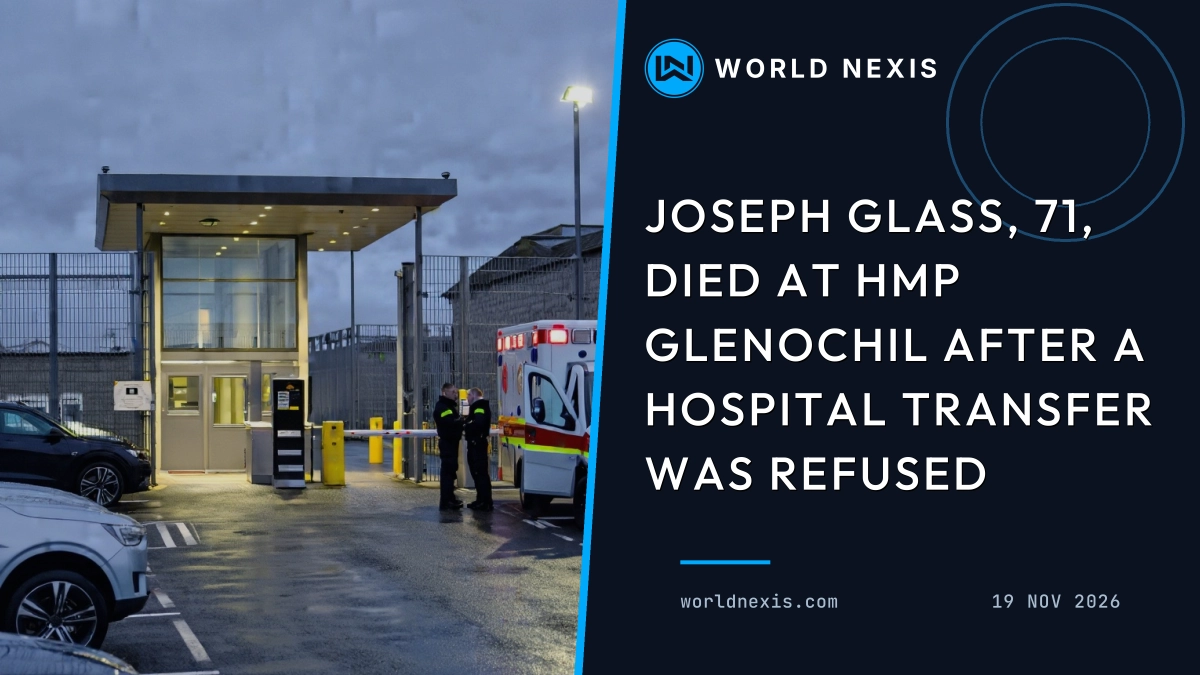
HMP Glenochil death of 71-year-old could have been avoided
An inquiry has found the HMP Glenochil death of 71-year-old Joseph Glass could have been avoided after a prison manager blocked a hospital transfer.
Updated 19 Nov 2026, 15:46 (UK time): The Scottish Prison Service, the Scottish Ambulance Service and the procurator fiscal have now commented publicly on the HMP Glenochil death inquiry, confirming the joint guidance and describing the failures identified, after the determination made no recommendations.
The Scottish Prison Service, the Scottish Ambulance Service and the procurator fiscal have all now commented publicly on the HMP Glenochil death inquiry, having been approached for response to Sheriff Robert More’s determination.
The prison service said it takes the learning from fatal accident inquiries “exceptionally seriously” and implements changes for improvement, pointing to the joint guidance developed with the ambulance service as the reason the sheriff made no recommendations. The ambulance service said it carried out a comprehensive review after Joseph Glass died and that the resulting guidance “clearly sets out responsibilities, prisoner healthcare rights and routes of escalation”.
Procurator fiscal Andy Shanks said the inquiry had “identified circumstances in which this death might realistically have been avoided and highlighted failures in the systems operating at the time”, and that the findings would be carefully considered by all those responsible for the care and treatment of people in custody.
The escalation route I said was missing from the determination is now at least described in general terms, which is more than the court record offered. But condolences are not compliance, and no one has yet said how a prison manager’s override is logged, reviewed or challenged in the moment.
An inquiry has concluded that the HMP Glenochil death of a 71-year-old prisoner could have been avoided, after a prison manager refused to let paramedics take him to hospital when he first fell ill. Joseph Glass died in his cell at the Clackmannanshire jail on 15 May 2021, hours after ambulance staff and an out-of-hours GP said he needed hospital treatment.
Sheriff Robert More published his determination at Kirkcaldy Sheriff Court on Thursday. He found that taking Glass to hospital on the first call-out would have been a “reasonable precaution” which realistically could have prevented the death.
Key points
- Joseph Glass, 71, died at HMP Glenochil on 15 May 2021 of a cardiac arrhythmia on a background of obstructive coronary artery disease.
- A prison manager blocked his removal, saying that if he was not dying he should not leave the prison.
- The sheriff found prompt defibrillation in a monitored hospital ward would probably have saved his life.
- No recommendations were made, because joint guidance on prisoner healthcare has since been issued.
How the HMP Glenochil death unfolded
Glass was serving an 11-year sentence, with an eight-year custodial element, after he was convicted in 2018 of assault and sexual offences against three girls in Clackmannanshire.
Scottish Ambulance Service crews were called to the prison at 8.40pm on 14 May 2021, when he became unwell and struggled to speak between breaths. An ambulance technician and an out-of-hours GP agreed that he should be conveyed to hospital.
A manager at the prison then refused to allow him to leave, saying that if he was not dying he should not go. The paramedics departed at 10pm, and crews were called back twice the following morning. When paramedics reached his cell for a third time at about 8am on 15 May, he was pronounced dead, roughly 11 hours after the first call for help.
What the sheriff found on cause of death
Glass died from a condition linked to heart disease, and Sheriff More set out in detail why the outcome could have been different. His findings on the HMP Glenochil death rest on what continuous monitoring would have offered:
“Had he been conveyed to hospital he would have been in a monitored clinical environment, with continuous cardiac monitoring and immediate access to resuscitation and defibrillation. If defibrillation had been delivered promptly, the arrhythmia would have been survivable.”
The sheriff said a hospital transfer at the first attendance was a “reasonable precaution” that realistically could have resulted in the death being avoided.
Why the inquiry made no recommendations
The HMP Glenochil death was the subject of the Joseph Glass fatal accident inquiry, held because the death took place in custody. The sheriff chose not to propose any change to practice, noting that new Scottish Prison Service guidance agreed with the ambulance service now covers how prisoner healthcare is handled.
That leaves the HMP Glenochil death on the record as preventable, without a formal instruction attached to it. The detail of the guidance, and the way a prison manager’s decision is meant to be challenged in future, is not set out in the determination.
Why it matters
For prisoners and their families, the HMP Glenochil death turns on a narrow question with a very wide reach: who decides when someone in custody needs hospital treatment, and what happens when a clinician at the cell door and a manager holding the keys disagree. Here the clinicians lost the argument, and the prisoner died hours later.
It also matters for the public services involved. Ambulance crews are routinely sent into prisons, and their clinical judgement depends on being able to move a patient out of the building. If a manager can override that judgement, every assessment made inside a cell block is weaker than it looks on paper.
Analysis
Having covered public services for World Nexis News, I look first at where the decision actually sat. It was not with the paramedics, and not with the out-of-hours GP, who both wanted Glass in hospital. It sat with a prison manager.
That manager applied a test, that a man who is not dying cannot leave, which no clinician in the case endorsed. On this evidence the sheriff is plainly right, and the HMP Glenochil death should be read as a failure of institutional judgement rather than of medicine.
Where I part company is the decision to make no recommendations. New joint guidance is genuinely welcome, but guidance is only as strong as its enforcement, and nothing here says how a manager’s override will be logged, reviewed or challenged next time. I think the stronger course would have been a short, specific recommendation requiring the prison service to publish how compliance is audited.
The fairest counter-argument is that a sheriff should not duplicate rules that have just been agreed, and that a fatal accident inquiry is a factual process rather than a management review. That is a reasonable reading of the law. It still leaves the public record with a preventable death and no named route to remedy.
What happens next
Because the HMP Glenochil death determination carries no recommendations, there is no formal deadline for the Scottish Prison Service or the Scottish Ambulance Service to publish an action plan. Both bodies have been approached for comment on the findings.
What we don’t know yet
The determination does not say whether any internal disciplinary or performance process followed for the manager who refused the transfer. It does not describe how compliance with the new joint guidance will be monitored, or who reviews a disputed decision in real time. Nor is it clear whether Glass’s family intend to take any further action.
Related coverage
- Freezer murder trial: 65-year-old denies murdering friend
- Bathgate crash: tributes to four-year-old Tiger Munthali
- Overdose deaths at 10-year low as White House claims credit
Further reading
- Prisoner died after trip to hospital refused when he first fell ill – FAI
- Prisoner died after trip to hospital refused when he first fell ill – FAI
About the author: Liam O’Connor is the UK Politics Reporter at World Nexis News (WNN), covering uk politics. The analysis section reflects the writer’s view.

Liam O'Connor
Liam O'Connor is UK Politics Reporter at World Nexis News, covering Westminster, devolved politics and the issues that matter to voters across England, Scotland, Wales and Northern Ireland. Based in London, he reports from primary sources — Hansard, official statements, published data — and explains…