NHS Grampian review ordered after 19 avoidable deaths
NHS Grampian review: ministers order an urgent independent inquiry into how warnings from surgeon Dr Mohammed Habib over patient deaths were handled.
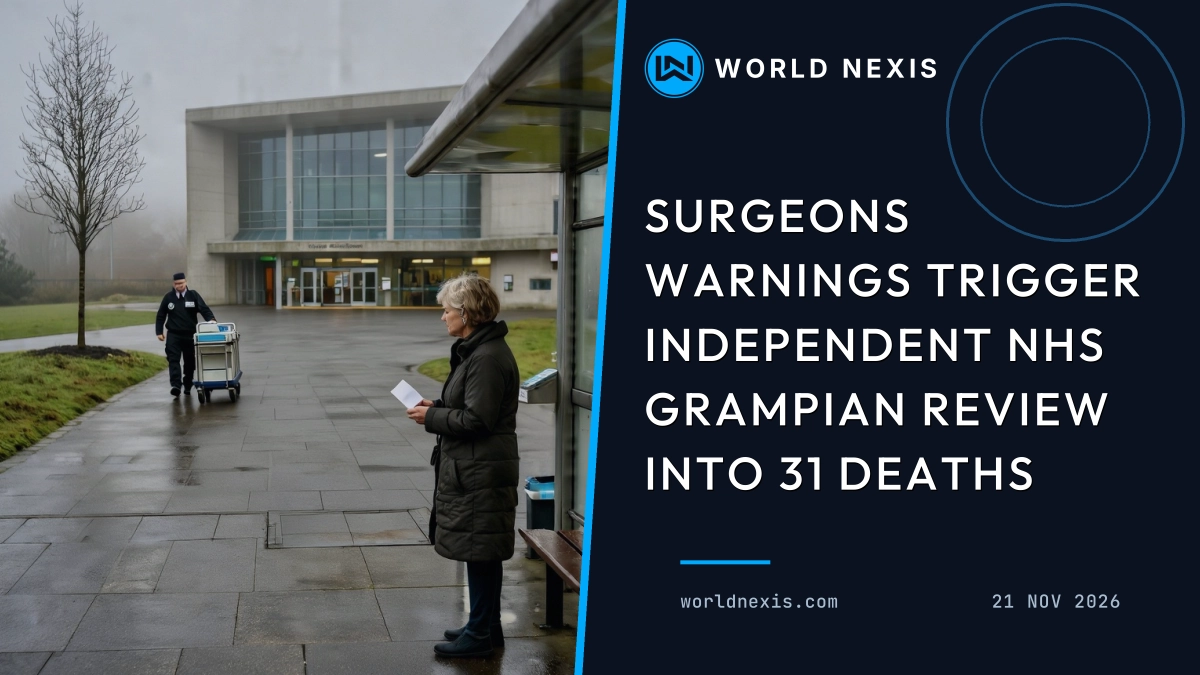
The NHS Grampian review announced by Scottish ministers will examine how warnings from a consultant surgeon about patient deaths in Aberdeen were handled. A 2022 report released by the surgeon this week found 19 of 31 deaths in liver and pancreatic surgery cases were avoidable. Health Secretary Angela Constance ordered the urgent independent review on Saturday, calling Dr Mohammed Habib’s concerns “deeply concerning and of the utmost seriousness”.
Key points
- An independent NHS Grampian review will examine how concerns about hepatobiliary surgery were handled by the health board and the Scottish Government.
- Nineteen of 31 deaths in liver and pancreatic surgery cases were found to be avoidable in a 2022 report released by Dr Habib on Thursday.
- Angela Constance will make a statement at Holyrood on Tuesday setting out the timetable and naming the reviewer.
- NHS Grampian has opened a helpline for patients with questions on 08085 202030.
What the NHS Grampian review will examine
The NHS Grampian review will look at how concerns about hepatobiliary (HPB) surgery were handled, both by the board and by ministers. HPB surgery covers the liver, bile ducts and pancreas. The remit explicitly includes the 2022 report into the deaths of patients who underwent that surgery.
Ms Constance said she was acting after discussion with the First Minister. “I am today commissioning an urgent and fully independent review of how concerns about hepatobiliary (HPB) surgery in NHS Grampian was handled,” she said.
She added that patients and staff in Grampian had a right to “full transparency and independent assurance that when valid concerns are raised, they are properly and robustly pursued”. She also said she recognised Dr Habib had raised his concerns repeatedly with the Government and other bodies over several years.
The surgeon, the report and the letters
Dr Habib has said he contacted the Scottish Government on four separate occasions. He also said he went to the police and to the Lord Advocate with his concerns about patient safety at the board.
He has called for the health board to face a corporate homicide investigation by police. He has also said that two people died after having the wrong procedure performed on them.
The 2022 report was not published until Dr Habib released it himself on Thursday. Alongside the review, the First Minister announced a separate review of how the Government handles correspondence. He said he first heard of three letters sent to him by Dr Habib on Thursday.
Reaction: Labour presses on who knew what
Jackie Baillie, Scottish Labour’s deputy leader, said it was “right” that the NHS Grampian review had been announced. She said it must establish who knew what and when, including ministers, NHS bosses and civil servants.
“Patients died unnecessarily and yet members of the public were kept completely in the dark about the extent of this crisis.”
Ms Baillie also said that without Dr Habib speaking out this week, “we may never have known just how far this went”.
NHS Grampian chief executive Laura Skaife-Knight welcomed the NHS Grampian review. She said there must be confidence that concerns raised between 2012 and 2026 were investigated properly, and that the learning took place.
Why it matters
For families in the north east of Scotland, this is the first formal test of whether warnings about a specialist surgical service reached the people with power to act. Patients who have questions can call the helpline set up by the board on 08085 202030.
The bigger question is trust in how the health service handles whistleblowers. If a consultant surgeon can approach a government four times and still see nothing published for years, other staff may conclude that speaking up is pointless.
Analysis
Having covered public services and devolution for World Nexis News, I look first at where accountability sits when a warning crosses from a hospital into a government department. On the facts here, the problem looks less like a single clinical failure than a failure of escalation. A report existed in 2022. Approaches were made to ministers, police and the Lord Advocate. Yet the public record only moved once the surgeon went public himself.
That is why I think the shape of the NHS Grampian review matters more than its headline. Its remit spans both the board and the Government, which is the right call, because a narrower inquiry into clinical practice would have left the awkward half untouched. The strongest counter-argument is that ministers should not be marking their own homework on how correspondence was handled, and families will not be comforted by a process that may run for years.
On balance, the evidence supports the view that Dr Habib’s warnings deserved a faster and more public response than they received. I side with those, including Ms Baillie, who say the question of who knew what and when is the central one. An inquiry that answers it in public would do more for patient safety than any number of reviews that stay on a shelf.
What happens next
Ms Constance will make a statement at Holyrood on Tuesday. She is expected to set out the timetable and name the person who will lead the NHS Grampian review, who is expected to be independent of the NHS in Scotland. The Government has said it will refer any issues, including potential criminality, to the relevant authorities as they arise, without waiting for the final report.
What we don’t know yet
The reviewer’s name, the full terms of reference and the reporting deadline have not been published. Nor has the scope of the separate review into how the Government handles correspondence.
Related coverage
- Sandie Peggie: nurse seeks to bring fresh NHS legal claim
- Glasgow shooting: woman, 27, shot in bed in targeted attack
- Stone of Destiny vandal admits £9,071 hammer attack
Further reading
- Independent review ordered after NHS Grampian revelations
- Independent review ordered after NHS Grampian revelations
About the author: Liam O’Connor is the UK Politics Reporter at World Nexis News (WNN), covering uk politics. The analysis section reflects the writer’s view.

Liam O'Connor
Liam O'Connor is UK Politics Reporter at World Nexis News, covering Westminster, devolved politics and the issues that matter to voters across England, Scotland, Wales and Northern Ireland. Based in London, he reports from primary sources — Hansard, official statements, published data — and explains…