Modern slavery credibility tests face backlash from watchdog
Modern slavery credibility tests in the Immigration and Asylum Bill have been branded appalling by the UK's independent anti-slavery commissioner.
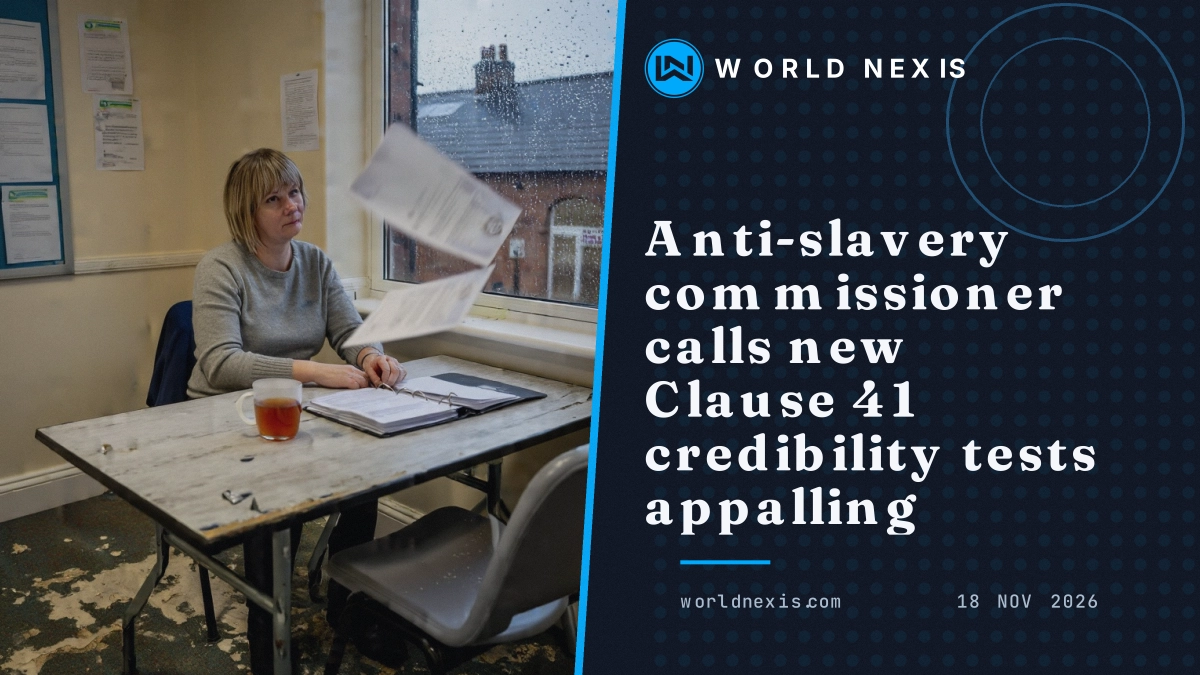
Modern slavery credibility tests written into the Immigration and Asylum Bill have been condemned as “appalling” by the UK’s independent anti-slavery commissioner, after the legislation completed its final stages in the Commons on Tuesday. Eleanor Lyons said the new clause could undermine survivors simply because time had passed since their exploitation, because their accounts contained inconsistencies, or because their experiences echoed those of other victims.
Key points
- The Immigration and Asylum Bill finished its Commons stages on Tuesday, with the new clause intact.
- Clause 41 sets out modern slavery credibility tests that treat delayed reporting, inconsistencies and “striking” similarities to another person’s story as damaging credibility.
- Eleanor Lyons, the independent anti-slavery commissioner, called the measure “appalling” and urged ministers to remove it.
- Isabella, a survivor confirmed by the Home Office as a victim of modern slavery, said the clause would let coercion “succeed twice”.
What Clause 41 would change in law
The Bill directs decision-makers weighing a modern slavery claim to consider a list of factors as damaging to a person’s credibility. Delayed reporting is one. Inconsistencies in an account are another. So are “striking” similarities to somebody else’s story.
Anti-trafficking campaigners say those features are the ordinary fingerprints of trafficking rather than warning signs of fabrication. Victims are frequently controlled, threatened or cut off from help, so silence and shifting detail are what a genuine case often looks like. For critics, the modern slavery credibility tests formalise a suspicion that already shadows these cases.
Why campaigners say modern slavery credibility tests punish trauma
Lyons said trauma changes how survivors remember and recount what happened to them, and that disclosure can take years. She told the Press Association the modern slavery credibility tests risk punishing people for the very effects of their exploitation.
“It is appalling that the Government is instead introducing new requirements in law that could undermine survivors’ credibility simply because time has passed since their exploitation, because there are inconsistencies in their accounts, or because their experiences are similar to those of other victims.”
The commissioner added that such factors “should not be used to cast doubt on their accounts or discourage them from coming forward”. She said survivors of sexual exploitation must feel comfortable speaking out, a step she described as taking “tremendous courage”.
Her recommendation is blunt. “The Government should remove these new additions from the legislation and instead focus its efforts on prosecuting the perpetrators of these crimes and wrapping care around victims,” she said.
The Fayed case and a warning for British victims
Isabella, whose name has been changed, is a survivor of sexual abuse and trafficking at the hands of the late billionaire Mohamed Al Fayed. The Home Office has confirmed her as a victim of modern slavery. She said the modern slavery credibility tests risk “turning the recognised consequences of trafficking into statutory reasons to doubt their credibility”.
She told PA that delayed disclosure, trauma-related inconsistencies and similarities between victims’ accounts are recognised consequences of trafficking. On that reading, “the very evidence that may establish an organised trafficking enterprise would be used against the victims”.
“We were silenced through threats, intimidation and surveillance, non-disclosure agreements and also trauma. And we also tried to report, but we were failed by the police and the CPS.”
Isabella argued that Clause 41 would treat the resulting delays as damaging credibility unless decision-makers were satisfied there were good reasons — reasons, she said, that the text does not set out. The consequence, in her words, is that “the coercion would succeed twice”.
She also rejected the idea that the clause is a narrow immigration measure. Its purpose may be to stop people lying about being trafficked in order to stay in the country, she said, but the outcome is a “broad brush impact on every victim of trafficking”, including British ones.
Analysis
Having covered Westminster’s immigration and public services files for WNN, I look first at what a clause does once it reaches the statute book, rather than at the intent announced alongside it. On that test the evidence supports Lyons and Isabella. The three markers the Bill elevates are the features caseworkers treat as consequences of control, so the modern slavery credibility tests turn proof of trafficking into grounds for disbelief.
In my view the drafting is where this argument is won or lost. Decision-makers are told to count delay against a claimant unless there is a good reason, yet the clause never says what qualifies. That hands wide discretion to individual officials and invites different outcomes for identical cases. Isabella’s point that the measure also reaches British victims makes the problem broader than immigration policy.
The strongest counter-argument is that any system needs a way to test claims, and Isabella herself accepted the clause appears aimed at people who lie about being trafficked to stay in Britain. I accept that scrutiny has to exist. I do not accept that recognised trauma responses should be written into law as presumptive dishonesty, and I side with the commissioner’s call to take the clause out rather than reinterpret it later in guidance.
What happens next
The Bill has now cleared its final stages in the Commons with Clause 41 still in the text. Lyons has asked the Government to remove the additions and to concentrate instead on prosecution and victim care. Unless the wording changes, the modern slavery credibility tests will apply to trafficking claims brought by British and foreign victims alike.
Related coverage
- Neet welfare reforms could extend to over-25s, Burnham says
- Stormont brake: DUP request rejected as 30 MLA test not met
- Freezer murder trial: 65-year-old denies murdering friend
Sources
- Plans for ‘appalling’ credibility tests for modern slavery victims under fire (sthelensstar.co.uk)
- Plans for ‘appalling’ credibility tests for modern slavery victims under fire (yorkpress.co.uk)
- Plans for ‘appalling’ credibility tests for modern slavery victims under fire (thurrockgazette.co.uk)
- Plans for ‘appalling’ credibility tests for modern slavery victims under fire (northwaleschronicle.co.uk)
- Plans for ‘appalling’ credibility tests for modern slavery victims under fire (thenorthernecho.co.uk)
About the author: Liam O’Connor is World Nexis News’s UK Politics Reporter, covering uk politics. The analysis section reflects the writer’s view.

Liam O'Connor
Liam O'Connor is UK Politics Reporter at World Nexis News, covering Westminster, devolved politics and the issues that matter to voters across England, Scotland, Wales and Northern Ireland. Based in London, he reports from primary sources — Hansard, official statements, published data — and explains…



