Brexit reset deal: Burnham seals three major EU agreements
Andy Burnham has sealed a Brexit reset deal with the EU on food and drink, emissions trading and youth mobility, but tuition fees could still derail it.
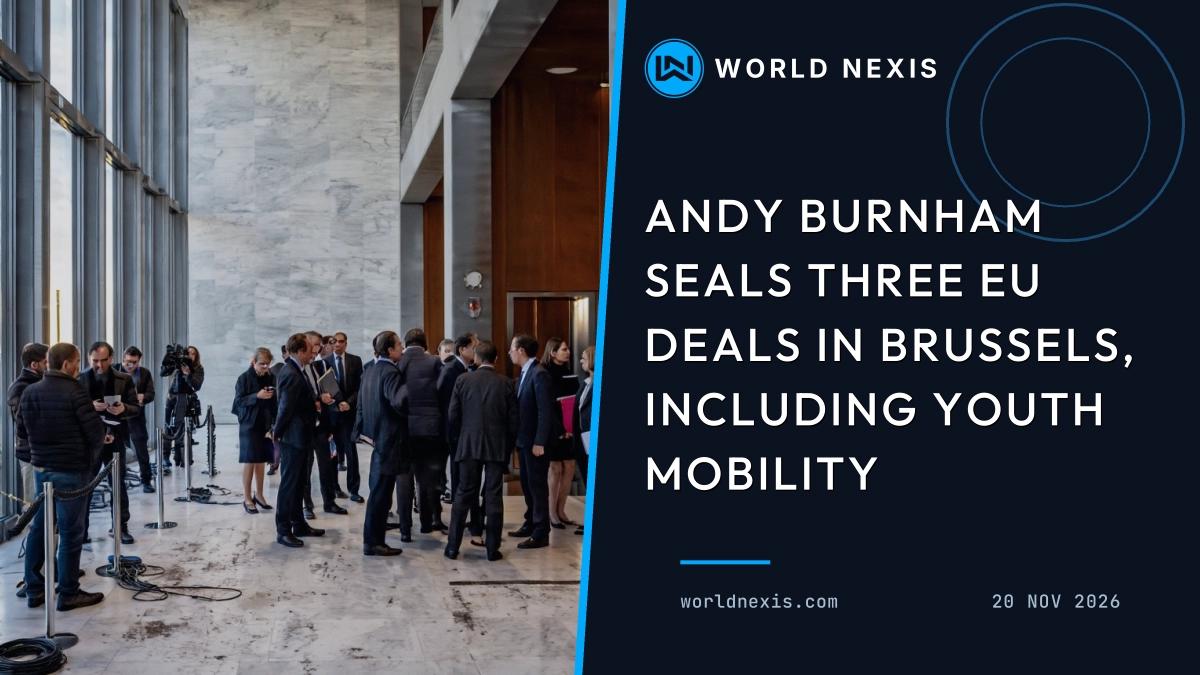
Andy Burnham has sealed a Brexit reset deal with the European Union in Brussels, announcing three agreements on food and drink, emissions trading and youth mobility after a summit with European Commission President Ursula von der Leyen and European Council President António Costa on Friday. The prime minister said the legislation would reach parliament next week and rejected suggestions that the package was not yet settled.
Key points
- Three agreements were announced: on food and drink, on emissions trading, and a youth mobility scheme letting young people live, work, study and travel on both sides of the Channel.
- Post-Brexit checks and restrictions on food and agricultural goods moving from Great Britain to Northern Ireland will be eased.
- The EU says it will not adopt the agreements unless the UK offers equal treatment on tuition fees for EU students.
- Burnham said the package would add 0.5% to UK GDP, a £17bn boost to the economy.
What the Brexit reset deal covers
The food and drink agreement is the most tangible part of the Brexit reset deal for ordinary trade. It reduces the checks and paperwork applied to agricultural and food products, the goods that have carried the heaviest bureaucracy since the UK left the EU.
The second element covers emissions trading. Burnham said the agreements as a whole would boost growth and lead to cheaper food and electricity, framing them as an answer to the cost of living.
The third is the youth mobility scheme, which will allow young people to live, work, study and travel in each other’s countries. It is the part of the Brexit reset deal most likely to be felt by students and recent graduates.
Northern Ireland: what the Brexit reset deal changes
Northern Ireland is where the agreement bites hardest. Because the region follows EU agri-food rules while Great Britain does not, the Irish Sea border has meant checks and paperwork at ports for goods arriving from Great Britain.
The Brexit reset deal reduces those barriers for food and agricultural products, cutting costs for businesses and making it easier for retailers to keep shelves stocked. It does not remove them entirely, however, and unionist politicians seized on that gap.
Northern Ireland minister Andrew Muir said: “Whilst this will not fix everything, it’s a massive step in the right direction.” He added that there would be “huge benefits for all of us in Northern Ireland from reduced trade barriers and less checks on goods moving between GB to Northern Ireland”.
Northern Ireland Secretary Sir Chris Bryant called the agreement “completely transformational” for businesses in the region. DUP leader Gavin Robinson countered that “reducing barriers is not the same as removing them”, and called for what his party regards as an internal border in the UK to be “totally dismantled”.
Reaction in Brussels
Von der Leyen played down the dispute over student fees, saying she was “confident we are going to find a solution”. Costa described the UK as “our closest neighbour, a reliable ally and a natural partner”.
Burnham was blunt when asked whether the terms were settled: “The deal is done. It is there in black and white in front of you.” He also challenged his critics, asking: “Why would anybody turn their back on that?”
Nigel Farage, who held a press conference in Brussels, called Burnham naive and said the EU had “used this moment to strongarm the British prime minister over tuition fee cuts for hundreds of thousands of EU students”.
Why it matters
For households in Northern Ireland, fewer checks on food means a shorter, cheaper route from Great Britain to the supermarket shelf. For young people, the youth mobility scheme opens a route to work and study abroad that has been closed since Brexit.
For businesses, the benefit is measured in administration: fewer forms, fewer inspections and lower compliance costs at the ports. Those gains rarely make headlines, but they show up in prices and in the reliability of supply.
The Brexit reset deal will not settle the wider argument about Britain’s relationship with Europe, but it changes the practical terms of trade for the first time in years.
Analysis
Having covered devolution and Northern Ireland for World Nexis News, I look first at what this does to the argument inside unionism rather than at the headline GDP figure. On the evidence in front of us, Burnham has won the substantive case. Fewer checks on goods crossing the Irish Sea is a tangible gain for shops, growers and hauliers, and the DUP’s own response concedes the direction of travel by calling it a reduction in barriers rather than a fiction.
I side with Burnham against Farage on whether to bank the deal. The claim that the UK has been strongarmed only works if you believe walking away would produce better terms, and the record of the past decade of Brexit negotiation gives that little support. The strongest counter-argument is not economic at all: the UK is accepting rules it does not write, and the internal border unionists object to is being managed rather than removed. That is a fair constitutional worry, and Robinson is right to keep pressing it.
What I would watch is the tuition fee condition. By tying adoption of all three agreements to equal treatment for EU students, Brussels has turned a domestic funding decision into the price of the entire Brexit reset deal. That is leverage, and Burnham will feel it in the months ahead.
What happens next
The legislation is expected in parliament next week. Adoption of the Brexit reset deal by the EU is not automatic: Brussels has said the three agreements cannot be adopted until the question of tuition fees for EU students is settled, so the package remains conditional.
Burnham has said he will “brainstorm” with the EU about future ties, but stressed that nothing in this parliament would go much beyond the current deal. That discussion, he said, “will be to inform the next parliament”.
What we don’t know yet
- Whether the UK will move towards equal treatment on tuition fees, and what that would cost universities and the public purse.
- How far the remaining paperwork on goods moving from Great Britain to Northern Ireland will fall in practice.
Related coverage
- Burnham EU deal: 100,000 visas in major Brexit reset
- Brexit impact: Burnham seeks major EU reset at summit
- Brexit reset deal: what Burnham’s Brussels summit changes
Further reading
- EU-UK talks: New Brexit deal ‘won’t solve’ all issues, but is a ‘step in the right direction’
- Burnham seals trade and youth mobility deals in biggest step towards EU since Brexit
About the author: Liam O’Connor is the UK Politics Reporter at World Nexis News (WNN), covering uk politics. The analysis section reflects the writer’s view.

Liam O'Connor
Liam O'Connor is UK Politics Reporter at World Nexis News, covering Westminster, devolved politics and the issues that matter to voters across England, Scotland, Wales and Northern Ireland. Based in London, he reports from primary sources — Hansard, official statements, published data — and explains…



