Billy Stokoe sentence raised to eight and a half years
Billy Stokoe sentence raised to eight and a half years after appeal judges rule the original term for killing Gloria Stephenson, 86, was unduly lenient.
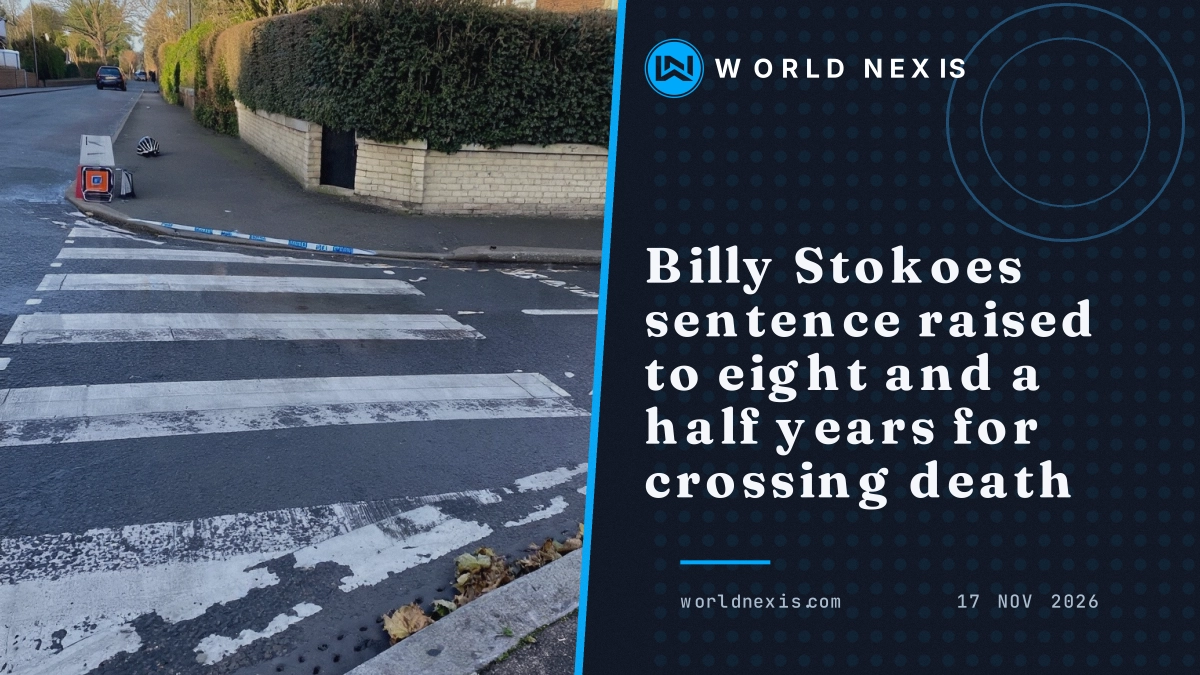
Billy Stokoe sentence was increased to eight years and six months detention on Tuesday, when three Court of Appeal judges ruled that his original term for killing great-grandmother Gloria Stephenson was unduly lenient. Stokoe, now 20, was 18 when he knocked down the 86-year-old on a zebra crossing in Sunderland while riding an illegal e-motorbike.
Judges quashed the six years and nine months detention imposed at Newcastle Crown Court in May. The Billy Stokoe sentence had been referred to the Court of Appeal on behalf of Solicitor General Andy Slaughter, whose lawyers argued the term was too soft.
Key points
- The Billy Stokoe sentence rose from six years and nine months to eight years and six months detention.
- He had taken cannabis and was using a mobile phone when he hit Gloria Stephenson, 86, on a zebra crossing in Sunderland in May last year.
- He was thrown from the Sur-Ron bike but rode off, changed his clothes and hid the machine before handing himself in.
- Appeal judges said there should have been a “significant” uplift to the starting point of the sentence.
How the Billy Stokoe sentence was challenged
Suki Dhadda, for the Solicitor General, told the court that Stokoe “was performing an obviously highly dangerous manoeuvre” by riding the bike with one hand. The Sur-Ron machine had only one working brake, she said. She argued the sentencing judge either used the wrong starting point, failed to increase the term enough for the aggravating features, “or gave too much weight to the mitigation”.
Stokoe appeared at the hearing by video link from HMP Deerbolt in County Durham, wearing a blue top. His barrister, Helen Towers, said he had been “glued to his phone” as he rode. She argued the sentencing judge made no “gross error” and was best placed to weigh the mitigation, including that Stokoe was a “particularly immature” 18-year-old at the time.
Lord Justice Stuart-Smith, sitting with Mrs Justice Farbey and Judge Mark Lucraft KC, said there should have been a “significant” uplift to the starting point. He said the court had not forgotten that “at the heart of the case is a devastating personal tragedy that has ripped apart the lives of those who loved her”.
The crash on a Sunderland zebra crossing
Gloria Stephenson had been fit and active. She was walking her daughter’s dog and trying to complete her 10,000 steps a day when she was fatally injured on the crossing on 16 May last year. She was a mother to four daughters and had 13 grandchildren, had been widowed three times and enjoyed a successful career in the NHS.
Dashcam footage showed that Stokoe did not slow down or try to avoid her, according to the BBC. After the impact he was thrown off the bike but did not stop. Instead he rode away to change his clothes and hide the machine at a friend’s house, before handing himself in at a police station just over an hour later.
He later admitted causing death by dangerous driving. Lord Justice Stuart-Smith said Mrs Stephenson had been described by her family as “a force of nature”.
What Gloria Stephenson’s family said
Julie Francis, one of her four daughters, said she was relieved that the Billy Stokoe sentence had been increased and that the family felt listened to. “No matter what sentence the judge passed, it’s not going to bring our mum back,” she said outside court.
“He has taken her life, but I feel like as a family we’ve been listened to, our concerns have been listened to,” she added. She described her mother’s death as “unimaginable”.
Ms Francis also said many factors contributed to the collision and that “it was inevitable that someone was going to be hurt”.
Analysis
In my first year at WNN covering UK crime and public services, I have learned to look first at what this kind of appeal is actually for. It is not a retrial, and it is not a public vote on a judge. It is a check on whether a term fell outside the range the law allows, and on these facts that check was needed.
In my view the Court of Appeal got this right, and the Solicitor General was right to refer the case. Stokoe was on cannabis, holding a phone in the hand that could work the only functioning brake, on a machine that should not have been on the road. He did not slow down, and he then left an 86-year-old dying on a crossing while he hid the bike and changed his clothes. Flight and concealment are exactly the aggravating features that should push a term up, and the original sentence did not reflect them.
The strongest counter-argument comes from his own barrister: the judge who heard the case saw the mitigation, and Stokoe was a “particularly immature” 18-year-old. That argument deserves respect, because courts should not second-guess every sentence. But immaturity and his admission cannot close a gap the appeal judges called significant.
For readers, the consequence matters beyond one family. Cases like this are a warning about illegal e-motorbikes on pavements and crossings, and the Chronicle reported that Mrs Stephenson’s death should serve as one. A term that looks too soft tells riders that risk is cheap. Eight and a half years is not a life for a life, as Ms Francis made clear. It does, though, correct the signal the law sends.
What happens next
Tuesday’s ruling ends the referral. The original term has been quashed and the Billy Stokoe sentence now stands at eight years and six months detention. He remains in custody, having appeared at the appeal from HMP Deerbolt.
For the family, Ms Francis said it had been difficult to move on and grieve for her mother while the challenge was hanging over them. She said the family now felt its concerns had been heard.
Related coverage
- West Bank sanctions: UK hits eight Israeli settlement firms
- Parnell Square attack: life sentence for 3 child stabbings
- Police reform: Gavin Stephens backs major 43-force overhaul
Sources
- Sunderland e-motorbike killer’s jail sentence increased (bbc.co.uk)
- Man riding illegal e-bike who killed great-grandmother has prison term increased (gazetteherald.co.uk)
- Man riding illegal e-bike who killed great-grandmother has prison term increased (romfordrecorder.co.uk)
- Man riding illegal e-bike who killed great-grandmother has prison term increased (borehamwoodtimes.co.uk)
About the author: Liam O’Connor is World Nexis News’s UK Politics Reporter, covering uk politics. The analysis section reflects the writer’s view.

Liam O'Connor
Liam O'Connor is UK Politics Reporter at World Nexis News, covering Westminster, devolved politics and the issues that matter to voters across England, Scotland, Wales and Northern Ireland. Based in London, he reports from primary sources — Hansard, official statements, published data — and explains…



