Police reform: Gavin Stephens backs major 43-force overhaul
Gavin Stephens backs police reform cutting England and Wales' 43 forces, as nine forces seek emergency funding and the projected shortfall hits £4.3bn.
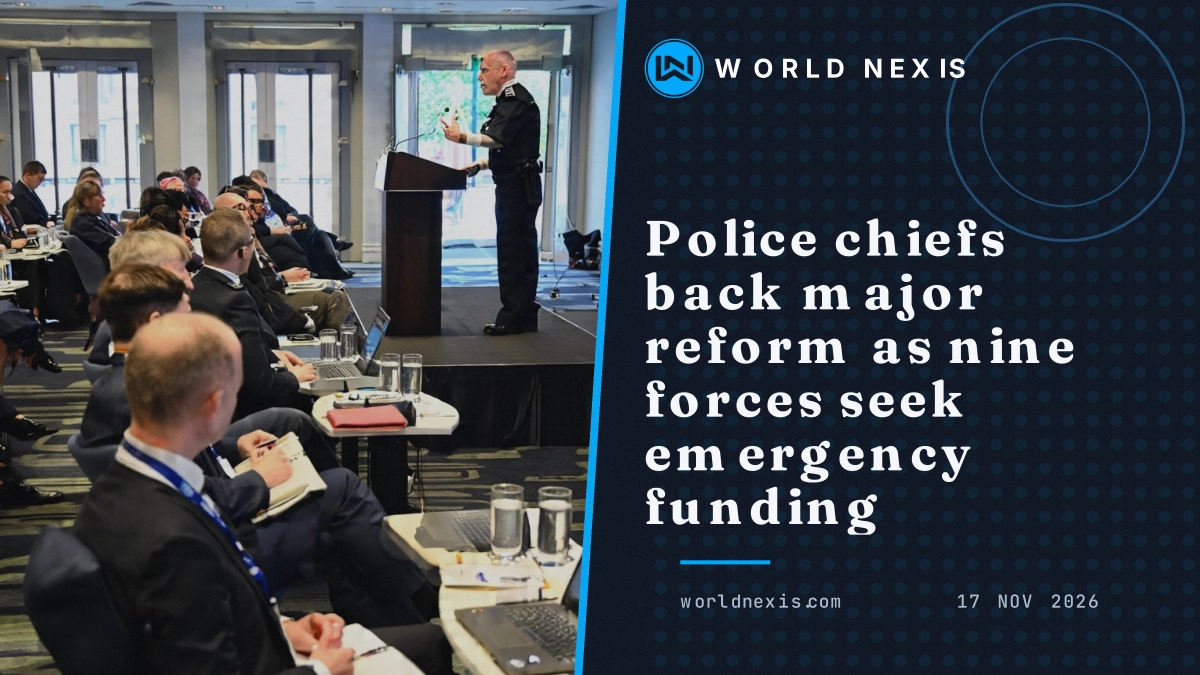
Police reform moved to the centre of the government’s public services agenda this week, when Gavin Stephens, chairman of the National Police Chiefs’ Council (NPCC), backed plans to cut the number of forces in England and Wales from 43 and create a new National Police Service. Speaking at the NPCC’s annual conference in Westminster, he told delegates: “We cannot afford a complacent nostalgia.”
Earlier this year the government set out proposals to bring counter-terrorism, some fraud and serious gang crime under a national body, while drastically cutting the number of local police forces. Stephens used his address, at a conference held jointly with the Association of Police and Crime Commissioners, to make the case for that police reform in public.
Key points
- NPCC chairman Gavin Stephens backed fewer, larger forces and a new National Police Service.
- He said the 43-force structure has produced a postcode lottery in technology and specialist support.
- Nine forces are seeking exceptional financial support, the Guardian reported.
- Chiefs put the projected funding gap by 2030 at £4.3bn, up from £3bn.
Why Gavin Stephens says police reform cannot wait
Stephens told delegates that “our job is not simply to preserve the police service we inherited”. He added: “We must reform policing to keep pace with threats to our safety, and we must be clear-sighted on what we are seeking to achieve.”
He framed the argument in personal terms, describing his mother in rural North Yorkshire and his son renting a first flat in London. Both, he said, deserve a local team tuned into local problems, and officers with equal access to proper equipment, specialist support and modern technology.
The 43-force jigsaw
For Stephens, police reform is about capability as much as structure. Officers are sometimes left typing the same information into different, incompatible systems, he said, and suppliers and services are duplicated across forces. Year-on-year savings since the 2008 financial crash have pulled the map apart. “The jigsaw of policing no longer fits together,” he said. “This cannot continue.”
He argued that crime has changed shape since he joined as a constable, with most offences now carrying a digital element and the regional boundaries he once knew barely existing. “A criminal can target a child in their bedroom, steal a pensioner’s savings, exploit a vulnerable person without ever setting foot in the victim’s hometown,” he said.
Falling crime, rising harm
Stephens set out the case for police reform against a mixed picture. Delegates were told homicide fell 7% in the year to March 2026 and knife-enabled crime fell 8%. Yet more than 40% of people in the UK report seeing anti-social behaviour, and more than five million women are victims of violence each year.
Around one in five recorded crimes is violence against women or a public protection offence, which he called “another national emergency”. He also cited Ofcom research suggesting almost three-quarters of children aged 11 to 17 encounter potentially harmful content on an app, website or game within four weeks.
The funding crisis driving police reform
The reform push comes as chief constables describe the worst financial position in decades. The South Wales Argus reported that Stephens pointed to billions of pounds of debt and a health crisis in the workforce. Paul Sanford, chief constable of Norfolk and the NPCC’s finance lead, told the Guardian that demand and population had grown while funding had not kept pace.
“That is why you see the retreat from the streets,” he said. He added that forces applying for exceptional financial support believe they are close to the tipping point where core services can no longer be sustained.
According to the Guardian, nine forces have applied: Durham, Cleveland, Greater Manchester, Wiltshire, Bedfordshire, South Yorkshire, Gloucestershire, Lincolnshire and Norfolk. The Home Office declined to confirm how many applications it has received. It will decide whether to release extra money or allow councils to charge taxpayers more.
Trevor Rodenhurst, Bedfordshire’s chief constable, said: “If I don’t get the money, the impact would be to degrade services.” His force has 1,486 officers, which he believes is hundreds fewer than needed, and is taking a thousand extra 999 calls a month on last year.
Catherine Roper, his Wiltshire counterpart, said the service had taken the efficiencies it could out of the system. “The wiggle room we have is leaner,” she said. Stephen Watson of Greater Manchester said “everyone agrees the system has been underinvested in”.
Police leaders also point to the government’s early release scheme for prisoners, which the NPCC predicts could raise crime by up to 6%. Reserves worth £300m were used by 43 forces last year. Officer numbers fell from 148,536 in June 2024 to 147,822 by March this year, and senior officers expect further decline.
Analysis
Having covered devolution and public services for WNN, I look first at where accountability actually sits. England and Wales run policing through 43 separate bargains between Whitehall, police and crime commissioners and local council taxpayers, and that structure explains both the duplication Stephens describes and the uneven access to specialists. On the evidence available, his case for police reform, pooling technology, forensics and serious-crime capability, is the stronger one.
The counter-argument deserves respect: reorganisation absorbs management attention and money precisely when nine forces warn they are close to the point where core services fail. Nor will restructuring pay for a single extra officer before the projected £4.3bn gap arrives by 2030. That is a sequencing problem ministers have not yet solved.
So I side with Stephens on the substance of police reform and with Sanford on the money. Structural change is necessary but not sufficient, and a national service built on underfunded local foundations would simply relocate the postcode lottery.
What happens next
The home secretary, Shabana Mahmood, is due to address the NPCC conference this week. The next test for police reform will be the Home Office ruling on the nine exceptional financial support applications, which will decide whether forces get more money or councils can raise the precept.
Ministers have promised 13,000 additional officers by 2029, a target chiefs privately doubt can be met. The plans for a National Police Service and fewer, larger forces were unveiled earlier this year.
Related coverage
- Prince William rickshaw drive opens major Earthshot gala
- Brexit reset: Burnham says major EU deal can lift GDP 0.4%
- Rosebank oil field: Greens force Holyrood drilling vote
Sources
- Police ‘retreating from streets’ due to major funding crisis, chief constables say (theguardian.com)
- Police chief warns against ‘complacent nostalgia’ as he backs major reforms (southwalesargus.co.uk)
- Police chief warns against ‘complacent nostalgia’ as he backs major reforms (westerntelegraph.co.uk)
- Police chief warns against ‘complacent nostalgia’ as he backs major reforms (stourbridgenews.co.uk)
- Police chief warns against ‘complacent nostalgia’ as he backs major reforms (yorkpress.co.uk)
About the author: Liam O’Connor is World Nexis News’s UK Politics Reporter, covering uk politics. The analysis section reflects the writer’s view.

Liam O'Connor
Liam O'Connor is UK Politics Reporter at World Nexis News, covering Westminster, devolved politics and the issues that matter to voters across England, Scotland, Wales and Northern Ireland. Based in London, he reports from primary sources — Hansard, official statements, published data — and explains…



