Cyber hygiene: 5 urgent steps as AI drives a patch surge
Cyber hygiene advice from security chiefs after a week of Outlook, FAA and bank outages, as AI-driven patching becomes the fastest fix and a new risk.
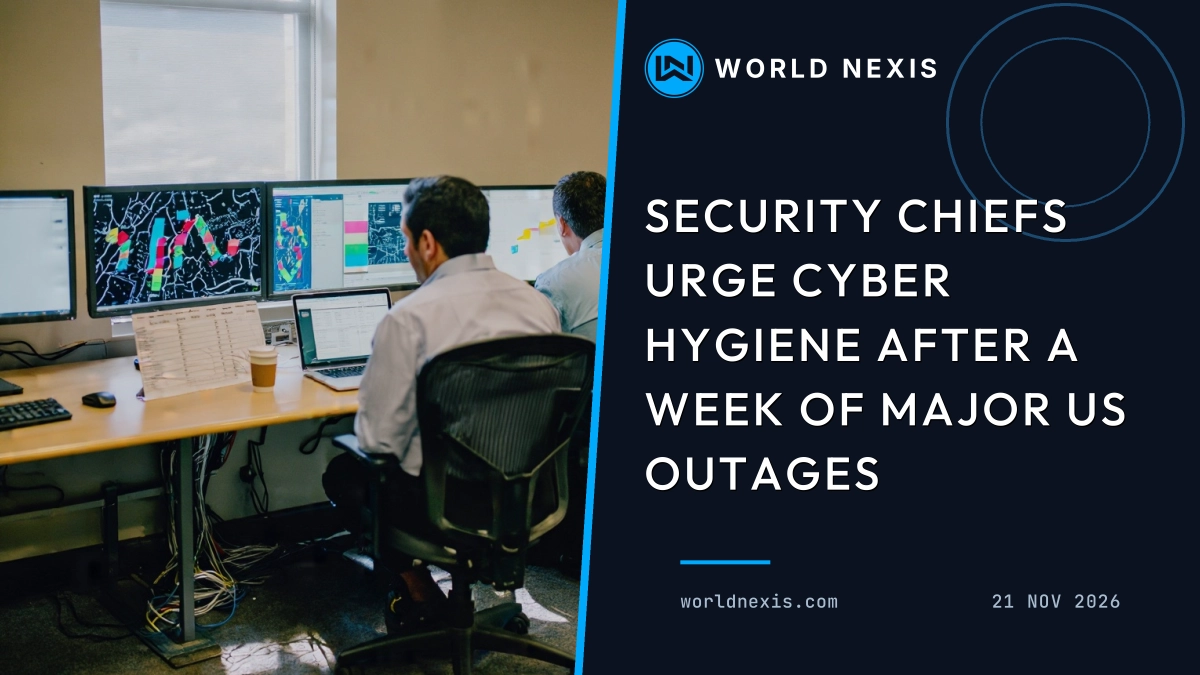
Cyber hygiene has become the week’s operational question after Microsoft Outlook went down for an extended period, the Federal Aviation Administration blamed a telecom outage for the first nationwide ground stop since the 9/11 attacks, and disruptions were reported at United Airlines, Apple and JPMorgan Chase. Initial reports say the incidents were unrelated and that no evidence points to outside attackers.
That is exactly why security leaders are pushing the unglamorous basics again. The failures landed in a stretch that also included a genuine large-scale cyberattack on customers of website designer Optimizely, said to include Zoom and Equifax, and an FBI warning about hackers and scammers using an AI-powered tool called ARTEX.
Key points
- Outlook, the FAA ground stop and the airline, bank and hardware outages are being treated as separate events, with no sign of malicious activity.
- Microsoft has shipped more than 1,200 patches this month, nearly 20 times the number in the November 2025 update compiled by data firm Qualys.
- Secretary of State Marco Rubio said patching is “creating short-term disruption in the way the system works”.
- Research by NTT Data found fewer than half of organizations have formal plans to manage AI- and cloud-related security risks.
A week of outages with no single villain
The Outlook failure was the longest-running of the consumer-facing incidents, taking corporate and personal inboxes offline for an extended stretch. In the same week, the FAA ordered its first nationwide ground stop since 9/11 and blamed a telecom outage for it. Outages were also reported at United Airlines, Apple and JPMorgan Chase, touching aviation, payments and consumer hardware within days of one another.
Nothing so far links the incidents. Initial reports indicate they were unrelated, with no evidence that bad actors were to blame. But a real breach reaching the clients of a major web platform, alongside the FBI’s warning about an AI-powered attack tool, has left little room for complacency.
Cyber hygiene: what security chiefs say to do now
“Please, please, please enable multi-factor authentication,” said Sandip Ghosh, managing director for cybersecurity at Japanese technology group NTT Data, which recently opened a cyber defense center in Plano, Texas. He describes it as part of cyber hygiene: the basics every person and company should keep running, whatever else changes.
For households, the list is short. Turn on multi-factor authentication, which Ghosh says “gives you an additional layer of protection”. Treat unsolicited calls asking for voice authentication as hostile, because AI now powers convincing deepfake scams. And never send money or private data on the strength of a single message when the request can be checked through a second channel.
For employers, NTT Data’s research points to a structural gap. Fewer than half of organizations have formal plans to manage AI- and cloud-related security risks, and Ghosh’s answer is to build the program before an incident rather than after one. Smaller firms that cannot hire a chief information security officer should contract a “fractional or virtual CISO” and protect budget for the work.
His explanation for how small organizations get breached is deflating. Default passwords and patches that are years out of date account for a large share of what NTT Data sees — failures of basic cyber hygiene, not sophisticated espionage. “Let’s not think of cybersecurity as an afterthought after an incident,” Ghosh said. “Let’s go and do cybersecurity proactively. Put a program in place, and run that program effectively.”
The patch paradox inside the cyber hygiene push
The most interesting explanation for this month’s cluster is not an attack at all. It is software patching itself. Small updates that close security holes are now written and pushed by AI coding agents, and the volume shows it: Microsoft alone implemented more than 1,200 patches this month, nearly 20 times the figure recorded in Qualys’ November 2025 update.
Marco Rubio, the Secretary of State, told reporters on Tuesday that patching is “creating short-term disruption in the way the system works”. The remark echoes a growing consensus in the industry that repair work, rather than criminality, sits behind several of the recent failures.
Ghosh does not think the answer is to slow down. AI has raised both the volume of attacks and the need to fix code quickly, and in his experience the growth is in the pace and scale of ordinary attacks rather than their sophistication. “We are using AI to beat AI,” he said. “We are using agents at various places to detect what is going on, and then start taking the right kind of corrective action so that the attack does not go through.”
Why it matters
For readers, the practical consequence is that everyday services — email, card payments, air travel — depend on maintenance schedules nobody sees. Cyber hygiene is no longer a workplace training module. It is the difference between a bad afternoon and a locked-out account.
For employers, the exposure is concentrated and cheap to reduce. A single reused default password or an unpatched server can take a service offline for millions of customers at once, and the strongest cyber hygiene controls are usually the least expensive ones.
Analysis
Having covered cybercrime and AI policy for World Nexis News, I look first at the explanation nobody in marketing wants to publish: that the repair is the fault. On the evidence available, the patching theory is stronger. The incidents are described as unconnected, no attacker has been identified, and the one hard number in the story — a near-twentyfold jump in Microsoft’s monthly patch count — lines up with the disruption window.
I side with Ghosh on what follows. Slowing the work down is not a strategy; tying patch deployment to proper testing, staged rollout and rollback is. The strongest counter-argument is that we are still working from initial reports rather than published technical findings, which leaves space for a mundane explanation such as a bad configuration or a supplier failure.
What frustrates me is how little of this conversation reaches the individual. A twentyfold rise in patches is an engineering story. Whether your bank account needs a second factor to open is a household story, and basic cyber hygiene is what decides how much damage the next bad week does.
What happens next
The FAA has attributed its ground stop to a telecom outage, which shifts scrutiny onto network providers rather than airlines. The remaining incidents are still described only in initial terms. The practical next step for organizations is the one Ghosh keeps repeating: a written plan, a named owner and a protected budget before the next incident, not after it.
What we don’t know yet
How far the FAA’s telecom failure and the other outages overlapped remains unclear beyond the initial assessments. The scale of the Optimizely breach, and how many customer accounts were exposed through it, has not been set out. The FBI has warned about ARTEX without saying how widely the tool has been used.
Related coverage
- National cyber director fired amid week of major US outages
- Alice Webb inquest: 7x filler death sparks urgent law call
- USDA hack: major cyberthreat hits farmer payment systems
Further reading
- Outlook, FAA, bank outage, oh my! How to practice ‘cyber hygiene’ in the AI age
- Outlook, FAA, bank outage, oh my! How to practice ‘cyber hygiene’ in the AI age
About the author: Priya Nair is the Technology Correspondent at World Nexis News (WNN), covering technology. The analysis section reflects the writer’s view.

Priya Nair
Priya Nair is Technology Correspondent at World Nexis News, covering artificial intelligence, cybersecurity, consumer devices and the companies building them. Based in London, she explains how new technology works, who it affects and what the evidence actually shows, with attention to privacy, competition and the…