AI chip loophole: US moves to close major remote access gap
The Commerce Department is closing an AI chip loophole by curbing remote access to advanced processors, days before Trump meets Xi Jinping in China.
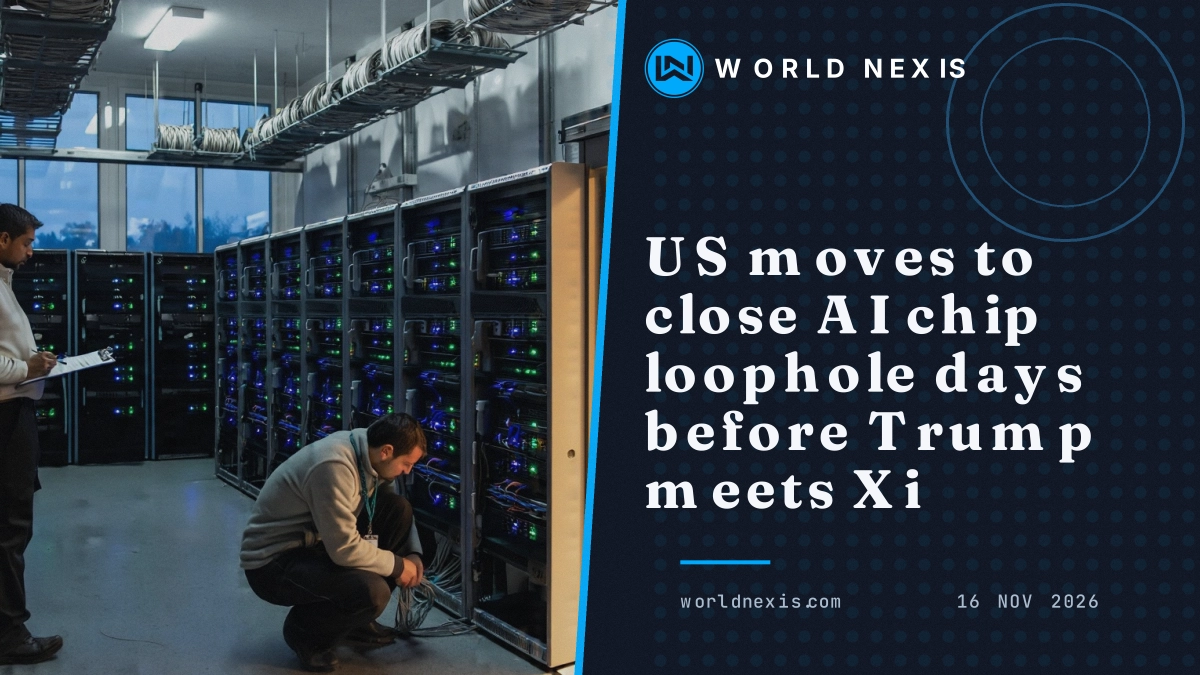
The Trump administration is moving to close an AI chip loophole that let foreign buyers reach advanced American processors through data centers in other countries, with the Commerce Department announcing a temporary rule days before the president leaves for China. According to CBS News, the measure curbs remote access to high-end chips, a route that needs no hardware to cross a US border. The timing matters because Donald Trump flies to Asia this week to meet Xi Jinping and Vladimir Putin.
Key points
- The Commerce Department announced a temporary rule to limit foreign access to advanced AI chips through data centers in other countries, CBS News reported.
- Trump travels to the ASEAN summit in Manila before heading to China, where he is expected to meet Xi and Putin together.
- Former Nvidia chief executive Jensen Huang, who resigned last Thursday over two extramarital affairs, is not joining the trip, CBS News reported.
- A petition calling for Huang’s reinstatement has passed 175,000 signatures, organizers say, including more than 8,700 Nvidia staff.
Inside the AI chip loophole
Export controls usually work by stopping physical shipments. The AI chip loophole works differently, because a foreign company can rent capacity in a data center abroad and run workloads on American accelerators without taking delivery of them. The New York Times reported that the administration is moving to shut that route ahead of the China trip.
The announcement lands in the middle of a wider dispute inside the US government. The BBC reported that the Huang scandal has created tensions between the Treasury and Commerce departments over shipments of high-end Nvidia chips to Megaspeed, the former firm of Alice Huang. US intelligence officials believe Alice Huang was recruited by China’s spy agency, and the row has raised questions about whether restricted chips reached China anyway.
Why remote access is hard to police
Cloud capacity is rented, not exported. That means the customs paperwork which normally tracks a chip from a US port to a foreign buyer simply does not exist, so officials must police who is using the compute and where the results end up. Closing the AI chip loophole therefore depends on auditing workloads, not cargo, and the measure is temporary, which leaves the licensing question unresolved.
Nvidia’s leadership crisis
Huang resigned last Thursday after the emergence of two affairs, one involving Alice Huang and another allegedly with an Nvidia executive who reported to him. The board named chief financial officer Colette Kress as interim chief executive. The Guardian’s business live coverage reported that the drama has knocked around $600 billion off Nvidia’s value, and that the shares fell again on Monday.
Support for a return has built quickly. Elon Musk and Epic Games chief executive Tim Sweeney are among the signatories of an open letter organized by a campaign called Stand with Jensen, which says it speaks for current and former employees, partners and shareholders. “Jensen drove supply chain brilliantly at Nvidia but many of those deals were a handshake with Jensen, not a written contract,” Musk posted on X.
The signatories said they were “concerned that Jensen was removed without meaningful due process”. Shareholders have joined in: Altimeter Capital’s Brad Gerstner and Atreides Management’s Gavin Baker urged the board to keep “all options on the table, including the potential return of Jensen Huang”, and Lord Sarfraz, a member of the UK’s House of Lords, wrote to Nvidia chair Harvey Jones asking directors to give the idea serious consideration.
The White House has not closed the door. Trump said he would not mind Huang being reinstated, according to the Guardian. Treasury Secretary Scott Bessent has taken a different view, calling for Nvidia to hire its next chief executive from outside the company, while the BBC understands reinstatement is unlikely while internal investigations continue.
Trump’s Asia reset
Trump’s trip starts in Manila at the ASEAN summit before he travels on to China, his second visit this year. NPR reported that Musk is joining him in Shenzhen and that expectations for major deals are low. The centerpiece is a trilateral meeting with Xi and Putin, which the White House confirmed on Friday.
Analysts doubt Beijing wants the nuclear agenda Trump has said he will raise. “The Chinese strongly disagree with the idea that they should be involved in any kind of trilateral discussions with the United States and Russia on nuclear weapons,” said Edgard Kagan, a former ambassador to Malaysia now at the Center for Strategic and International Studies. A White House official said: “We do not expect to get to any kind of agreement.”
Domestic politics hang over the trip. NPR noted that the president and his party face voter backlash after the midterm elections, which could weaken his bargaining position, and Trump said he may also meet North Korean leader Kim Jong Un. The Nvidia export restrictions under review will be part of the backdrop in every room.
Analysis
Having covered AI policy and export controls for WNN, I look first at whether a rule changes behavior or only changes paperwork. The AI chip loophole was always the softest point in the American system: no crate, no customs declaration, no paper trail. Closing it is the right call, and doing it before sitting down with Xi rather than after is better sequencing.
The strongest counter-argument comes from industry, which says hastily drafted temporary rules with vague definitions will chill legitimate cloud business and prove impossible to enforce. That concern is real, and I would judge this rule by whether enforcement officials at the Bureau of Industry and Security get the technical capacity to audit who is running what on whose servers. On the substance, though, the case for closing the AI chip loophole is better supported by the facts than the argument that the gap should stay open while a permanent framework is negotiated.
On Nvidia, I side with Scott Bessent. Reinstating Huang before an independent investigation reports, with an alleged espionage link still under FBI scrutiny, would tell every export-control partner that commercial convenience outranks counter-intelligence. Musk’s argument about handshake deals carries commercial weight, but boards exist to weigh that against risk, and this one has not yet been handed the facts.
What happens next
Trump travels to Manila and then China this week, with Musk joining him in Shenzhen and a possible meeting with Kim Jong Un still on the table. The White House has said it expects no denuclearization agreement from the trilateral. Nvidia’s board continues its internal investigation with Kress as interim chief executive, while Huang’s planned testimony to Congress, including before the House Select Committee on China, remains scheduled. The Commerce Department’s rule is temporary, so the AI chip loophole could reopen on paper unless a permanent version follows.
Related coverage
- Nvidia earnings loom as Asian shares fall in major AI test
- Chinese automakers could fill Canada auto gap, Carney warns
- Nvidia chip scandal: Trump faces calls to fire Lutnick
Sources
- Elon Musk joins ‘Bring Jensen Back’ campaign to reinstate the ex-Nvidia boss (bbc.co.uk)
- Trump says he wouldn’t mind Jensen Huang being reinstated as Nvidia CEO, as its shares fall again – business live (theguardian.com)
- Trump heads to Asia to meet with Xi and Putin amid Nvidia fallout (npr.org)
About the author: Priya Nair is World Nexis News’s Technology Correspondent, covering technology. The analysis section reflects the writer’s view.

Priya Nair
Priya Nair is Technology Correspondent at World Nexis News, covering artificial intelligence, cybersecurity, consumer devices and the companies building them. Based in London, she explains how new technology works, who it affects and what the evidence actually shows, with attention to privacy, competition and the…