Mississippi tanker crash: Coast Guard cites two 2024 malfunctions on tanker
The Mississippi tanker crash in New Orleans came after the Atlantic Asphalt lost steering and its rudder locked to starboard, NTSB investigators say.
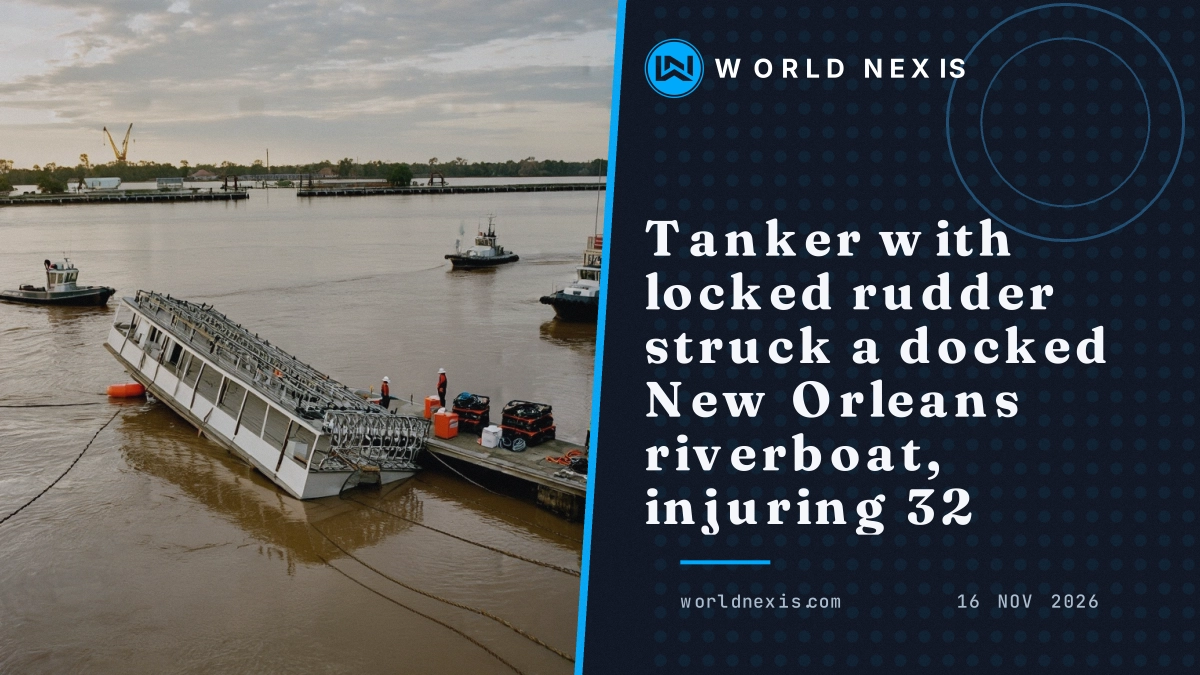
Updated 17 Nov 2026, 22:25 (UK time): The U.S. Coast Guard disclosed that the tanker involved in the Mississippi tanker crash had two navigational malfunctions in 2024, and New Orleans officials closed the family assistance center as the number of hospitalized patients fell to four.
The U.S. Coast Guard reported that the tanker at the centre of the Mississippi tanker crash, the Atlantic Asphalt, suffered two navigational malfunctions in 2024, though the service said those problems were repaired, the reflector reported. That disclosure came as the National Transportation Safety Board said its preliminary report is still about a month away and stressed the investigation remains in its early stages.
Casualty figures have firmed up. Four of the 32 people taken to hospital on Friday were still being treated on Monday, according to New Orleans officials, while WDSU reported that five patients remained hospitalised, two of them in serious condition. All 190 passengers and crew aboard the American Heritage survived, and no one suffered critical injuries.
The City of New Orleans has closed its Family Assistance Center for passengers of the capsized riverboat, directing anyone needing further help to contact American Cruise Lines. Meanwhile, a crew member gave the first detailed survivor account, telling ABC News she helped evacuate passengers after the power failed, then jumped into the river when the gangway collapsed. Investigators have also narrowed the timeline: the steering casualty was logged at 12:26 p.m. and the collision at 12:28 p.m.
My take: a pair of earlier steering-related faults on the same hull, even if repaired, is exactly the paper trail the port’s lawsuit will chase, and it raises the stakes for the NTSB’s maintenance review.
Federal investigators confirmed on Sunday that the Mississippi tanker crash that capsized a docked riverboat in New Orleans began with a loss of steering, two days after the collision sent 32 people to hospital. The National Transportation Safety Board said the tanker Atlantic Asphalt suffered a “steering casualty” before striking the American Heritage on Friday, and that no one is unaccounted for.
Investigator-in-charge Bart Barnum told a news conference in New Orleans that the rudder stayed at a starboard position, pushing the vessel’s heading toward the river’s east bank. He said the exact cause of the failure has not been determined. The tanker’s voyage data recorder was recovered on Saturday.
Key points
- Investigators link the Mississippi tanker crash to a steering failure on the Atlantic Asphalt.
- 32 people were treated in hospital, none with critical injuries; eight remained on Saturday, two in serious condition.
- The Port of New Orleans is suing the tanker’s owner and manager for at least $1 million.
- A preliminary NTSB report is due within 30 days, with a final report in 18 to 24 months.
How the Mississippi tanker crash unfolded
According to the NTSB, the Atlantic Asphalt was upbound on the Mississippi River and moving toward the east bank just before the collision. Investigators drew that sequence from the vessel’s voyage data recorder.
Minutes before impact, audio consistent with the ship’s warning system was broadcast, along with commands to deploy the vessel’s anchors and emergency ship handling orders, Barnum said. The port authority said calls about the collision began around 13:30 EST, or 18:30 GMT.
The lawsuit filed by port commissioners records the impact at 12:30 p.m. Friday at the Thalia Street terminal, where passengers were disembarking. The American Heritage was finishing an eight-day cruise calling at destinations in Louisiana and Mississippi.
“We are aware that there was an issue with the steering on board and causing the rudder to remain at a starboard position, causing the heading of the vessel to veer towards the east bank,” Barnum said.
What a steering casualty leaves open
The NTSB said many different failures can be classified as a steering casualty and that investigators are “looking at all of them”. Whether the tanker’s anchors were deployed, and at what depth, is among the questions under review, according to the Associated Press.
NTSB board member John DeLeeuw said the voyage data recorder would supply speeds and maneuver data, describing it as the marine equivalent of an aircraft’s flight data recorder. Interviews with the tanker’s crew are scheduled over the next week.
Accounts of how many people were aboard the American Heritage have varied. The port authority said about 129 passengers plus crew were on the vessel, the AP reported 190 people aboard, and NPR put the figure at almost 200.
Port of New Orleans lawsuit targets tanker owner
The Board of Commissioners of the Port of New Orleans sued the tanker’s owner, Nave Shipping SA, and its management company, Thome Ship Management. The commissioners are seeking at least $1 million, saying the Thalia Street terminal suffered significant damage.
In the filing, the port said physical damage is currently estimated to exceed $1 million, “with additional substantial direct, indirect and consequential damages anticipated”. It also cited expected cleanup, survey, repair, replacement and salvage costs, and alleged the collision resulted from negligence, gross negligence, fault or carelessness.
On Friday, port officials asked a federal judge to seize the tanker and sell it to cover costs, and the judge approved the request. The tanker has since been towed away from the site, although the Port of New Orleans lawsuit continues.
Rescue, salvage and a river under restrictions
Passengers began leaving the paddlewheeler as it listed and then tipped onto its side. Tugboat operators, police and other rescuers pulled people from the water while officials shut the river to traffic, and more than 100 people were rescued from the river. New Orleans Mayor Helena Moreno called the outcome “the miracle on the Mississippi”.
Coast Guard Capt. Melanie Burnham said operations are focused on fully reopening the river and removing hazardous material safely, with an estimated 160,000 gallons of fuel aboard the American Heritage. Divers are assessing the wreck, teams are monitoring for pollution, and restrictions remain on boat traffic.
Moreno said on Saturday that it could take weeks to fully remove the riverboat, which the Mississippi tanker crash left lying on its side and partially submerged.
Analysis
Having covered emergency response and verification for WNN, I look first at what the recorders and the timestamps can prove, and this week they point in one direction. The voyage data recorder, the warning audio and the anchor orders give investigators a sequence that is hard to dispute, and that sequence places the failure on the tanker before the American Heritage was touched. On the evidence available, I side with the port’s decision to pursue the owners and managers quickly rather than wait 18 to 24 months for a final probable-cause report.
My reasoning is practical. A rudder stuck hard to starboard on a loaded asphalt tanker in a working harbor is not a minor defect, and the questions that follow, from maintenance records to whether emergency steering was ready, are exactly the ones a court can force into the open faster than a federal safety board can. The strongest counter-argument is that a preliminary finding is not a finding of fault, and a mechanical casualty can strike a well-run ship; the owners are entitled to make that case.
Still, for readers who live and work along the river, the more urgent point is not who pays. It is that a cruise vessel carrying close to 200 people was saved by nearby tugboats, fast improvisation and no small amount of luck, and that the margin for error when a large ship loses control is thinner than the phrase “miracle on the Mississippi” suggests.
What happens next
The NTSB expects to publish a preliminary report on the Mississippi tanker crash within 30 days, with a final report on probable causes and safety recommendations in 18 to 24 months. Crew interviews continue over the coming week, and salvage crews will keep assessing the American Heritage while the Coast Guard works toward reopening the river.
Related coverage
- New Orleans port lawsuit seeks $1m after tanker hits cruise ship
- Carbon monoxide poisoning kills San Antonio dog groomer and puppy, 60
- Nvidia chip scandal: Trump faces calls to fire Lutnick
Sources
- Steering failure preceded New Orleans cruise ship collision, says NTSB (bbc.co.uk)
- New Orleans port sues owners of tanker involved in Mississippi crash (npr.org)
- Steering problem caused Mississippi paddleboat crash (theadvocate.com.au)
- Steering problem caused Mississippi paddleboat crash (northerndailyleader.com.au)
- Steering problem caused Mississippi paddleboat crash (goulburnpost.com.au)
About the author: Tariq Al-Mansoori is World Nexis News’s Breaking News Reporter, covering breaking news. The analysis section reflects the writer’s view.

Tariq Al-Mansoori
Tariq Al-Mansoori is a Breaking News Reporter at World Nexis News, covering major incidents, official statements and developing stories across the UK, US and internationally. Based in London, he works to confirm details before publication, attributes information to named sources where possible and updates stories…



