Carbon monoxide poisoning kills San Antonio dog groomer and puppy, 60
A 60-year-old San Antonio dog groomer died of carbon monoxide poisoning inside her mobile grooming van alongside a puppy, as her family urges safety alarms.
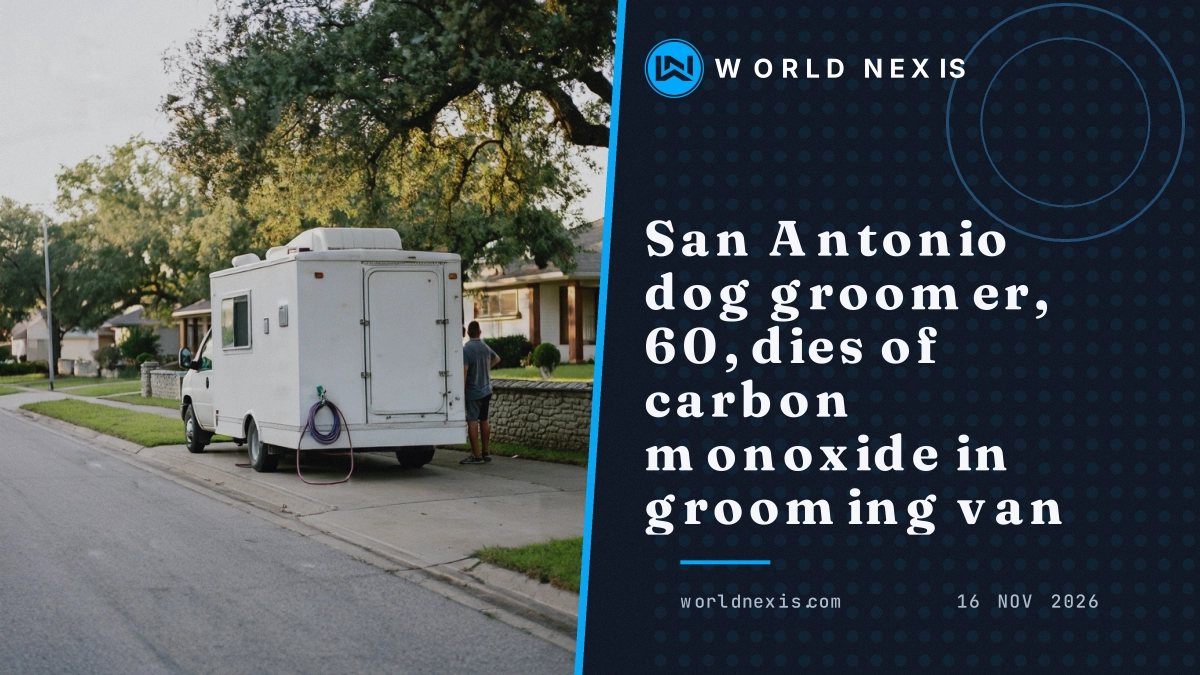
Victoria Starr Ferraro, a 60-year-old dog groomer working in San Antonio, died from carbon monoxide poisoning after she was found unresponsive inside a mobile grooming van alongside a puppy, according to the Bexar County Medical Examiner’s Office. The discovery was made on Wednesday afternoon in the Davis Ranch community on the city’s Far Northwest Side, and her family is now asking whether a cheap safety alarm could have saved her.
Key points
- Ferraro, 60, was found dead inside a mobile grooming van in Davis Ranch on San Antonio’s Far Northwest Side.
- The Bexar County Medical Examiner’s Office ruled her death a result of carbon monoxide poisoning.
- A puppy named Oliver Oken, the pet she had arrived to groom, also died at the scene.
- Investigators have not yet determined how the gas accumulated inside the vehicle.
Family remembers a groomer with ‘a big heart’
Ferraro worked for Dog Gone Clean and spent much of her life caring for animals. Her nephew Nicco Ferraro told News 4/FOX San Antonio that she was devoted to her work and her own pets, and had recently gone from two dogs to ten after one of them gave birth to a litter of puppies.
“She was very nice to us, and she had a big heart when it came to animals, and that’s why she was working as a dog groomer,” he said. “She loved dogs.” His brother Antonio Ferraro described her as “very strong-willed” and “very caring”, while Nicco recalled that the two had spoken days before her death and had planned to catch up at the weekend.
The family learned of the death through their parents, who they believe were told by Ferraro’s son.
How the carbon monoxide poisoning was discovered
Ferraro had arrived at a customer’s home to groom Oliver Oken. When several hours passed without any word from her, the puppy’s owner grew concerned and asked a neighbour to help check on the van. Both Ferraro and the puppy were found unresponsive inside, and neither survived.
The case has renewed attention on the risks carried by mobile grooming vans, which often run fuel-powered generators or dryers in enclosed spaces while a single operator works alone. The US Centers for Disease Control and Prevention describes carbon monoxide as a colorless, odorless gas that can build up when fuel-burning equipment runs without adequate ventilation.
Relatives stressed that they do not know what went wrong and are not accusing the company of responsibility. They argue instead that the carbon monoxide poisoning raises wider questions about equipment standards in vehicles where people and animals spend long periods.
‘A $10 alarm could have gone a long way’
Nicco Ferraro questioned whether inexpensive detectors or better ventilation could have changed the outcome. “You could put it like, I don’t know, like a $10 carbon monoxide alarm could have gone a long way,” he said. “A warning could have went a long way. An extra exhaust vent could have went a long way.”
He added that engineering fixes exist and could be adopted cheaply. “There’s a lot of different engineering solutions that could have prevented something like this,” he said. “It’s odorless, so how can you tell without a sensor?”
Another relative pointed to colour-changing carbon monoxide indicators used in aircraft, suggesting similar low-cost devices could add a layer of protection inside grooming vans. No regulatory body has announced a review of the vehicles in connection with the case.
Analysis
Having covered emergency response and verification for WNN, I look first at the sequence of events rather than the grief. A groomer works alone, inside a sealed box, with combustion equipment running for hours, and nobody outside knows anything is wrong until a client notices silence. That is a structural risk, not an unlucky accident.
The facts here support the family’s argument more than any defence of the status quo. A battery-powered carbon monoxide alarm costs a few dollars and would have sounded before the gas reached a lethal concentration; ventilation and exhaust routing are settled engineering problems. The strongest counter-argument is that no rule yet requires these devices in mobile grooming vans, and that operators on thin margins cannot be expected to retrofit voluntarily. But a requirement that costs less than a haircut is precisely the kind of rule that should not need a death to prompt it.
What I would watch for is whether this remains a single, sad story or becomes a prompt for inspection regimes. Mobile grooming is a growing, lightly regulated trade, and the same risk sits in food trucks, mobile clinics and pet-care vans across the country.
What happens next
Investigators have not determined how carbon monoxide accumulated inside the van, and no findings on the cause have been released. The family says it is still waiting for answers about the circumstances of Ferraro’s death.
Related coverage
- Isaac the cat found alive 4 days after Brooklyn collapse
- FAA ground stop: 8,800 flights delayed as chaos drags on
- Peoria bomb evacuation: 5,000 residents return after FBI search
Sources
- ‘She had a big heart’: Family remembers dog groomer killed by carbon monoxide poisoning (abcnews4.com)
- ‘She had a big heart’: Family remembers dog groomer killed by carbon monoxide poisoning (foxrochester.com)
- ‘She had a big heart’: Family remembers dog groomer killed by carbon monoxide poisoning (cbs12.com)
- ‘She had a big heart’: Family remembers dog groomer killed by carbon monoxide poisoning (wach.com)
- ‘She had a big heart’: Family remembers dog groomer killed by carbon monoxide poisoning (abc3340.com)
About the author: Tariq Al-Mansoori is World Nexis News’s Breaking News Reporter, covering breaking news. The analysis section reflects the writer’s view.

Tariq Al-Mansoori
Tariq Al-Mansoori is a Breaking News Reporter at World Nexis News, covering major incidents, official statements and developing stories across the UK, US and internationally. Based in London, he works to confirm details before publication, attributes information to named sources where possible and updates stories…