Mississippi plane crash: coroner names six victims, all from one family
The Mississippi plane crash off Horn Island has left four adults and two boys missing, with the cabin and three life jackets found but no one recovered.
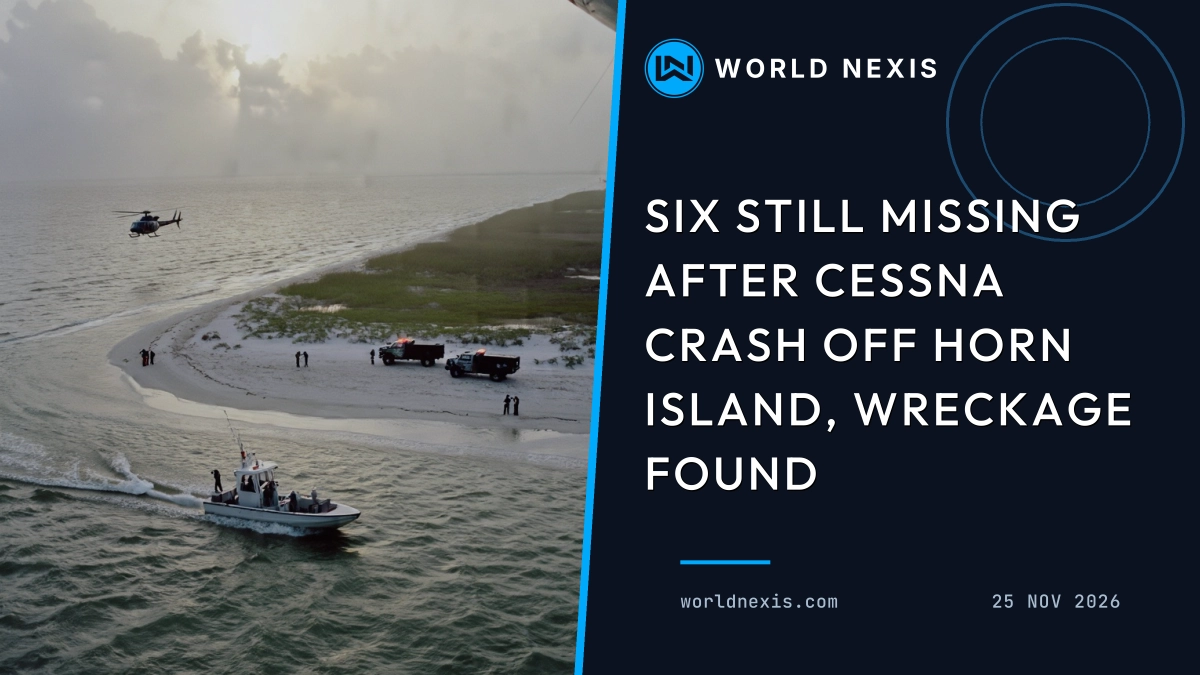
Updated 25 Nov 2026, 14:42 (UK time): Jackson County Coroner Bruce Lynd Jr. has publicly named the six people killed in the Mississippi plane crash, all of them related, revealing an age breakdown that differs from the Coast Guard’s earlier account.
The six people killed in the Mississippi plane crash now have names. Jackson County Coroner Bruce Lynd Jr. identified them as Brent Stokes, 42, Hunter Stokes, 16, Michael Knox, 40, Arlyn Knox, 40, Charles Holden Knox, 12, and Truett Knox, 10. All six were related, and the group was returning from a fishing trip when the Cessna 210 went down near Horn Island on Tuesday afternoon.
Until now, officials had declined to name anyone on board, and the families were left as an unnamed group of four adults and two children. Naming them changes the character of the story: this was one family, and the two boys the Coast Guard described as aged 8 and 10 were part of it.
There is also a discrepancy to resolve. The coroner’s list includes a 16-year-old and a 12-year-old, which does not match the Coast Guard’s account of four adults and two boys aged 8 and 10. The victim count is unchanged at six, but the makeup of the group is now in question.
The National Transportation Safety Board still leads the investigation with the FAA, and the descent rate remains unexplained. I would rather see the age breakdown corrected than left to sit alongside the Coast Guard’s version as though both can be right. The families have enough to carry without a muddled public record of who was on that aircraft.
Updated 25 Nov 2026, 11:56 (UK time): Flight-tracking data shows the Cessna 210 dived at about 18,000 feet a minute — more than 200mph and nearly double the FAA’s initial 10,000 feet a minute figure — after levelling at 8,800 feet roughly 30 minutes into the flight.
New flight-tracking data has sharpened the picture of the final seconds of the Mississippi plane crash. The Cessna 210 levelled at about 8,800 feet roughly 30 minutes after leaving New Orleans, then went into a dive that tracking data puts at about 18,000 feet a minute, more than 200mph, before the signal stopped at around 3:30 p.m. Tuesday.
That is close to double the 10,000 feet a minute the FAA gave in its first account, and it is the sharpest detail yet on a flight that ended two miles northeast of Horn Island. The Coast Guard confirmed the search ran about four hours before divers from the Mississippi Department of Marine Resources found all six people inside the fuselage: four adults and two boys aged 8 and 10.
Cmdr. Trevor Blount, the Coast Guard’s search and rescue coordinator at Sector Mobile, called it a heartbreaking outcome and said interagency coordination allowed crews to locate those aboard quickly and give families closure. The National Transportation Safety Board is leading the investigation into the 24 November crash, with the FAA taking part.
Two descent figures now sit in the public record, and they do not match. Reconciling the FAA’s number with the tracking data is the first thing I would expect the investigators to do, because everything else about this flight follows from how fast it went down.
Updated 25 Nov 2026, 06:36 (UK time): Divers located the bodies of all six people aboard the Cessna 210 inside the fuselage, and the Coast Guard ended the search, turning the Mississippi plane crash from a rescue into a recovery and an NTSB investigation.
The search off Horn Island is over. Divers from the Mississippi Department of Marine Resources found the bodies of all six people who were aboard the Cessna 210 inside the fuselage, the Coast Guard said, and the rescue operation has been ended. Four adults and two boys, aged 8 and 10, were killed.
Crews searched for roughly four hours after air traffic controllers in Mobile lost contact with the aircraft at about 3:45 p.m. Tuesday before divers reached the wreckage, which sits about two miles northeast of Horn Island. The cabin, a life raft and three life jackets had been spotted on the surface earlier, with nobody in them.
This settles the question that hung over the Mississippi plane crash from the first hour: there are no survivors, and the case now belongs to investigators rather than rescuers. The National Transportation Safety Board leads that work, with the FAA taking part, and will want the wreckage raised and the tracking data from the final minutes.
Four hours is a short window in open water, and the families deserved a faster answer than the early confusion over how many people were on board allowed. The number I still want explained is the descent rate, because nothing released so far accounts for it.
The Mississippi plane crash near Horn Island remains a search-and-rescue operation, with four adults and two boys still unaccounted for after their aircraft went down in the Gulf of Mexico on Tuesday afternoon. Crews have located the cabin of the Cessna 210 Centurion floating on the water, along with a life raft and three life jackets, but nobody on board has been found.
Key points
- Six people were on the Cessna 210 Centurion: four adults and two boys, aged 8 and 10.
- The aircraft went down about two miles northeast of Horn Island at around 3:30 p.m. local time.
- It had left New Orleans bound for Fort Myers, Florida, and was descending at about 10,000 feet per minute before impact.
- The National Transportation Safety Board will lead the investigation while Coast Guard crews keep searching.
What we know about the Mississippi plane crash
The Federal Aviation Administration said preliminarily that the Cessna came down southwest of Pascagoula, Mississippi, at about 3:30 p.m. The Coast Guard places the crash site about two miles northeast of Horn Island, which forms part of the Gulf Islands National Seashore.
Coast Guard watchstanders in Mobile received the first report from the FAA. Controllers had lost communication with the aircraft at about 3:45 p.m., a short time after the initial estimate of the crash.
The flight had left New Orleans and was heading for Fort Myers, Florida, tracking data shows. The Coast Guard said the aircraft was descending at roughly 10,000 feet per minute before it reached the water, a rate that stands out in the first official accounts.
What crews have found
Wreckage broke the surface within hours of the first alert. The cabin was seen floating, along with a life raft and three life jackets, and a multi-agency response moved into the area between Pascagoula and the island.
The Coast Guard’s Heartland division set out the operation in a public update:
Rescue crews are searching for a downed Cessna 210 Centurion aircraft with 6 people, 2 mi NE of Horn Island, Mississippi.
The search has continued since, without a confirmed sighting of anyone who was on board.
Who was on board
Four adults and two boys, aged 8 and 10, were aboard, the Coast Guard said. Coast Guard spokesperson Juan Ros gave the breakdown of adults and children. Officials have not publicly named anyone on the flight.
Who is leading the Horn Island plane crash response
The Coast Guard is running the search, with several partner agencies working the same stretch of water. The FAA and the National Transportation Safety Board will investigate, and the NTSB will lead that work and issue updates.
Both agencies have been careful with early detail. The FAA said at first that the number of people on board was not known, while the Coast Guard has consistently put it at six.
Horn Island lies in the Gulf of Mexico off the Mississippi mainland, close to Pascagoula, and the crash site falls within the Gulf Islands National Seashore.
Why it matters
For the families of the six people on board, the next few hours decide what kind of story this becomes. A live search-and-rescue operation is a different thing from a recovery operation, and the Coast Guard has not announced a change of status.
The Mississippi plane crash also matters to the wider flying public. A descent of about 10,000 feet per minute is the sort of figure investigators build a timeline around, and whatever explains it will shape how this flight is understood.
Analysis
Having covered emergency response for World Nexis News, I look first at the clock rather than the list of wreckage. The FAA puts the crash at about 3:30 p.m., the loss of communication at about 3:45 p.m., and the Coast Guard was alerted after that. In a water search, that gap is the detail I would want explained before I accepted any firm narrative about the final minutes.
The figure I keep returning to is the descent rate. Ten thousand feet per minute is not a glide, and it is not a controlled approach to a runway; it points to something abrupt at the end of the flight. I think that number, more than the life jackets, will define the investigation.
I also think the Coast Guard is right to keep describing this as a search. The counter-argument is obvious: once a cabin is floating and three life jackets are in the water with nobody in them, the odds narrow with every hour, and readers should be prepared for that. Yet until the agency says otherwise, the accurate description is six people missing, not six people lost. Open water also works against rescuers, because anything on the surface moves with the current while crews are still working out where the aircraft first struck.
What happens next
The search continues across the water between Pascagoula and Horn Island, with the Coast Guard and partner agencies still treating the case as a rescue. The NTSB will lead the investigation into the Mississippi plane crash and provide updates as the work develops, with the FAA taking part.
Investigators will want the wreckage recovered from the water and the tracking data from the final minutes of the flight. The NTSB has said it will issue updates on the investigation.
What we don’t know yet
- Why the aircraft went down, and whether mechanical failure, weather or another factor was involved.
- Whether anyone survived the impact.
- The identities of the four adults and two boys.
- Whether all six were aboard when the Cessna hit the water, given the FAA’s early caution.
Related coverage
- Ilhan Omar search warrant: federal grand jury empaneled in fraud inquiry
- Meta Muse launch: six UK brands on board as regulators warn
- Amazon drone crash prompts FAA probe as 500-city push looms
Further reading
- Coast Guard searching for 2 children, 4 adults after plane crashes off Mississippi coast
- Plane carrying 6 people crashes off Mississippi coast, search ongoing: US Coast Guard
About the author: Tariq Al-Mansoori is the Breaking News Reporter at World Nexis News (WNN), covering breaking news. The analysis section reflects the writer’s view.

Tariq Al-Mansoori
Tariq Al-Mansoori is a Breaking News Reporter at World Nexis News, covering major incidents, official statements and developing stories across the UK, US and internationally. Based in London, he works to confirm details before publication, attributes information to named sources where possible and updates stories…



