Strictly Come Dancing police called over live show disruption
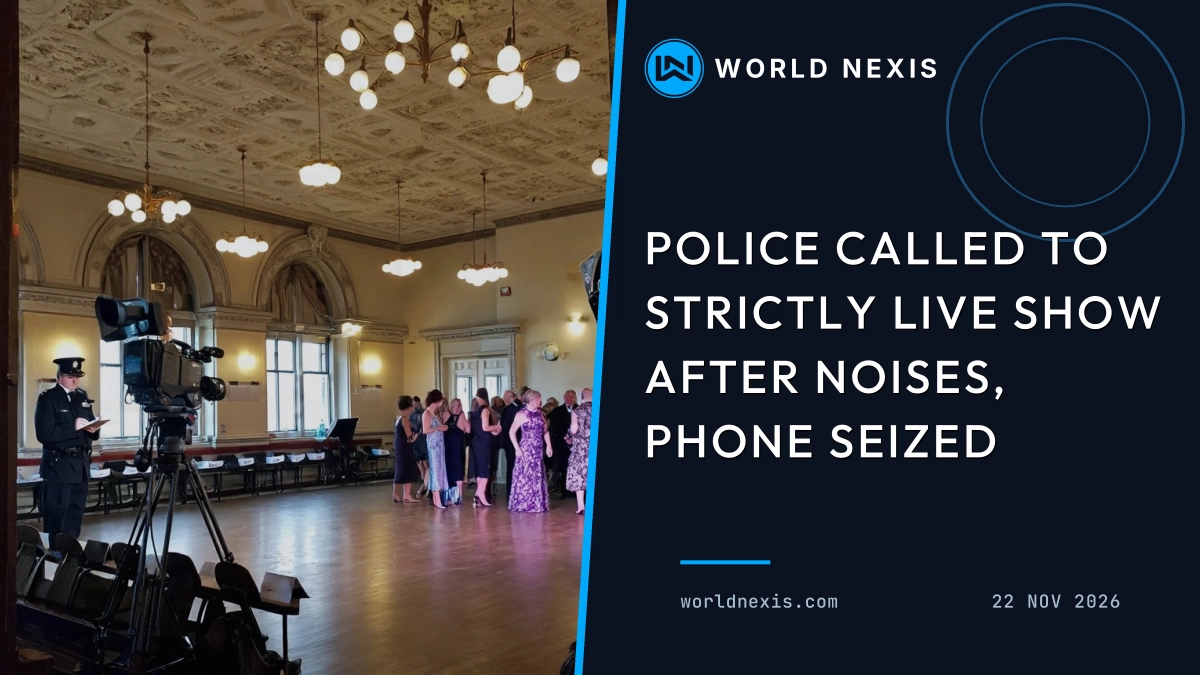
Strictly Come Dancing police were called after unusual noises interrupted the live Blackpool show; the BBC apologised and officers seized a phone.
Updated 22 Nov 2026, 13:26 (UK time): The BBC has now confirmed on the record that the disruption was lewd audio — a recording of sex noises played from the ballroom audience — and the prankster’s own livestream shows the stunt was aimed at judge Craig Revel Horwood over what he called “bullying”, giving the inquiry a stated target and motive it did not previously have.
The noises that cut across Saturday’s Strictly broadcast are now described on the record as lewd audio, with the BBC acknowledging that a recording of sex noises appeared to play from the audience in the Blackpool Tower Ballroom while Motsi Mabuse was giving feedback. That fills a gap the police inquiry had left open, because until now Lancashire Police had declined to characterise the sounds at all.
The livestream also gives the prank a target and a stated motive. Daniel Jarvis, who posts as Jarvo69, pointed at judge Craig Revel Horwood and said the stunt was for “all the people you keep bullying”, before appearing to make a call he expected to trigger the noise. The audio instead landed during Mabuse’s comments, and he told his viewers he had been trying to get “the other one” and complained of a delay. He has previously claimed responsibility for sex noises disrupting Match of the Day in 2023.
None of this alters the legal position. Lancashire Police have made no arrest, named nobody and say they are assessing whether a criminal offence took place after a formal complaint and the seizure of a mobile phone. The BBC has apologised to viewers offended during the broadcast and will edit the version on iPlayer.
A prank with a named target and a stated grudge reads very differently from an unexplained noise in a live audience, and it makes the question of how a phone got into that ballroom far harder for the corporation to file away as a technical hiccup. The police still owe us the only answer that matters: whether a stunt counts as a crime.
Updated 22 Nov 2026, 12:01 (UK time): A content creator, Daniel Jarvis (known online as Jarvo69), has been publicly identified as livestreaming during Saturday’s Strictly broadcast and hinting beforehand that something unexpected would happen, while Lancashire Police have named no one and made no arrest.
A content creator has been publicly identified as the person behind the disruption that cut across the Strictly Come Dancing broadcast on Saturday. Daniel Jarvis, who posts online as Jarvo69, was livestreaming during the Blackpool show and indicated during his own broadcast that he knew something unexpected was about to happen.
The noises came as the judging panel gave feedback to the first couple of the night, singer Delta Goodrem and her professional partner Kai Widdrington. Motsi Mabuse appeared distracted by the sound behind her and paused before telling the ballroom: “It’s not me.” Lancashire Police have still not named anybody in connection with the incident and have made no arrest.
The naming changes the shape of the story rather than its legal position. The Strictly Come Dancing police inquiry continues around the seized handset, and detectives have yet to say whether any criminal offence took place. Being identified as a prankster online is not the same as being charged, and the force has not confirmed the account.
I would rather the investigation be slow and correct than fast and wrong. What I want to know is whether the BBC now changes anything about how a live audience gets through the ballroom doors.
Strictly Come Dancing police were called to the Blackpool Tower ballroom on Saturday night after unusual noises interrupted the live BBC One broadcast, prompting an on-air apology and a formal complaint. Lancashire Police said a mobile phone had been seized and that officers were looking into whether any criminal offence had taken place. Three couples finished level at the top of the leaderboard on 39 points, one short of a perfect score.
Key points
- Strictly Come Dancing police were called after unusual noises cut across the live show from Blackpool on Saturday night.
- Lancashire Police said a formal complaint had been made and a mobile phone seized.
- The BBC apologised to viewers on air and said an edit would be made to the version on iPlayer.
- Three couples tied on 39 points at the top of the leaderboard, with no perfect 40 awarded.
What happened at the Blackpool Tower ballroom
The disruption struck the ninth live episode of the series, which the BBC stages each year in the seaside ballroom. The noises cut across the broadcast while the judging panel was speaking, and viewers watching at home heard them clearly.
Singer Delta Goodrem and her professional partner Kai Widdrington were among the couples who took to the floor before the interruption became the story of the night. Presenter Emma Willis addressed it directly before the leaderboard was revealed.
The programme still completed its full running order, and the results were delivered as planned. Behind the scenes, however, the incident moved quickly from a technical fault to a policing matter.
Strictly Come Dancing police seize a phone after a complaint
Officers confirmed they had been contacted by the event organisers after Saturday’s broadcast. A spokesperson for Lancashire Police set out the position plainly.
We have been in contact with the event organisers, and a formal complaint has been made to us. A mobile phone has been seized and we are now looking into the matter to see if any criminal offences have taken place.
The force has not named anybody, confirmed whether anyone was removed from the audience, or said who made the complaint. It has also declined to characterise the noises themselves, describing the episode only as an incident during filming.
Seizing a handset matters because it gives investigators a route to identifying who was behind the audio. The Strictly Come Dancing police inquiry now runs alongside the broadcaster’s own review, on two separate tracks and at two different speeds.
BBC apology and an edit for iPlayer
The corporation moved quickly to draw a line under the moment. Willis told viewers the show wanted to say sorry for any disruption they had heard and for any offence caused.
A BBC spokesperson added that the broadcaster apologised to any viewers offended during the live broadcast and was investigating how it happened. An edit will be made to the programme available on BBC iPlayer, which means the version streaming after transmission will not carry the audio exactly as it went out.
The language used on air was careful. The apology referred to audio disruptions rather than describing the sounds, an approach that keeps the episode contained while a police inquiry is open.
A near-perfect night on the leaderboard
On the dance floor, the contest itself produced the tightest result of the series so far. Love Island’s Cach Mercer and Maddie Ingoldsby, content creator John Nellis and Katya Jones, and Olympian Tabby Stoecker and Mark Karmalita all finished on 39 points.
Craig Revel Horwood held back a 10 that much of the ballroom expected, leaving the three couples one mark short of perfection. Stoecker’s Charleston to Another Day Of Sun drew warm praise from the panel, while Nellis and Jones impressed with a Viennese waltz.
The night had opened with a music festival-themed routine from Basement Jaxx, performed with the cast, before the competition got under way. For a show built on live spectacle, the evening delivered both the highs and the hazards of going out unedited.
Why it matters
For viewers, the practical effect is small but real: the programme they watch back on iPlayer will not sound the same as the one that aired. For the BBC, the episode is a reminder that a live audience is also an uncontrolled one, and that a single phone can reach several million homes.
For anyone in that ballroom, a night out has become part of a police file. That is a serious step for a noise that lasted seconds.
Analysis
Having covered television and live entertainment for World Nexis News, I look first at how a broadcaster handles a moment it simply cannot control. My view is that the BBC got this broadly right: it apologised at the first opportunity, avoided describing the audio, and confirmed the iPlayer edit on the night. A live show that stops to litigate the joke is a worse show for everyone watching.
The defence being made online is that this was harmless mischief and that calling the police is a heavy-handed response to a prank. I do not buy it. Once a broadcaster logs a formal complaint and a handset is seized, the prank framing collapses, because the consequences are now attached to a real investigation and a real person. The strongest counter-argument is that no one was hurt and that British television has a long, affectionate history of people misbehaving on air; I accept that, but a joke that costs a public broadcaster its reputation for control in its biggest live format is a poor trade.
What most coverage misses is the economics underneath. Live event television is one of the last things holding a mass audience together, and its value depends entirely on trust that what goes out is what was planned. Every successful interruption makes the next one more likely.
What happens next
Lancashire Police will continue examining the seized phone and will decide whether any criminal offence has taken place. The BBC is running its own investigation into how the audio reached the broadcast, and the edited version will replace the original on iPlayer.
What we don’t know yet
The BBC has not said what the noises were, and police have not named anybody or confirmed an arrest. It is also unclear whether the audio came from a member of the audience, from equipment, or from somewhere else in the ballroom. Those answers will decide how serious this becomes.
Related coverage
- Peter Fluck dies at 85: Spitting Image creator’s legacy
- Titanic ring auction: rare diamond sells for £150,000
- Kate Middleton documentary Heal reveals cancer’s deep toll
Further reading
- Police called to Strictly Come Dancing after ‘disruption’ during live show
- Three couples land near-perfect score on Strictly Come Dancing
About the author: Emily Carver is the Culture & Entertainment Writer at World Nexis News (WNN), covering culture & entertainment. The analysis section reflects the writer’s view.
Emily Carver
Emily Carver is Culture & Entertainment Writer at World Nexis News, covering film, television, music, gaming, books and the creative industries from Los Angeles. She writes about the business and craft behind the work — streaming economics, production decisions, criticism and the way culture travels…