Kate Middleton documentary Heal confirms Australia and Canada air dates
Kate Middleton documentary Heal shows the princess saying cancer changes your body and mind, ahead of its first BBC One broadcast on 29 November.
Updated 22 Nov 2026, 13:46 (UK time): The BBC has confirmed Heal’s full international rollout beyond the US, adding Channel 9 in Australia on 1 December and CTV and Noovo in Canada on 7 December.
The Kate Middleton documentary Heal now has a confirmed international rollout rather than a US date and a promise. The BBC has set out that after the film airs on BBC One on 29 November and lands on iPlayer from 12:00 GMT, it moves to NBCUniversal in the US on 30 November, Channel 9 in Australia on 1 December and CTV and Noovo in Canada on 7 December.
That turns a two-territory launch into a four-country run inside nine days, and it is the first time the overseas schedule has been spelled out in full. All funds paid for the film’s distribution still go to The Royal Marsden Cancer Charity, so the wider the film travels, the more the hospital charity receives.
Nothing else in the record has moved. Kensington Palace has added no new statement beyond its earlier line that Catherine hopes the project helps others navigate diagnosis, recovery and life beyond cancer, and the 30-minute running time and Kirsty Young introduction stand as previously confirmed.
A nine-day spread across four countries is a lot of reach for half an hour of television. I think the reach is the point, but the questions the film declines to put to anyone in power will travel just as far as the ones it answers.
Updated 21 Nov 2026, 21:51 (UK time): The BBC has confirmed on the record that Heal is a 30-minute film introduced by Kirsty Young, with its chief content officer publicly setting out what the broadcaster hopes the programme will do for viewers.
The Kate Middleton documentary now has its shape confirmed by the broadcaster itself. Heal runs 30 minutes and will be introduced by Kirsty Young when it airs on BBC One on 29 November and lands on iPlayer from 12:00 GMT, with the same half-hour film going out internationally afterwards.
The BBC has also gone on the record about intent. Its chief content officer, Kate Phillips, said the corporation hopes the film “will resonate with BBC viewers and provide comfort and support to those navigating their own health challenges”. That is the first public statement from the broadcaster, rather than the palace, about what the project is for.
A half-hour slot is the detail worth holding on to. It is enough time for the bell she never rang and the family embrace at the finish, and not much else. I still expect the film to be quoted in kitchens and clinics for months, but nobody should expect 30 minutes of tightly produced, family-approved television to ask the NHS a hard question.
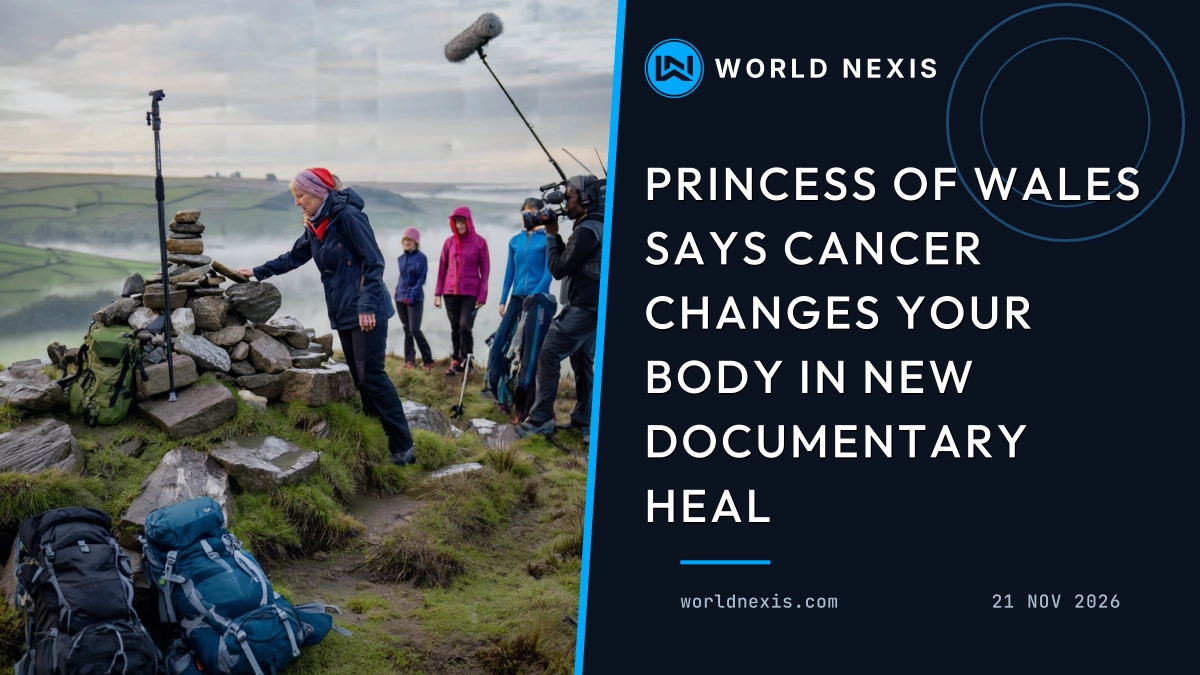
The Kate Middleton documentary Heal will be broadcast on BBC One on 29 November, with the Princess of Wales saying in the film that cancer “changes your body” and shifts something far deeper. A trailer released on Saturday shows Catherine climbing the highest mountains in Scotland, England and Wales within 24 hours, then embracing Prince William and their children at the end of the challenge. All funds paid for the film’s distribution will go to The Royal Marsden Cancer Charity.
Key points
- Heal streams on BBC iPlayer from 12:00 GMT and airs on BBC One at 18:40 GMT on 29 November.
- Catherine says cancer “changes your body, it changes you physically”.
- She reveals she never rang the Royal Marsden’s end-of-treatment bell.
- US viewers see the film on NBCUniversal on 30 November, with proceeds going to the hospital’s charity.
What Catherine says in the Kate Middleton documentary
Catherine has never disclosed the type of cancer she was treated for. She said in March 2024 that she had been diagnosed and was receiving chemotherapy, and in January 2025 she announced that she was in remission. Since then she has returned gradually to royal duties while insisting that recovery is not a simple return to how she felt before.
She has spoken about the good days and the bad ones, and about the need for care that goes beyond the physical. This is the fullest account yet of the Princess of Wales cancer experience. In the trailer she says:
“Cancer does change you. It changes your body, it changes you physically – but there is a much, much deeper part to what a cancer diagnosis shifts in you.”
She goes on to describe healing as a process rather than an event, and ties it to the company of other people.
“It’s clear we’re not meant to carry life’s challenges alone… It is often through pain that we realise there is a greater beauty that lies beyond that.”
The most intimate moment concerns the bell that patients ring at the Royal Marsden in London when their treatment finishes. Catherine tells her brother: “I didn’t ring the bell.” He replies: “Maybe this is your ringing the bell.” That exchange is the point where the Kate Middleton documentary stops being a statement and becomes a scene.
Three Peaks, remission and a return to royal work
The Kate Middleton documentary was built around the National Three Peaks Challenge, which Catherine completed in June. The test involves reaching the highest peaks in England, Scotland and Wales inside a day. She used it to raise money for the Royal Marsden Cancer Charity and to explore what life beyond a diagnosis can hold.
In the Kate Middleton documentary, footage cuts between the climbs, other patients, and Catherine with her family at the finish. Kensington Palace said she hopes the film will help others navigating their own health challenges, and that it explores the many ways people find comfort, strength and hope in the face of serious illness.
The timing is deliberate. Catherine has spent this year returning to her charities, and this week she joined Prince William in India for the Earthshot Prize ceremony. It was the first time the couple had carried out overseas royal duties together since her treatment.
Why it matters
For most patients, cancer treatment ends with a discharge letter rather than a plan for the year that follows. A film that names the changed body, the fear and the gap between finishing chemotherapy and feeling well gives people language that clinics rarely supply. That is why the Kate Middleton documentary will be quoted in living rooms far more often than in hospitals.
The reach of the Heal documentary does the heavy lifting. A film on BBC One, followed within a day by a US broadcast, will land in front of people who would never open a clinical guidance leaflet. The distribution money also goes somewhere useful, because it is paid to a charity that works with people living with and beyond cancer.
Analysis
Having covered the royals as a media operation for World Nexis News, I watch a trailer like this for what it declines to do as much as for what it says. Catherine does not present remission as a finish line, and she does not claim that positivity cures anything. That restraint is the most valuable part of the project, because the brave-face version of survivorship does real damage to people who are still struggling.
There is a serious counter-argument. This is a tightly produced, family-approved film with the palace’s hands all over it, and it asks nothing of the NHS, of waiting times or of anyone in power. A documentary that cannot put a difficult question to its subject is not accountability journalism, and nobody should pretend otherwise.
I still think the balance falls in the film’s favour. The detail about the bell she never rang, and the admission that pain comes before any sense of beauty, is more honest than royal messaging usually permits. If the Kate Middleton documentary nudges even a few clinics into talking about the after-treatment void, the trade-off between access and control will have been worth it.
What happens next
Heal is available on BBC iPlayer from 12:00 GMT on 29 November and airs on BBC One at 18:40 GMT the same evening. It then goes to NBCUniversal in the United States on 30 November, to Channel 9 in Australia on 1 December, and to CTV and Noovo in Canada on 7 December.
What we don’t know yet
- The type of cancer Catherine was treated for has not been disclosed.
- The sum the international distribution will raise for the Royal Marsden Cancer Charity has not been made public.
Related coverage
- Fiona the hippo necropsy reveals hat 50 feet deep in gut
- Kerr Smith memoir reveals 25-year bond with Van Der Beek
- Patrick Stewart cause of death reveals two brain diseases
Further reading
- Princess of Wales: Catherine talks about her cancer journey in new documentary Heal
- Princess Kate gives bombshell cancer update in brand new documentary – AOL
About the author: Emily Carver is the Culture & Entertainment Writer at World Nexis News (WNN), covering culture & entertainment. The analysis section reflects the writer’s view.
Emily Carver
Emily Carver is Culture & Entertainment Writer at World Nexis News, covering film, television, music, gaming, books and the creative industries from Los Angeles. She writes about the business and craft behind the work — streaming economics, production decisions, criticism and the way culture travels…