Rents rise faster than house prices as rental stock falls 26% in a decade
UK rents rise faster than house prices under new forecasts, with Hamptons projecting 14.2% growth for new lets by 2029 while Knight Frank cuts its price…
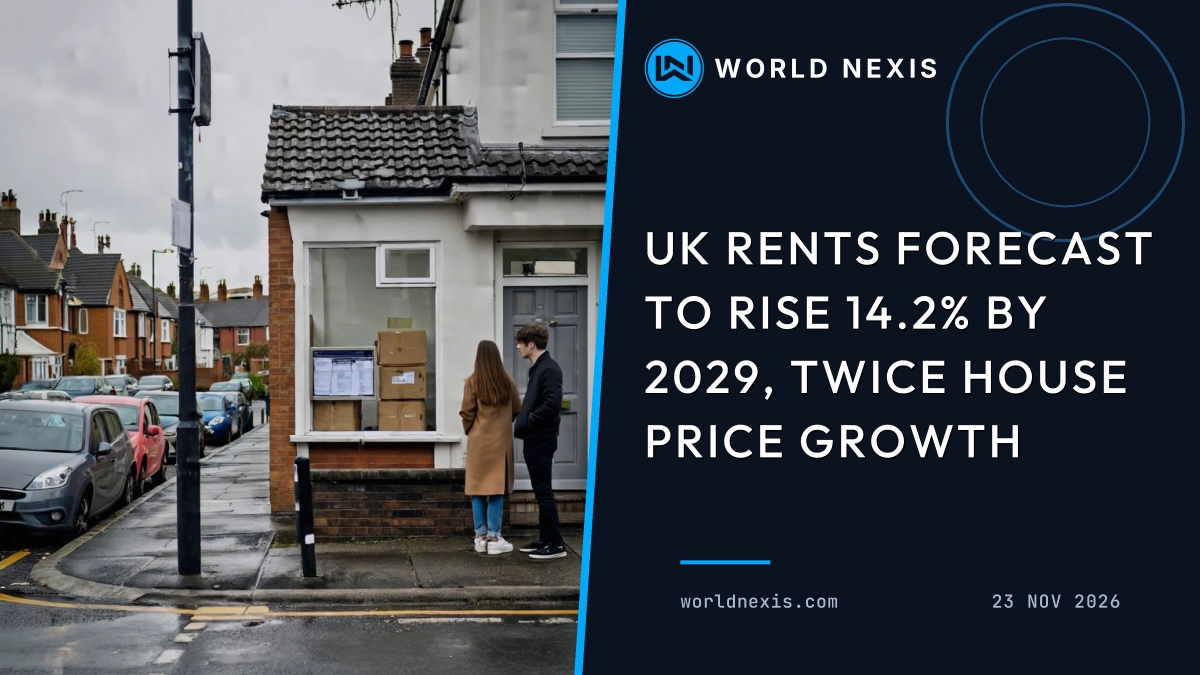
Updated 23 Nov 2026, 12:32 (UK time): Hamptons’ research now quantifies the rental shortage, showing the stock of available rental homes in Great Britain down 26% over a decade (39% in London) with 10% more prospective tenants, alongside a year-by-year path for rent growth peaking at 4.5% in 2027.
The forecast that rents rise faster than house prices now comes with hard numbers on supply. Research from Hamptons puts the number of rental homes available in Great Britain in October 26% lower than a decade earlier, with a steeper 39% fall across London over the same period. At the same time, 10% more people were looking to rent in October than a year earlier.
The firm also set out the annual path behind its three-year projection of a 14.2% rise in rents on newly agreed lets against 7.2% for house prices: growth on new lets is expected to peak at 4.5% in 2027, then ease to 3.5% in 2028 and 2.5% in 2029. Hamptons attributes part of the squeeze to regulatory change under the Renters’ Rights Act, alongside higher tax and mortgage costs that it values at about £900 per tenancy a year in England, equal to 18% of rental growth over the decade.
Regional data from the Office for National Statistics underlined how uneven the picture is. Average house prices in Ceredigion reached £245,000 in September, up 4.9% year on year against 1.8% across Wales, while average private rents there stood at £724 a month, below the Welsh average of £849. The ONS described its local estimates as provisional and subject to revision.
What changes is the burden of proof. A forecast from an estate agency is one thing; a 26% fall in available stock is a measurable fact about the market tenants are negotiating in. I would still treat three-year projections with caution, but the direction is no longer just a prediction.
Private rents on newly let homes across Britain are set to rise faster than house prices over the next three years, with Hamptons forecasting a 14.2% increase between the fourth quarter of 2026 and the fourth quarter of 2029. Over the same period the estate agency expects house prices to grow by just 7.2%, meaning tenants face roughly double the pace of increase seen by homeowners.
Key points
- Hamptons forecasts a 14.2% rise in rents for newly let homes by late 2029, against 7.2% house price growth.
- Rents across all privately rented homes are projected to climb 10.9% over the same three years.
- Lloyds found buying is cheaper than renting in seven of 12 major UK cities, including Glasgow, Newcastle and Bristol.
- Knight Frank has cut its 2027 house price growth forecast from 3% to 1%, citing political uncertainty and borrowing costs.
Why rents rise faster than prices in the Hamptons forecast
Hamptons attributes the gap to a shrinking pool of rental properties and continuing affordability problems for first-time buyers. Fewer homes are entering the rental market, so competition between tenants is expected to stay fierce through 2029.
Aneisha Beveridge, head of research at Hamptons, said: “With fewer homes entering the rental market, competition between tenants is likely to keep rents rising faster than house prices over the next few years.” She added that landlords now have more scope to pass on their own rising costs than they did historically.
The firm also expects stronger growth on newly agreed lets to filter into the wider market over time. Tenants already in place may be insulated at first, but Beveridge warned that “the new-let and existing-tenancy markets do not operate independently”.
There is some relief in sight on the supply side of costs. Hamptons expects rent growth on newly agreed lets to begin slowing in 2028 and 2029, as mortgage rates are projected to fall. Even so, it says many long-term structural problems in the rental sector are likely to persist.
For landlords the picture is mixed. Hamptons said improving yields, particularly in parts of southern England, have already begun to tempt some investors back into the London market. Higher rents do not automatically follow higher costs, however, and Beveridge described the position as “a delicate balancing act” for owners.
Buying versus renting: where owning is cheaper
Separate analysis by Lloyds looked at the cost of buying compared with renting in 12 major UK cities, using Office for National Statistics data and assuming a 5% deposit. It concluded that owning a home could be cheaper than renting in seven of them.
Glasgow showed the largest gap, with buyers saving an estimated £288 a month against renters. In Newcastle the saving was put at £187 a month and in Bristol at £139.
Andrew Asaam, mortgages director at Lloyds, said: “Higher mortgage rates have seen the cost of borrowing increase this year, making that affordability calculation even more important.” He added that in many cities buyers could still pay less on a mortgage than they would in rent.
The contrast matters because it undercuts the simple assumption that renting is always the cheaper option. In those seven cities, a buyer who can raise a deposit and secure a mortgage comes out ahead each month, even with borrowing costs elevated.
House price forecasts cut as buyer demand cools
On the sales side, the mood has darkened. Property consultancy Knight Frank has revised its UK house price forecasts downward, now expecting growth of just 1% in 2027, compared with the 3% it projected in April.
Knight Frank said cumulative UK house price growth over the five years to 2031 is now expected to reach 14.2%, down from a previous estimate of 20.4%. It cited the political climate, higher borrowing costs and geopolitical instability as factors likely to dampen buyer demand and confidence.
The result is an unusual split in the housing market. Capital values are expected to creep upward while the cost of a new tenancy climbs at roughly twice the rate, squeezing renters who are trying to save for a deposit at the very moment prices are more subdued.
Why it matters
For renters, the forecast points to three more years of difficult negotiations at renewal and even sharper increases when moving home. Every extra pound on rent is money that cannot go towards a deposit, which delays the point at which a tenant can take advantage of cheaper monthly ownership costs.
For anyone hoping to buy, the weaker price outlook is not the good news it first appears. Lower growth reflects weak demand and stretched affordability rather than an easier market, and lenders are still pricing mortgages cautiously.
Analysis
Having spent five years covering central banking and household finances for World Nexis News, I look first at what these numbers say about the cost of waiting. The clearest conclusion from the evidence is that the gap between owning and renting is now doing damage to renters rather than helping them, and I side with the reading that supply, not landlord greed alone, is the binding constraint.
Lloyds’ finding that a mortgage costs less than rent in seven major cities is striking, but it comes with a catch that most coverage glosses over. That saving requires a deposit and loan approval, and renters facing 14.2% growth in new-let costs are precisely the people least able to build one. A cheaper monthly payment is of little use to someone who cannot reach the starting line.
The strongest counter-argument is that these are forecasts from firms with an interest in a lively market, and that lower mortgage rates from 2028 could soften the picture considerably. That is fair. Even so, the direction of travel is consistent across three separate sets of numbers, and I think tenants should plan for rents to outrun wages and prices for the rest of the decade.
What happens next
Hamptons expects rent growth on newly agreed lets to start easing in 2028 and 2029 as mortgage rates decline, though it warns that structural strains will remain. Knight Frank’s downgraded forecasts will now be watched against official house price data to see whether the 1% call for 2027 holds.
What we don’t know yet
Neither report sets out how many rental homes will actually leave or enter the market over the period, and the pace of any mortgage rate reduction remains uncertain. Those two variables will decide whether the gap between rents rise faster and house price growth narrows or widens.
Related coverage
- Parma shooting: three dead at baby shower, suspect held
- House majority: Democrats seal 258 seats, largest since 1992
- Miley Cyrus wedding: private Palm Springs vows after 5 years
Further reading
- UK rents forecast to rise twice as fast as house prices over the next 3 years
- UK rents forecast to rise twice as fast as house prices over the next 3 years
About the author: Daniel Whitmore is the Business & Markets Editor at World Nexis News (WNN), covering business & markets. The analysis section reflects the writer’s view.

Daniel Whitmore
Daniel Whitmore is Business & Markets Editor at World Nexis News, based in New York. He leads coverage of companies, economies, markets and the forces that move them, from central bank decisions to corporate earnings and the cost-of-living pressures facing households on both sides of…