SNAP cuts: San Diego staff open pantry as 5 million lose aid
With SNAP cuts stripping benefits from about five million Americans, San Diego County staff are handing out free groceries at their own offices.
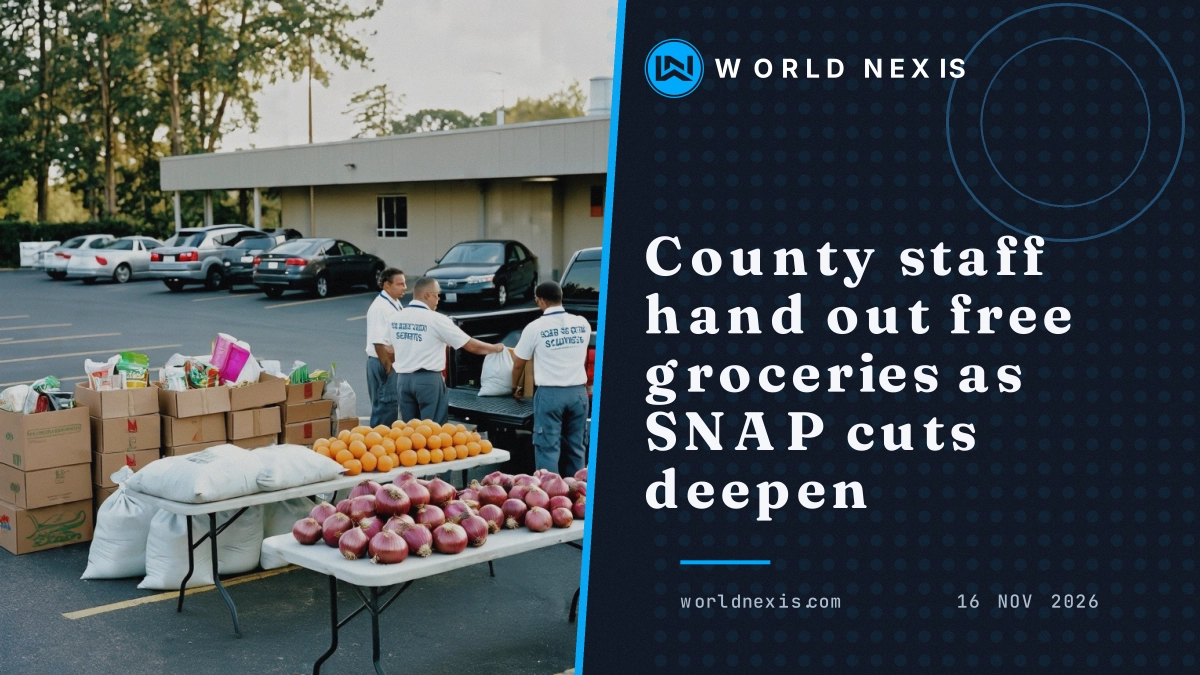
SNAP cuts have pushed a San Diego County social services office into an unusual second job: handing out free groceries. On a recent Saturday morning, county staff pushed carts of food across a parking lot in the Kearny Mesa neighborhood and loaded them into residents’ cars, NPR reported, as roughly five million Americans have lost federal food benefits nationwide.
Key points
- About five million people across the United States have lost federal food benefits since the One Big Beautiful Bill was signed into law in July 2025, according to NPR.
- San Diego County’s SNAP caseload fell by 36,000 between July 2025 and September.
- The county now works with local food banks to distribute free groceries from the same offices where residents apply for aid.
- New work requirements cover homeless people, former foster youth, veterans, parents of a child older than 14 and able-bodied adults aged 55 to 64.
How the SNAP cuts reached San Diego
Participation in the Supplemental Nutrition Assistance Program has plummeted over the past year. The One Big Beautiful Bill, a sweeping tax and spending law, slashed SNAP funding, tightened eligibility and barred food aid for most asylum seekers and refugees. NPR describes the drop as the fastest decline in decades, and says it has far exceeded the federal government’s own estimates of the impact.
The SNAP cuts were felt quickly in San Diego County. Officials recorded 36,000 fewer people on the county’s caseload this September than in July 2025, when the bill became law. In response, the county teamed up with local food banks to hand out groceries at its own social service offices.
Inside the office that became a San Diego food pantry
For Rosa Rodarte, a human services specialist for San Diego County, the distribution meant giving up a day off. She spent it pushing carts and loading sacks of red onions and oranges into trucks. Her official job is helping people apply for programs such as food assistance; lately, she has simply been helping people get food.
“We have the same goal,” Rodarte said. “We want to make sure everybody is being helped and not judged.”
Nina Olivas, who oversees San Diego’s Access Customer Service Call Center, said the strain is emotional as well as procedural. “The emotionally draining part is where you see someone that’s telling you on the phone that they need your help and they need it today, and when you can’t do something,” she told NPR.
Olivas said her staff work as frontline responders, meeting residents at the lowest points of their lives, whether that is a lost job or an illness. “You’re helping someone put food on the table. You’re helping someone pay rent. You’re helping someone buy diapers,” she said. She added that being unable to help can be really difficult.
County officials are clear that the distributions are not a long-term fix. They say they could not sit back while their neighbors went hungry as the SNAP cuts took hold.
New work requirements, heavier workloads
The law extended SNAP work requirements to groups that had previously been exempt, including homeless people, former foster youth, veterans, parents with a child older than 14 and able-bodied adults aged 55 to 64. Supporters argue the change restores the dignity of work. Agriculture Secretary Brooke Rollins and other Trump officials wrote in a New York Times op-ed last year that “for many, welfare is no longer a lifeline to self-sufficiency but a lifelong trap of dependency.”
On the ground, the new SNAP work requirements have mostly meant more paperwork to process, alongside heavier caseloads and financial pressure to avoid errors, according to NPR. Offices across the country have spent the past year absorbing new rules while watching participants lose benefits en masse.
Analysis
Accountability reporting has taught me to test a policy against the distance between what it promises and what its administrators can actually deliver, and San Diego is an unusually clear test case. In my view, the evidence there supports the argument that these SNAP cuts are biting faster and deeper than their authors predicted. A decline that outruns the federal government’s own estimates, plus one county shedding 36,000 participants in two months, is a signal rather than a rounding error.
The strongest counter-argument is not trivial: the USDA’s case that unconditional aid can entrench dependency, and that work requirements restore dignity, is a defensible position that many voters share. I would not dismiss it. Yet a work requirement is only as credible as the support behind it. County employees handing out onions and oranges on their days off is what a policy looks like when the transitional help never arrives.
I side with the county workers, because their evidence is concrete and their claim is modest: people are arriving hungry now, and the paperwork is not feeding them. The test for readers is not whether work requirements sound reasonable in a press release, but whether households pushed off the rolls in the first year can still eat.
What happens next
San Diego County intends to keep partnering with local food banks on grocery distributions at its social service offices, while staff continue processing documentation tied to the new work requirements. Officials have been explicit that the pantries are a stopgap, not a substitute for federal benefits.
Nationally, NPR reports that SNAP’s funding model is starting to change and has examined what that means for the program. The SNAP cuts remain in force, and the distribution lines in Kearny Mesa are continuing alongside the paperwork.
Related coverage
- AAA Thanksgiving travel dips to 81.5 million on record fuel
- L&G job cuts: 1,000 roles go in sweeping overhaul
- Carbon monoxide poisoning kills San Antonio dog groomer and puppy, 60
Sources
- Who’s duping whom? Cut-price versions of luxury items are Christmas hit (theguardian.com)
- They saw people losing food benefits. So they started handing out free groceries (npr.org)
- Live Updates: Iran says no U.N. inspections of damaged nuclear sites until war is (cbsnews.com)
- They saw people losing food benefits. So they started handing out free groceries (kuaf.com)
- They saw people losing food benefits. So they started handing out free groceries (kccu.org)
About the author: Ayesha Rahman is World Nexis News’s Senior Political Correspondent & Columnist, covering politics & opinion. The analysis section reflects the writer’s view.

Ayesha Rahman
Ayesha Rahman covers politics and opinion for World Nexis News from London, focusing on elections, legislatures and the policy choices that shape everyday life in the US and UK. She writes analysis and columns that separate what is confirmed from what is claimed, working from…



