Raskin Signal probe gains second front as FBI investigates NCIC hack
The Raskin Signal probe orders five agencies, including the FBI and DOJ, to preserve records amid warnings that official messages were deleted.
Updated 21 Nov 2026, 21:31 (UK time): President Trump went beyond his initial ‘not good’ reaction to the FBI’s NCIC hack, suggesting without evidence that the breach could expose material on the Russia investigation and his voter fraud claims.
President Donald Trump has gone further than his first reaction to the apparent hack of the FBI’s National Crime Information Center, telling an interviewer on Saturday that the intrusion could expose information about matters involving him, including the Russia investigation and his claims of voter fraud. He offered no evidence for either suggestion, and the bureau has not said what, if anything, was taken from the database used by local, state and federal police for warrants, missing persons, criminal histories and stolen property.
The FBI declined to comment on Saturday, and people briefed on the matter say the inquiry is open but the scope and impact remain undefined. The episode follows the September breach of the bureau’s job portal, which a criminal group tracked as ShinyHunters claimed credit for; there is still no indication the two are connected.
For the Raskin Signal probe, this shifts the argument onto new ground. The congressman’s letters to five agencies are about whether official messages can be made to disappear; the president is now speculating publicly about what a security failure might bring into the open. Neither answers whether any records have been destroyed, and none of the five agencies has publicly confirmed that messages are being frozen.
A president musing about what a breach might reveal is not the same as an agency accounting for what it holds. I would still rather hear from the bureau about its database than from the podium about its secrets.
Updated 21 Nov 2026, 19:51 (UK time): The FBI, one of the five agencies named in the Raskin Signal probe, is now investigating an apparent hack of its National Crime Information Center database, a breach President Trump called ‘not good’ in a Saturday interview.
The Raskin Signal probe has picked up an unexpected second front. The FBI, one of the five agencies Raskin asked to freeze messages held on encrypted apps, is investigating an apparent hack of the National Crime Information Center, the database federal, state and local police use to check warrants, missing persons, criminal histories, stolen property and gun background checks. A person familiar with the matter confirmed the inquiry; the bureau declined to comment on Saturday. Asked about the breach in a Fox News interview, President Donald Trump said he had “just heard” about it. “I will say that it’s not good. I don’t like that,” he said.
It is the second known intrusion at the bureau in months, after a September hack of its job portal that a criminal group tracked as ShinyHunters claimed credit for. The FBI has not said what, if anything, was taken from the crime database, and there is no indication the two episodes are connected.
Nothing in the new reporting answers Raskin’s letters. None of the five agencies has publicly confirmed that messages on private devices are being frozen, and no internal inquiry into deleted records has been announced. What the hack does change is the frame: an agency can lose its records to an intruder as easily as to an auto-delete setting, and the legal duty to preserve them does not bend either way.
The records fight was already about whether the paper trail survives the year. It now sits alongside a live security failure at the same institution that would normally police the destruction of evidence. I would watch whether the bureau’s answers on the breach arrive faster than its answers to the Judiciary Committee.
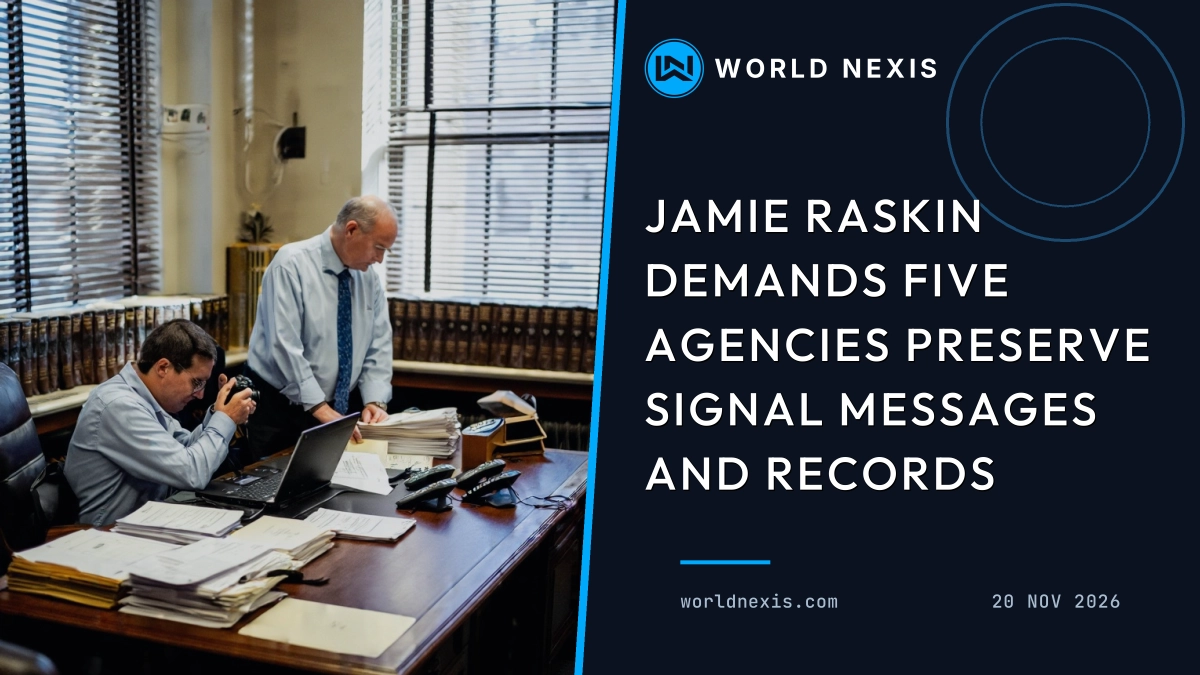
The Raskin Signal probe widened on Friday as the top Democrat on the House Judiciary Committee demanded that five federal agencies preserve messages sent on encrypted apps and investigate whether official records have already been deleted. Rep. Jamie Raskin of Maryland sent nearly identical letters to the FBI, the Justice Department, the Department of Homeland Security, the Bureau of Prisons and Immigration and Customs Enforcement. He is the committee’s ranking Democrat and its incoming chairman.
Key points
- Raskin says Trump administration officials may be dodging federal records law by using apps that can wipe messages automatically.
- The letters went to five agencies: the FBI, the Justice Department, Homeland Security, the Bureau of Prisons and ICE.
- He cites a Signal exchange between the FBI’s top lawyer and an associate of Donald Trump Jr. that discussed a possible healthcare fraud investigation.
- None of the five agencies has publicly commented on the letters.
What the Raskin Signal probe asks agencies to do
Each letter asks the agency to preserve communications created on nongovernment messaging apps and to establish whether records tied to official business have been destroyed. Raskin notes that the agencies are legally required to keep all records related to their official business, policies and decisions.
The Raskin Signal probe turns on a narrow legal point. Signal can be configured to delete messages automatically after a set time, which would place official conversations beyond the reach of federal preservation rules. In the letters, made public on Friday, Raskin argues that the problem goes well beyond careless use of a private app.
“There is significant evidence that Trump Administration officials have engaged in the widespread destruction, mutilation, and concealment of government records, seemingly with the express purpose of circumventing federal record preservation laws. This attempt to evade transparency extends to the highest levels of federal agencies, including top-ranking law enforcement officials.”
The demand lands on agencies that answer to the same Justice Department which would normally police the destruction of evidence. It also puts the White House under pressure to explain how senior staff are expected to work.
The exchange at the centre of the inquiry
At the centre of the Raskin Signal probe is a conversation the congressman says he obtained between the FBI’s top lawyer and an associate of Donald Trump Jr., the president’s oldest son. A potentially ongoing healthcare fraud investigation was discussed in that exchange.
Signal offers direct messages, group chats and phone and video calls, all protected by end-to-end encryption that prevents third parties from reading the content or listening in. That protection is a selling point for officials handling sensitive material, and a serious obstacle for anyone trying to reconstruct a decision months later.
Encrypted messaging apps have already caused disruption at the top of government. Journalist Jeffrey Goldberg revealed that he had been inadvertently added to a Signal group chat of US national security officials coordinating plans for airstrikes. The White House and the Pentagon have said that disgruntled former employees were spreading false claims.
Why it matters
Federal records are the raw material of oversight. They underpin freedom-of-information requests, congressional hearings, lawsuits against agencies and the historical account of what a government decided and why. When decisions are made on apps that erase themselves, that paper trail can vanish before anyone thinks to ask for it. For ordinary readers, the Raskin Signal probe is about something simple: whether a decision that affects you can be checked afterwards.
The effect reaches far beyond Washington. A defendant challenging a fraud investigation, a contractor disputing a payment or a family appealing a benefits decision all depend on records an agency is obliged to keep. For the FBI and the Justice Department the stakes are sharper still, because those are the institutions that prosecute others for destroying evidence.
Analysis
Having covered accountability and constitutional law for World Nexis News, I read the Raskin Signal probe as a records argument first and a political fight second. The legal ground is not exotic. Federal agencies have a duty to preserve records of official business, and an auto-delete setting on a private app does not suspend that duty for an hour, let alone a year.
I side with Raskin on the core point, because the harm is structural rather than personal. Even if every official using Signal had innocent motives, what matters is whether a record exists at all six months later, when a court, a journalist or a select committee comes looking. The strongest counter-argument is that encrypted apps protect genuinely sensitive operational material, and the White House and the Pentagon say critics are repeating claims from disgruntled former employees. That may explain individual cases, but it does not answer who decides what gets kept.
What the Raskin Signal probe can realistically prove is narrower than its rhetoric. Showing that messages were deleted is achievable. Showing that officials deleted them deliberately to defeat transparency law requires intent evidence that usually sits on the devices themselves. I expect the fight to move quickly from letters to compulsory process, and I would watch whether agencies quietly change their default settings before they are forced to explain them.
What happens next
The immediate test for the Raskin Signal probe is preservation. The five agencies must decide whether to confirm that messages held on private devices and accounts are being frozen, and whether to open internal inquiries into any deletions of official business records.
Raskin’s leverage changes when the new Congress organizes and he takes the Judiciary gavel, shifting him from written requests to the committee’s compulsory powers. If agencies refuse to confirm preservation, the dispute could end in a court fight over compliance with federal records law.
What we don’t know yet
Nobody has established publicly how many messages were deleted, which investigations they touched, or whether any official acted with the intent Raskin alleges. The status of the healthcare fraud inquiry discussed in the exchange is also unknown.
Because none of the five agencies has responded publicly, their own account of how staff use encrypted messaging apps is still missing.
Related coverage
- Pensions dashboard to launch summer 2027 for 75m records
- Trump crypto wealth nears $3bn as Democrats vow probes
- Rikers Island closure plan sets 2032 target and $146m boost
Further reading
- House Democrat investigates government agencies
- Trump administration use of encrypted messaging apps like Signal is scrutinized by House Democrat
About the author: Ayesha Rahman is the Senior Political Correspondent & Columnist at World Nexis News (WNN), covering politics & opinion. The analysis section reflects the writer’s view.

Ayesha Rahman
Ayesha Rahman covers politics and opinion for World Nexis News from London, focusing on elections, legislatures and the policy choices that shape everyday life in the US and UK. She writes analysis and columns that separate what is confirmed from what is claimed, working from…



