Jensen Huang: Nvidia board rules out return as revenue doubles
Trump says he would not mind a Jensen Huang reinstatement at Nvidia as his administration tightens chip export rules and his team splits on China.
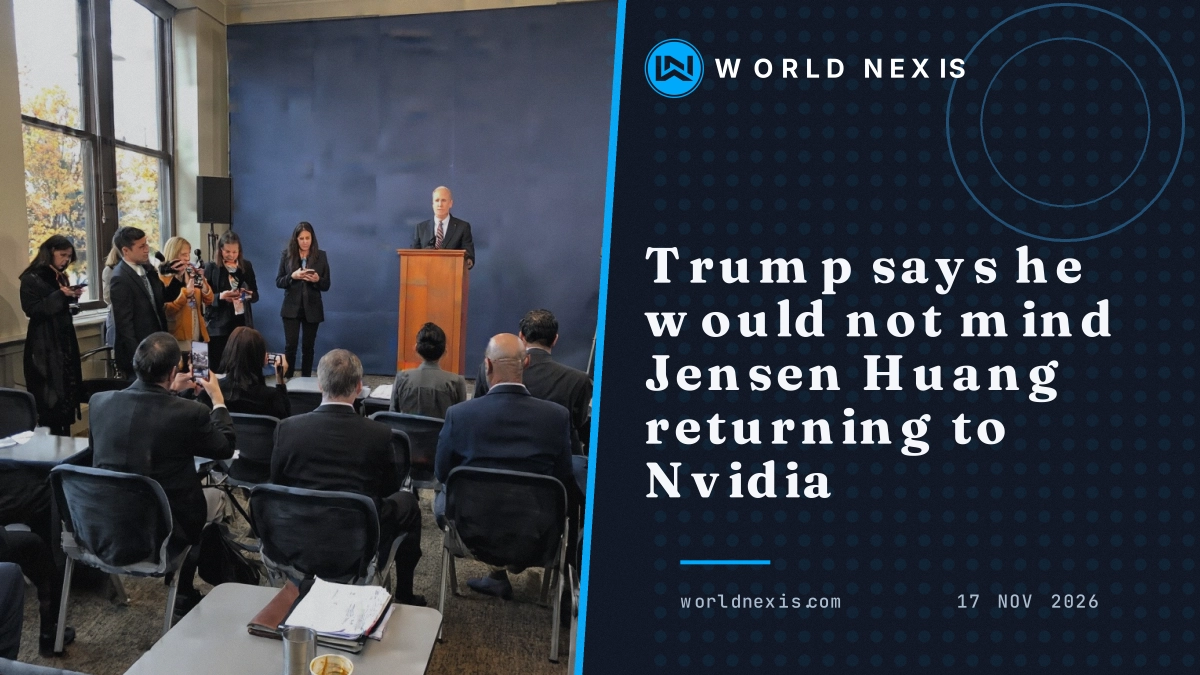
Updated 19 Nov 2026, 02:55 (UK time): Nvidia’s board chairman Harvey Jones publicly stated the company does not intend to reinstate Jensen Huang as CEO, made during its first earnings report since his ouster, which also showed revenue doubling.
Nvidia’s board has now said in public what it had only signalled in private: it does not intend to reinstate Jensen Huang as chief executive. Chairman Harvey Jones made the statement on Tuesday during the company’s first quarterly earnings report since Huang’s ouster, ending weeks of speculation that began when President Donald Trump said he “would certainly not mind” a comeback.
The same report showed the chipmaker roughly doubling revenue year on year and beating expectations. That gives the board cover it did not have a week ago, when more than 175,000 people had signed the “Stand with Jensen” letter demanding his return while an internal investigation continues.
The decision effectively closes the succession fight at the top of the company, though not the questions underneath it. The interim export licensing regime covering advanced chips sent to data centres in Singapore, Thailand, Malaysia, Indonesia and Brazil, and the dispute between Treasury and Commerce over shipments to Megaspeed, Alice Huang’s former employer, remain live regardless of who sits in the chief executive’s chair.
A board that had been silent in public has now attached its name to a refusal, and it chose a strong quarter to do it. That is sensible governance, but the timing invites the reading that the numbers, not the facts, settled the matter.
Jensen Huang’s future at Nvidia became a White House story on Monday, when President Donald Trump said he “would certainly not mind” seeing the company’s ousted co-founder reinstated as Nvidia CEO. The comments, made as Trump left Washington for a trip to Asia, put him at odds with senior figures in his own administration. They came on the same day that Washington announced fresh curbs on AI chip exports.
Jensen Huang co-founded Nvidia in 1993 and ran it for 33 years. He resigned last Thursday after a second extramarital relationship came to light, reportedly with a company executive who reported to him. The earlier affair involved Alice Huang, a former executive at the Singapore-based chip customer Megaspeed, whom US intelligence has reportedly described as a suspected Chinese asset. Beijing denies that, and Alice Huang is no relation to Jensen Huang.
Key points
- Trump told reporters Jensen Huang “could return”, adding that a “big group of people” want him back.
- Nvidia’s board is not interested in reinstating him, the BBC was told, and the Financial Times reported it is not considering a return.
- More than 175,000 people have signed an open letter urging the board to bring him back while an internal investigation runs.
- The US issued interim rules requiring export licenses for advanced chips sold to data centers in Singapore, Thailand, Malaysia, Indonesia and Brazil.
Trump puts his weight behind a Jensen Huang comeback
Speaking to reporters on Monday, the president described the former chief executive as chastened rather than disqualified. “I think he learned a big lesson,” Trump said. “He could return. There’s a big group of people that would like him to return.”
His support adds the White House to a pressure campaign that already includes Elon Musk and Epic Games chief executive Tim Sweeney. The “Stand with Jensen” letter, which organizers say was launched by current and former Nvidia employees, partners and shareholders, argues that the co-founder “was removed without meaningful due process”.
Trump also cast doubt on the espionage allegations at the heart of the story. Asked by ABC News whether he trusted US intelligence assessments, he replied: “I don’t know that she is a spy.” He went on: “Nobody’s proven that she is a spy. She may not be a spy.”
According to ABC News, Trump had been briefed twice in the past year on Jensen Huang’s relationship with Alice Huang, by intelligence officials and Secretary of State Marco Rubio. The BBC reported that Trump said he believed Huang when the former boss told him he had “no idea she was a spy”.
Chip export restrictions tighten the same day
The same day, the Commerce Department confirmed interim rules covering the most advanced AI chips and servers. Companies in Singapore, Thailand, Malaysia, Indonesia and Brazil must now apply for export licenses before supplying overseas data centers with the highest-end hardware.
The department said the measure would ensure existing restrictions “cannot be circumvented through remote computing arrangements involving data centers in third countries”. Officials fear Chinese firms have been renting foreign computing capacity to train models they could not otherwise build.
The announcement exposes a running argument between the Treasury and Commerce departments over shipments of high-end Nvidia chips to Megaspeed, Alice Huang’s former employer. Treasury Secretary Scott Bessent has called for the company to hire its next chief executive from outside.
Megaspeed said on Sunday that it is a “legitimate and lawful business” and that Alice Huang left the company in 2025.
Two camps, one boardroom
Jensen Huang spent years arguing that broad access to global markets keeps American chipmakers competitive. In 2025 he said the AI chip market in China would eventually be worth $50bn. That argument now sits awkwardly beside a national security scare involving people close to him.
The New York Times reported that the administration’s divide on China policy had broken into public view. Nvidia’s board has stayed quiet in public and firm in private. The BBC was told directors are not interested in a return, and the Financial Times reported the board is not considering reappointment.
Analysts are skeptical as well. Dan Ives of Yorkville Ives called the petition “noise and distraction” and said the best path was a new external chief executive or the permanent appointment of interim boss Colette Kress, Nvidia’s finance chief. “We see no chance Jensen comes back to Nvidia as CEO,” he added.
Analysis
Having covered accountability fights in Washington for WNN, I look first at who carries the risk when a president speaks freely during a live investigation. On the substance, I think the skeptics have the stronger case. Trump’s warmth toward Jensen Huang is a personal verdict, not a governance one. It answers neither question that matters to Nvidia’s board. Can an inquiry conclude cleanly with its subject back in the chair? Can a company selling advanced chips worldwide absorb an espionage question at the top?
If the board reversed course on a presidential hint, every future compliance decision would be read as political. Bessent’s call for an outside hire is the more defensible position, because it separates Nvidia from a scandal that touches export controls directly. The strongest counter-argument is the due process point. Huang was pushed out before the internal probe finished, and nobody has proven Alice Huang was a spy. Trump is right that suspicion is not proof.
Yet suspicion is enough to change policy, which is what makes this week so revealing. The interim licensing rules treat the Megaspeed question as real while the president says he cannot say whether the woman at its center was a spy. That contradiction is exactly the divide the New York Times detected. I side with the officials tightening the regime, and with the board members who want the facts settled before any comeback.
What happens next
Trump travels to Asia this week for a meeting with Xi Jinping, and the Nvidia affair will follow him there. Nvidia’s board must weigh the internal investigation against shareholder pressure over whether Jensen Huang should return, with Kress continuing as interim chief executive. Companies in the five named countries must apply for licenses before shipping the most advanced chips to overseas data centers.
Related coverage
- Nvidia scandal: Trump takes Asia summit stage as engineer quits over Huang
- Nvidia chip scandal: Trump faces calls to fire Lutnick
- Jensen Huang comeback: China confirms Xi-Trump-Putin summit for 19 November
Sources
- Nvidia dismisses campaign to bring back Jensen Huang as Trump backs effort (bbc.co.uk)
- Trump backs calls for reinstatement of Jensen Huang as Nvidia CEO (theguardian.com)
- Trump says he ‘would not mind’ if Jensen Huang is reinstated as Nvidia CEO (abcnews.com)
About the author: Ayesha Rahman is World Nexis News’s Senior Political Correspondent & Columnist, covering politics & opinion. The analysis section reflects the writer’s view.

Ayesha Rahman
Ayesha Rahman covers politics and opinion for World Nexis News from London, focusing on elections, legislatures and the policy choices that shape everyday life in the US and UK. She writes analysis and columns that separate what is confirmed from what is claimed, working from…



