Florida disaster declaration unlocks FEMA aid in 6 counties
Florida disaster declaration signed by Trump releases FEMA individual assistance to six counties, with more expected as damage assessments continue.
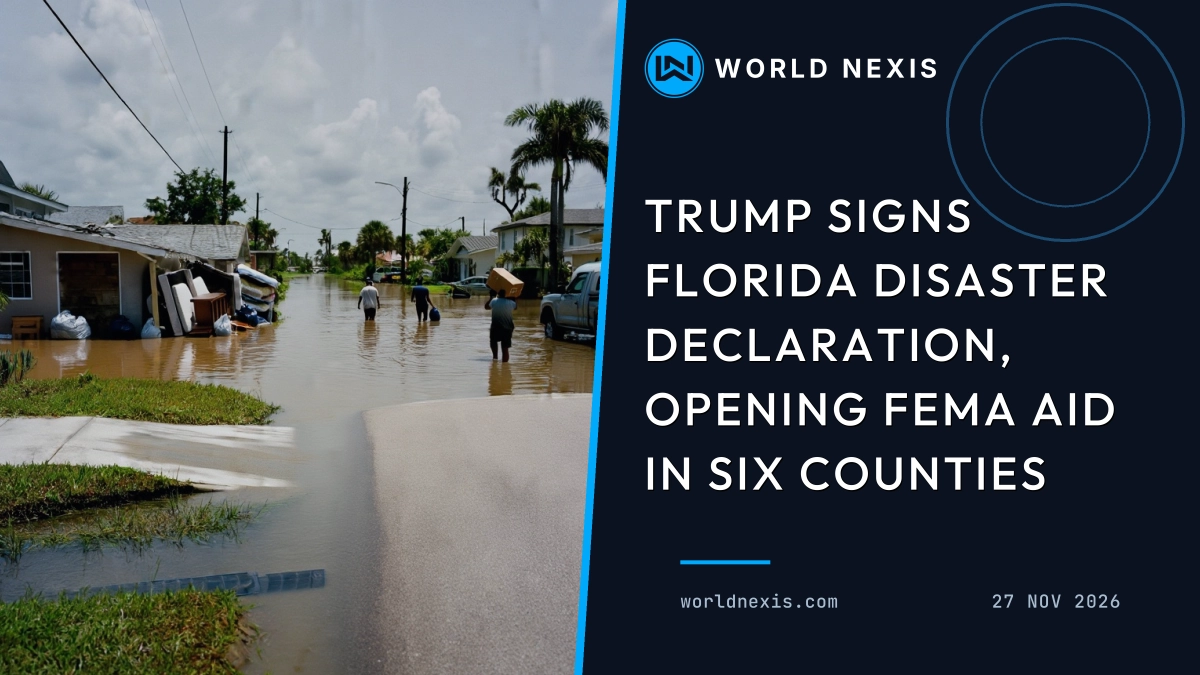
Federal money under the Florida disaster declaration is now flowing to storm-hit communities, after President Donald Trump signed a major declaration on Thanksgiving Day that unlocks FEMA relief for six counties. Households in those counties can apply for grants and low-cost loans immediately, while Governor Ron DeSantis presses for more of the state to be included.
Key points
- Trump signed the major declaration at his Palm Beach resort on Thanksgiving Day, releasing FEMA money for individuals and for public infrastructure.
- Households in Brevard, Indian River, Martin, Okeechobee, Palm Beach and St. Lucie counties qualify for individual help.
- Debris removal and emergency protective measures are funded on a cost-sharing basis across six counties, including Hardee.
- DeSantis has asked for Broward and Miami-Dade to be added as damage assessments continue.
What the Florida disaster declaration pays for
The FEMA individual assistance opened by the Florida disaster declaration covers grants for temporary housing, essential home repairs and other recovery needs for residents and households. It also makes low-cost loans available for uninsured property losses, aimed at homeowners, renters and business owners who lost belongings in the fall floods.
The declaration also authorizes federal funding on a cost-sharing basis for state, tribal and eligible local governments, plus some private nonprofits. That money supports debris removal and emergency protective measures in Brevard, Hardee, Indian River, Martin, Okeechobee and Palm Beach counties.
Brett H. Howard has been named federal coordinating officer for the recovery. FEMA says the list of designated counties is not final and can grow as joint preliminary damage assessments continue.
How residents apply
FEMA advises affected residents to file a claim with their insurer first, then apply for federal help. Applications can be made online at DisasterAssistance.gov, through the FEMA mobile app or by phone on 1-800-621-3362.
Six counties first, with more expected
The storms and flooding have run since Halloween, and Trump described the rainfall as relentless during the signing. “Since October it has been raining continuously. It’s the craziest thing. It stopped now,” he said, calling the flooding a “record setter” for the state.
He also left the door open to further action elsewhere. “I think Florida maybe got hit the worst,” Trump said, adding that his administration had received requests from other states after a Thanksgiving storm moved up the East Coast.
State and local leaders are already working the edges of the declaration. DeSantis has formally requested that Broward and Miami-Dade be added, while officials in flooded Central Florida counties such as Volusia, Seminole and Orange are urging residents to register with FEMA now so claims are on file if their areas qualify.
Money is moving at state level too. FloridaCommerce has activated the Florida Small Business Emergency Bridge Loan Program, making $10 million available to affected small businesses across 21 counties.
In Palm Beach County, local officials estimate about $53 million is needed to cover household losses and municipal cleanup. Representative Lois Frankel, who appeared alongside Trump at the signing, said the declaration was a lifeline for families who lost homes, vehicles and belongings days before the holiday.
Senator Rick Scott said Trump told him personally that approval was coming, and praised how quickly the federal government moved.
Why it matters
For a household inside one of the six counties, the Florida disaster declaration is the difference between an insurance shortfall and a dry place to sleep. Grant money can cover temporary housing and basic repairs, and the loan route exists for losses that insurers will not touch.
For the state, the declaration shifts part of the cleanup bill to Washington while local budgets are already stretched. It also sets the terms of the next fight over Florida flood relief: which counties get in, and how quickly.
Analysis
Having covered federal disaster response on this beat, I look first at the county map, because that is where the argument will be fought. The Florida disaster declaration is the right call and it came fast, but the boundary drawn this week follows verified damage assessments rather than the waterline. Residents in Seminole or Orange counties who watched their streets flood are not covered yet, and they are being asked to file paperwork on a promise that their county may join later.
In my view the stronger case sits with DeSantis and the local officials pushing to widen the declaration. The evidence is straightforward: one storm system produced the same flooding across county lines, and Palm Beach County’s own $53 million estimate shows how far household need outruns what insurance covers. The counter-argument is serious, since FEMA cannot wave counties through without verified damage data, and loosening that rule would weaken the program for everyone. But the speed of verification is a choice, not a law of nature.
I would watch the politics as closely as the paperwork. Trump signed this at his own club in the state he now calls home, with a Democratic congresswoman at his side, and both sides will claim credit. What matters for readers is not the photograph but the second and third county lists.
What happens next
Under the Florida disaster declaration, joint preliminary damage assessments continue in counties that were not designated this week, and FEMA has said the list can be amended. DeSantis’s request to add Broward and Miami-Dade is the next decision point, and no deadline for it has been published.
Residents in the six designated counties can apply now, and officials in Central Florida counties are telling households elsewhere to pre-register so their claims are ready. The state’s $10 million emergency bridge loan program is already open to small businesses in 21 counties.
Trump said his administration had requests from other states after the East Coast storm, which means more declarations may follow. He gave no timetable.
What we don’t know yet
Three questions remain open: the final list of designated counties, the total federal bill, and whether the Thanksgiving storm produces declarations in other states. FEMA has not said when the next counties will be added.
Related coverage
- Democratic majorities vow major corruption crackdown
- Thanksgiving storm knocks out power to 900,000 on East Coast
- Trump Putin talks: he urges major pull-back in Europe
Further reading
- Trump signs major disaster declaration for Florida flooding, unlocking FEMA relief funds
- Trump signs major disaster declaration for Florida flooding, unlocking FEMA relief funds
About the author: Ayesha Rahman is the Senior Political Correspondent & Columnist at World Nexis News (WNN), covering politics & opinion. The analysis section reflects the writer’s view.

Ayesha Rahman
Ayesha Rahman covers politics and opinion for World Nexis News from London, focusing on elections, legislatures and the policy choices that shape everyday life in the US and UK. She writes analysis and columns that separate what is confirmed from what is claimed, working from…



