Tommy Robinson appeal: new charge over phone PIN after Russia trip
Tommy Robinson appeal: he has filed a bid at the Court of Appeal to challenge his harassment conviction, with sentencing due on 16 December.
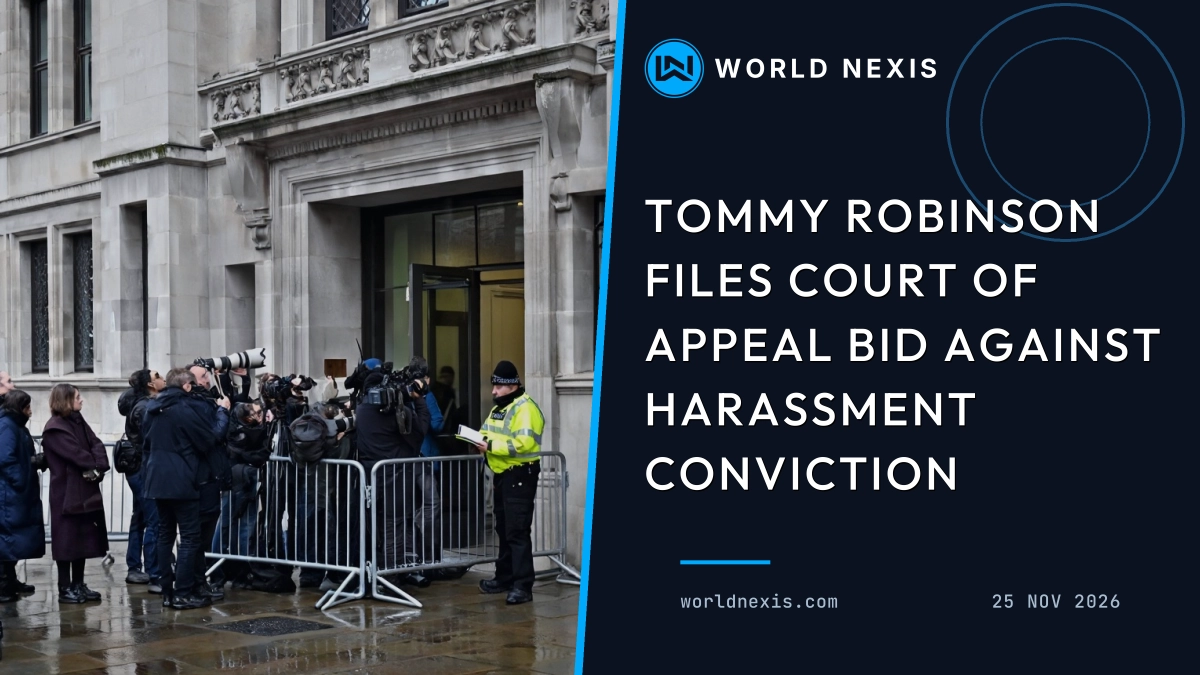
Updated 26 Nov 2026, 16:46 (UK time): The Metropolitan Police have charged Tommy Robinson with wilfully failing to comply with a duty under counter-terrorism legislation after he refused to hand over his phone PIN when detained at Heathrow on 13 June, with a Westminster Magistrates’ Court date of 14 December now sitting two days before his harassment sentencing.
Tommy Robinson now faces a second criminal case while he waits to learn the outcome of his sentencing and his Tommy Robinson appeal. The Metropolitan Police said he has been charged via postal requisition with wilfully failing to comply with a duty imposed by counter-terrorism legislation, after he was detained at London’s Heathrow Airport on 13 June on his return to the UK from Russia via Turkey. He is due to appear at Westminster Magistrates’ Court on 14 December.
The charge adds a fresh court date in the same week that the 43-year-old, who has given his name in court as Stephen Lennon, is listed for sentencing at Southwark Crown Court on 16 December over two counts of harassment causing fear of violence against two journalists. Each of those counts carries a maximum of up to 10 years. No decision has yet been made on whether his challenge to that conviction at the Court of Appeal can proceed.
In a post on X after being charged, Robinson said he refused the PIN because it held private messages from grooming gang survivors, and described himself as a journalist. That explanation is his account alone; police have set out only the alleged failure to comply, and the case has not been tested in court.
Two hearings in one week changes the shape of this story. Whatever a judge decides about the harassment sentence, the magistrates’ case will keep him in the news cycle and complicate any argument that his legal troubles are nearly over.
A Tommy Robinson appeal bid has been lodged at the Court of Appeal, court staff confirmed on Wednesday. The man convicted of harassing two journalists now waits to be sentenced. Robinson, whose trial name is Stephen Lennon, was found guilty at Southwark Crown Court in October of two counts of harassment causing fear of violence. He is due to be sentenced on 16 December, with the offence carrying a maximum of up to 10 years in prison.
Key points
- Robinson has filed a bid to challenge his conviction at the Court of Appeal, court staff confirmed on Wednesday.
- A jury convicted him in October of two counts of harassment causing fear of violence against two journalists.
- Sentencing is listed for 16 December, with a maximum of up to 10 years available to the judge.
- No decision has been made on whether the challenge can go ahead, and he remains on bail.
Inside the case that led to the Tommy Robinson appeal
Prosecutors told the trial that Robinson acted as a “bully” who sought to “intimidate” freelance reporter Andrew Young and Daily Mail editor Jacob Dirnhuber in August 2024. Jurors heard the two men felt forced either to leave their homes or to employ extra security, because they feared a “vigilante” attack.
The Tommy Robinson appeal follows a trial that centred on his response to coverage of unrest across the UK. The court was told he “retaliated” after the Daily Mail and its sister title MailOnline published a story about him “stoking riots from his sunbed”. That article ran after the murders of three girls in Southport.
Robinson had been posting about the disorder on social media while on holiday in Cyprus. The newspaper then sent Mr Young and a photographer to the island.
Addresses, photographs and a menacing phone call
After the article appeared, Robinson used his X account to criticise Mr Young and Mr Dirnhuber over their involvement in it. He went on to hire private investigators to find the home addresses of both men, and of the Daily Mail’s editor-in-chief, Ted Verity.
Prosecutors said he posted a photograph of Mr Dirnhuber outside his home, along with cropped images of Mr Young’s family. He also sent direct messages to Mr Dirnhuber and became “increasingly menacing” on a call with Mr Young on 5 August 2024, telling the freelance journalist: “I’m coming to get you.”
Robinson denied the charges. He told jurors the Daily Mail had put his family in danger by publishing its story, and after the verdicts he described them as “insane”.
What the Tommy Robinson appeal means for the December sentencing
Court staff confirmed the Tommy Robinson appeal filing on Wednesday. No decision has been made on whether the bid can go ahead, and the conviction stands unless the Court of Appeal quashes it.
He remains due to be sentenced at Southwark Crown Court on 16 December. The two counts each carry a maximum of up to 10 years in prison, and he is on bail until the hearing.
Robinson has previously thanked Tesla owner Elon Musk for funding his legal fees. It is unclear whether Mr Musk is paying for the new Court of Appeal bid.
Why it matters
The Tommy Robinson appeal turns on something small and serious: what a reporter’s home address is worth once a story goes live. Jurors heard that two journalists changed how they lived, or paid for protection, because they feared an attack.
For ordinary readers, the case tests how far a large online following can be turned on private individuals. Courts will have to weigh loud criticism against conduct that makes people fear for their own safety.
Analysis
Having spent two years covering court filings and breaking crime for World Nexis News, I look first at the timing. The Tommy Robinson appeal was lodged with sentencing now three weeks away, which keeps the case in public view while a judge still has to fix a term that could run to 10 years. That is a legitimate move, but it is a request, not a ruling.
On the evidence aired in open court, I think the journalists’ account is the stronger one. Prosecutors set out a sequence: home addresses hunted down, photographs posted, a phone call in which a reporter was told “I’m coming to get you”. A jury accepted that case on both counts. Robinson’s grievance about the newspaper story explains his anger; it does not answer the charge of making two men fear for their safety.
The best counter-argument is that harassment law can be stretched, and that the posts of a provocative public figure are not the same as sending a mob to a doorstep. That argument deserves to be tested. Even so, the appeal will be decided on the trial record, not on whether people dislike the man.
What happens next
Robinson is due back at Southwark Crown Court on 16 December for sentencing, where the two counts carry a maximum of up to 10 years. Court officials must first decide whether the Tommy Robinson appeal can proceed; if it can, a hearing at the Court of Appeal would follow.
What we don’t know yet
It is not yet known whether the challenge will be allowed through, or what grounds Robinson is relying on. Nor is it clear whether Elon Musk is funding this bid, after Robinson previously thanked him for covering legal fees.
Related coverage
- Lambhill shooting: £20,000 reward in urgent appeal
- Nidal Hasan execution: 3 survivors lose final witness bid
- Huawei conviction: tech giant guilty on 10 of 12 counts
Further reading
- Tommy Robinson seeking to challenge conviction for harassing journalists
- Tommy Robinson seeking to challenge conviction for harassing journalists
About the author: Tariq Al-Mansoori is the Breaking News Reporter at World Nexis News (WNN), covering breaking news. The analysis section reflects the writer’s view.

Tariq Al-Mansoori
Tariq Al-Mansoori is a Breaking News Reporter at World Nexis News, covering major incidents, official statements and developing stories across the UK, US and internationally. Based in London, he works to confirm details before publication, attributes information to named sources where possible and updates stories…



