Huawei conviction: tech giant guilty on 10 of 12 counts
A US jury has returned a Huawei conviction on 10 of 12 counts, including trade secret theft and bank fraud, but cleared the firm of racketeering.
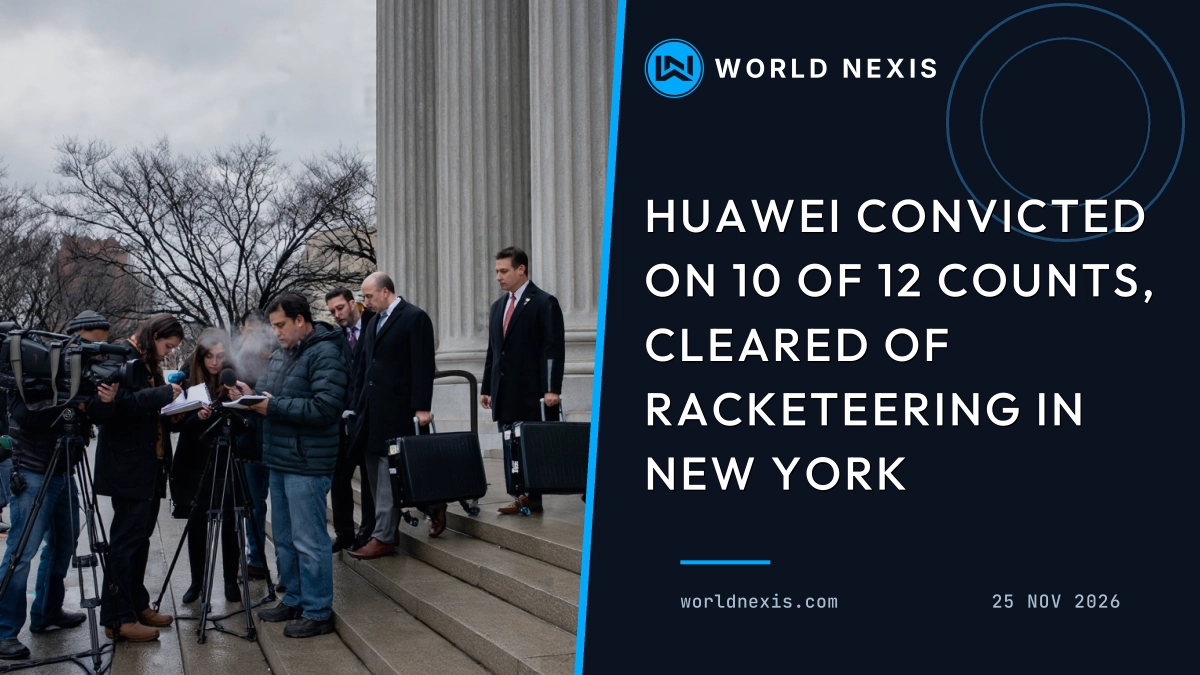
Updated 25 Nov 2026, 13:36 (UK time): Court records in the Huawei conviction now name the companies behind the trade-secret counts — Cisco, Motorola Solutions, T-Mobile, Quintel USA and Fujitsu — and China’s foreign ministry has issued a formal response, while the FBI’s New York field office said the verdict showed Huawei’s success was built on deception and theft.
Court records behind the Huawei conviction now name the companies at the centre of the trade-secret counts: Cisco Systems, Motorola Solutions, T-Mobile, Quintel USA and Fujitsu. The material at issue runs from router source code to antenna designs and robotic testing equipment, and the list is broader than the single copied-code episode and the Chicago trade-show booth described at trial.
Beijing has also responded formally. China’s foreign ministry said it “firmly opposes the US suppression and containment of Chinese companies” and supports Chinese firms in safeguarding their legitimate rights and interests. In New York, the FBI’s assistant director in charge, James Barnacle, said the verdict made clear that fraud, sanctions evasion and the theft of intellectual property “are not business strategies, they are serious crimes”, adding that Huawei’s success was built on deception and theft.
Nothing here moves the calendar. Sentencing in the Huawei conviction remains fixed for September 14, 2027, and Huawei says it will appeal, insisting the remaining counts are without legal or factual merit. What has changed is the level of detail around the theft pillar rather than the verdict itself.
Naming Motorola and Fujitsu does make it harder for Huawei to wave the trade-secret counts away as a paperwork quarrel between rivals. The honest caveat is that these were conspiracy charges, and a named company in a court record is not the same as a proven loss — which is exactly the ground Huawei’s appeal will test.
Updated 25 Nov 2026, 03:11 (UK time): Sentencing in the Huawei conviction is now fixed for September 14, 2027, and the jury convicted three of the company’s subsidiaries alongside the parent firm, with Huawei calling the remaining counts baseless and promising legal action.
Sentencing in the Huawei conviction is now set for September 14, 2027, according to the US Justice Department. The court will use that hearing to fix fines, forfeiture and restitution against a company that has already said it will appeal.
The verdict also reached wider than first reported: the jury convicted Huawei together with three of its subsidiaries, on counts that include bank fraud, conspiracy to violate US sanctions and conspiracy to steal trade secrets. Huawei had framed the trial as a case against the parent company alone.
Huawei responded formally on Wednesday, saying the remaining counts are “without legal or factual merit” and that it would review the verdicts and take “all necessary legal actions to defend our rights and interests.” It again described the racketeering acquittal as confirmation that the broader allegations lacked a factual basis.
For me the subsidiaries detail matters more than the calendar. It widens who carries the criminal record into future contract fights. A date two years out also gives Huawei plenty of room to ask customers and governments for patience while the appeal takes shape.
A Huawei conviction in a Brooklyn federal court on Tuesday found the company guilty of conspiracy to steal trade secrets and bank fraud. The verdict ends a trial that opened in September and leaves the firm exposed to billions of dollars in penalties. Jurors convicted Huawei Technologies on 10 of 12 counts, but cleared it of the most serious charge it faced: a criminal racketeering conspiracy.
The case was announced in early 2019 and later expanded. No individual was charged, so the company alone stood trial. Huawei, one of the world’s biggest suppliers of wireless network equipment, denied every count.
Key points
- Huawei was convicted on 10 of 12 counts, including conspiracy to steal trade secrets and bank fraud.
- Jurors acquitted the company of criminal racketeering conspiracy and of conspiracy to obstruct justice.
- The company alone stood trial and could be ordered to pay billions of dollars at sentencing next September.
- Huawei says it will appeal, and its lawyer called the acquittals a vindication of its compliance culture.
Inside the Huawei conviction in Brooklyn
Prosecutors built the case on two pillars: sanctions and technology theft. The first involved countries subject to US restrictions, including Iran and North Korea. Huawei was accused of hiding that business from banks and US officials, which produced the bank fraud counts.
The second pillar was technology theft. The indictment described a long pattern of stealing secrets from competitors and partners. That allegation sat at the heart of the Huawei trade secrets case, and it accounted for most of the counts behind Tuesday’s Huawei conviction.
The racketeering charge went further. Usually reserved for organized crime and drug networks, it accused Huawei of acting as an illicit enterprise from the top down. Jurors rejected that framing, and also acquitted the company of conspiracy to obstruct justice.
Allegations: copied code and a Chicago trade show
Prosecutors said Huawei once sold internet routers containing source code copied from a competitor. In one episode described in the indictment, a person working for Huawei slipped into a rival’s booth at a trade show in Chicago. The aim was to photograph the circuits inside another company’s networking device.
Huawei’s lawyers said federal investigators stitched together isolated episodes of wrongdoing by a few of its more than 200,000 employees. They argued the government spun those episodes into a grand conspiracy that never existed. The company says the real Huawei is successful, innovative and hardworking.
Reaction to the Huawei conviction
Brooklyn US Attorney Joseph Nocella Jr. said the convictions reflected a long record of harm. “Few crimes are as serious as Huawei’s decades-long pattern of endangering U.S. national security, violating the sanctity of U.S. commerce, and impeding the enforcement of U.S. laws,” he said in a statement.
Attorney General Todd Blanche added: “No person or company is above the law.”
Outside the courthouse, Huawei lawyer Brian Heberlig called the acquittals “a vindication of the company and its good-faith compliance culture”. He said the Huawei racketeering verdict was a “profound rejection” of the government’s portrait of a business corrupt from top to bottom.
Heberlig added: “The allegations that the government made in this case overreached and simply weren’t consistent with the successful, innovative and hardworking company that we came to know and deeply respect.”
Huawei said it “has always adhered to integrity in business” and respected intellectual property. “We remain focused on serving our customers and partners and ensuring continuous and stable business operations,” the company said. Chinese officials have called the US case “economic bullying” and accused Washington of using national security as a pretext.
Why it matters
For most people, the Huawei conviction will not change a phone or a broadband contract overnight. Huawei has been barred from selling equipment to US carriers for years over security concerns. Canada and Britain have blacklisted it too, yet its smartphones and telecom gear still sell widely elsewhere.
The commercial stakes sit in chips. Huawei has pushed into chipmaking as the artificial intelligence boom drives demand for microprocessors. It has become an important domestic alternative in China to Nvidia.
A criminal record, even one under appeal, gives US officials a fresh argument when they press allies to keep Huawei out of networks and supply chains. For regulators weighing that equipment, the verdict adds a jury finding to a debate that has largely turned on security assessments.
Analysis
I have covered technology policy for four years at World Nexis News, and that shapes how I read a verdict like this. Ten of 12 counts means jurors accepted documented episodes — copied source code, photographed circuits, false statements to banks. They did not accept a general unease about Chinese technology.
I side with the prosecution on those counts, and with Brian Heberlig on racketeering. Charging a company as a criminal enterprise with no individual in the dock was the weakest part of the case. The acquittal shows jurors drew a line between sharp practice and organized corruption, undercutting the rotten-from-the-top framing behind much Western policy.
The strongest counter-argument is that a fine, however large, is easy for a company this size to absorb. That is fair. Still, if the penalty lands at the scale prosecutors want, compliance costs rise for every Chinese supplier, not just this one.
What happens next
After the Huawei conviction, sentencing is set for next September. The judge will then decide the scale of the penalty, which could run into billions of dollars. Huawei has said it will appeal the verdicts.
What we don’t know yet
The size of the fine is unresolved. So is the question of whether an appeal succeeds on any count. It is also unclear whether allied governments will use the Huawei conviction to tighten restrictions on the company’s gear or its chips.
Related coverage
- Kalshi Utah charges: state drops 14 felony counts as Kalshi exits
- Ian Huntley murder: Anthony Russell pleads guilty to Frankland killing
- Tech outages: US spy chief warns of more after 4-hour halt
Further reading
- Chinese tech giant Huawei is guilty of conspiracy to steal trade secrets, US jury finds
- Chinese tech giant Huawei is guilty of conspiracy to steal trade secrets, US jury finds
About the author: Priya Nair is the Technology Correspondent at World Nexis News (WNN), covering technology. The analysis section reflects the writer’s view.

Priya Nair
Priya Nair is Technology Correspondent at World Nexis News, covering artificial intelligence, cybersecurity, consumer devices and the companies building them. Based in London, she explains how new technology works, who it affects and what the evidence actually shows, with attention to privacy, competition and the…