Jeffries speaker nomination sealed as Democrats fill out leadership slate
House Democrats sealed the Jeffries speaker nomination 251-11, with the full House vote set for 3 January and eleven progressives dissenting.
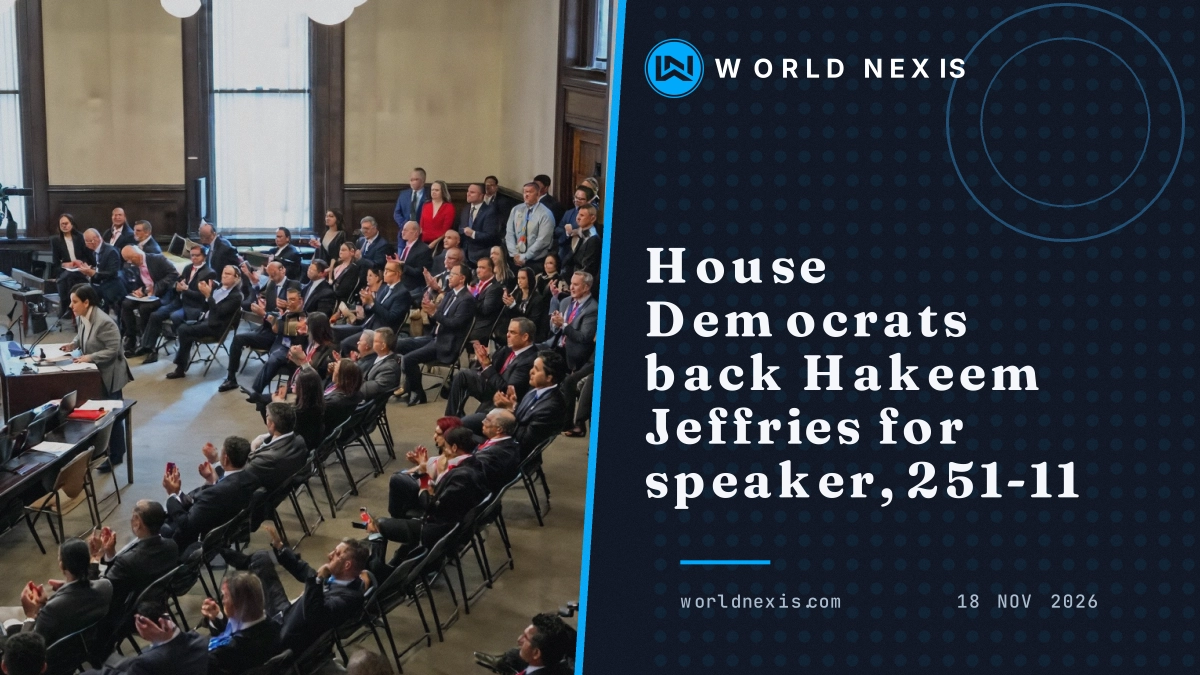
Updated 19 Nov 2026, 19:07 (UK time): Hours after the 251-11 Jeffries speaker nomination, Barack Obama addressed House Democrats-elect behind closed doors, urging them to value ideological diversity and listen to colleagues they disagree with, while incoming majority leader Katherine Clark made her own pitch for party unity.
Barack Obama met House Democrats-elect behind closed doors at the Folger Shakespeare Library on Wednesday afternoon, hours after the Jeffries speaker nomination was confirmed by 251 votes to 11, and used the session to press the incoming class to treat its ideological range as an asset. In excerpts of his remarks released by his office, the former president said the diversity of the class is its power, naming regional and ideological difference alongside race and religion, and told members that if they extend grace to colleagues they do not agree with 100 per cent of the time they will still find agreement on core values and basic direction.
He also warned against the pull of national politics, cable bookings and social media at the expense of individual constituents, arguing that people’s cynicism comes from feeling unseen by the forces that control their lives. The message was delivered to the same room that had just cast eleven votes against Hakeem Jeffries, and Rep.-elect Don Leonard of Ohio has now confirmed publicly that he was among those who did not back the nominee.
Incoming majority leader Katherine Clark has likewise stressed Democratic unity as the party prepares to take control of the chamber, framing the agenda around cohesion rather than the disputes that surfaced in the caucus ballot. Nothing in the arithmetic has moved: the floor vote remains 3 January, and the majority is well past 218.
What has changed is the tone of the management operation around the Jeffries speaker nomination. A former president telling freshmen to argue with grace is a message, not a concession, and the eleven still have no commitment on the votes they asked for. I read this as the leadership buying quiet rather than settling the argument.
Updated 19 Nov 2026, 02:36 (UK time): House Democrats formally elected the rest of their leadership team — Katherine Clark as majority leader, Pete Aguilar as whip and Joe Neguse as assistant speaker — completing the slate around Hakeem Jeffries ahead of the 3 January floor vote.
House Democrats have formally elected the rest of the team that will serve alongside Hakeem Jeffries, confirming Katherine Clark of Massachusetts as majority leader, Pete Aguilar of California as whip and Joe Neguse of Colorado as assistant speaker. Until the caucus voted, those posts were intentions rather than results; the Jeffries speaker nomination at the top of the ticket was settled on Wednesday by 251 votes to 11.
Nothing in the arithmetic has shifted. Democrats will hold at least 257 seats when the new Congress convenes, well past the 218 needed, and the decisive moment remains the floor vote on 3 January rather than any closed-door ballot this week.
The slate matters for what comes after the gavel changes hands. Jeffries now has a full bench to negotiate with the eleven members who withheld support over Israel policy and corporate PAC money, and to manage the oversight fights Democrats are preparing once they take control of the chamber’s investigative powers.
I still read the dissent as a symptom rather than a threat, because a majority this size does not require bargaining. What the leadership results show is a party quietly assembling its machinery while the argument about direction stays unresolved.
House Democrats confirmed the Jeffries speaker nomination on Wednesday, backing Hakeem Jeffries by 251 votes to 11 in a closed-door caucus ballot. The result puts him on course to become the first Black Speaker of the House. The New York Democrat ran unopposed, and the full chamber votes on 3 January, when the new Congress convenes and Democrats take control.
Democrats will hold at least 257 House seats next year, with seven races still uncalled, the BBC reported. That margin makes the House speaker vote on 3 January all but decided.
Key points
- House Democrats nominated Hakeem Jeffries for Speaker by 251 votes to 11 in a secret ballot on Wednesday.
- The Jeffries speaker nomination went through with no rival on the ballot.
- Democrats are on course for at least 257 seats, comfortably past the 218 needed to elect a Speaker.
- Eleven progressives withheld support over Israel policy and corporate PAC ties.
Why the Jeffries speaker nomination was never in doubt
Jeffries has led House Democrats since 2023 and drew no challenger this week, according to NPR. He asked colleagues for a tallied vote rather than a voice vote, citing the party’s 2018 leadership elections as the model.
“Certainly seems to me it would be appropriate that we take exactly the same approach to give every single person the opportunity to weigh in one way or the other on who the caucus feels is best positioned based on track record, experience, vision,” Jeffries told reporters on Tuesday, CBS News reported.
The rest of the House Democratic leadership fell into place quickly. Katherine Clark of Massachusetts is running for majority leader, Pete Aguilar of California for whip and Joe Neguse of Colorado for assistant speaker, CBS News reported. Ted Lieu of California won the vote for caucus chair.
Republicans made their own choices. House Republicans picked Jim Jordan of Ohio as minority leader, while Senate Republicans tapped South Dakota’s John Thune for a second term as party leader, NPR reported.
The size of the Democratic majority is the decisive detail for the Jeffries speaker nomination. At least 257 seats and seven outstanding races leave him well clear of the 218 votes he needs on the floor. The Speaker sits second in the line of succession to the presidency, after the vice-president.
Eleven dissenters test the party’s left flank
The Jeffries speaker nomination still drew eleven votes against, reflecting resistance from the party’s left-most flank. Critics argue Democrats should press a more progressive agenda now that they hold power. They point to his support for Israel and his ties to corporate political action committees, which they say reflect establishment priorities.
Some incoming members wanted commitments first. Rep.-elect Don Leonard of Ohio, who flipped a district Trump carried in 2024, told local media he would be “shopping for a new leader” if Jeffries did not change his position on Israel, Fox News Digital reported. Rep.-elect Adam Hamawy of New Jersey, a new progressive caucus member, declined to comment when asked how he voted.
Others brushed the split aside. “It was a blowout number,” Representative Bennie Thompson of Mississippi told Fox News Digital after the result, as the committee room reportedly erupted in cheers. Former Speaker Nancy Pelosi publicly backed Jeffries’ bid.
The left’s demands are specific. Members want votes on Medicare for All and on legislation that would stop the transfer of offensive weapons to Israel, NPR reported. Headline reports on Wednesday also said Bernie Sanders had unveiled his plan to push Medicare for All.
Senate leadership fight casts a longer shadow
The Jeffries speaker nomination was confirmed on the same day the last Senate race of the midterms was called. Sky News reported that Democrat Mary Peltola had defeated incumbent Republican Dan Sullivan in Alaska, completing the party’s sweep of the chamber’s contests.
Divisions look sharper in the Senate. Minority Leader Chuck Schumer faces a challenge from Chris Van Hollen of Maryland, who announced last week and is pitching himself as an alternative to the status quo. Van Hollen has backed Jeffries for Speaker, according to Fox News.
Schumer, the party’s Senate leader for nearly a decade, says he has the votes to become majority leader. A handful of current and incoming members have declined to back him, NPR reported. Leadership elections are set for early December.
Analysis
Having covered election data and accountability for five years at WNN, I look first at the arithmetic, because it explains almost everything about Wednesday. A leader with at least 257 seats behind him does not have to bargain with eleven dissenters, and the eleven know it. The Jeffries speaker nomination says far more about the size of the Democratic majority than about the strength of the left.
So I side with Jeffries’ camp, and with Bennie Thompson’s “blowout” reading. The progressive case for extracting concessions early is a serious theory of leverage, but it only works when the margin is thin. That was the Republican experience four years ago, when a handful of holdouts forced round after round of ballots before the party settled on a Speaker. The strongest counter-argument is that eleven votes, plus reports of congressional offices being inundated with calls from frustrated voters, signal grassroots distrust that will not fade once the gavel changes hands.
My eye is on the Senate now. If Schumer holds on in early December, both chambers will be led by two of the party’s most established figures, and the left’s energy will have nowhere to go but public pressure. I think that means loud hearings and slow legislating.
What happens next
The Jeffries speaker nomination goes to the floor on 3 January, when the new Congress begins and the whole House elects a Speaker. Jeffries is widely expected to clear the 218-vote threshold.
Senate Democrats settle their leadership question in early December, with Schumer and Van Hollen both working to lock down support. Once in the majority, Jeffries is expected to use the gavel for investigations and legislative oversight of President Donald Trump’s policies, Fox News Digital reported.
Related coverage
- FDA nominee Heidi Overton dropped one day before major vote
- Trump Xi Putin summit: historic three-way talks in China
- Two-tier policing: Mahmood sets out impartiality crackdown
Sources
- Hakeem Jeffries nominated to be US Speaker of the House (bbc.co.uk)
- Democrats formally nominate Hakeem Jeffries for speaker of the House (npr.org)
- Jeffries wins Democratic nomination for House speaker, paving way for historic election (cbsnews.com)
- Jeffries survives Dem vote to secure speaker position as progressive resistance clouds his chances (foxnews.com)
About the author: Ayesha Rahman is World Nexis News’s Senior Political Correspondent & Columnist, covering politics & opinion. The analysis section reflects the writer’s view.

Ayesha Rahman
Ayesha Rahman covers politics and opinion for World Nexis News from London, focusing on elections, legislatures and the policy choices that shape everyday life in the US and UK. She writes analysis and columns that separate what is confirmed from what is claimed, working from…