Two-tier policing: Mahmood sets out impartiality crackdown
Shabana Mahmood will tell police chiefs that a new impartiality standard is needed to tackle the corrosive perception of two-tier policing in the UK.
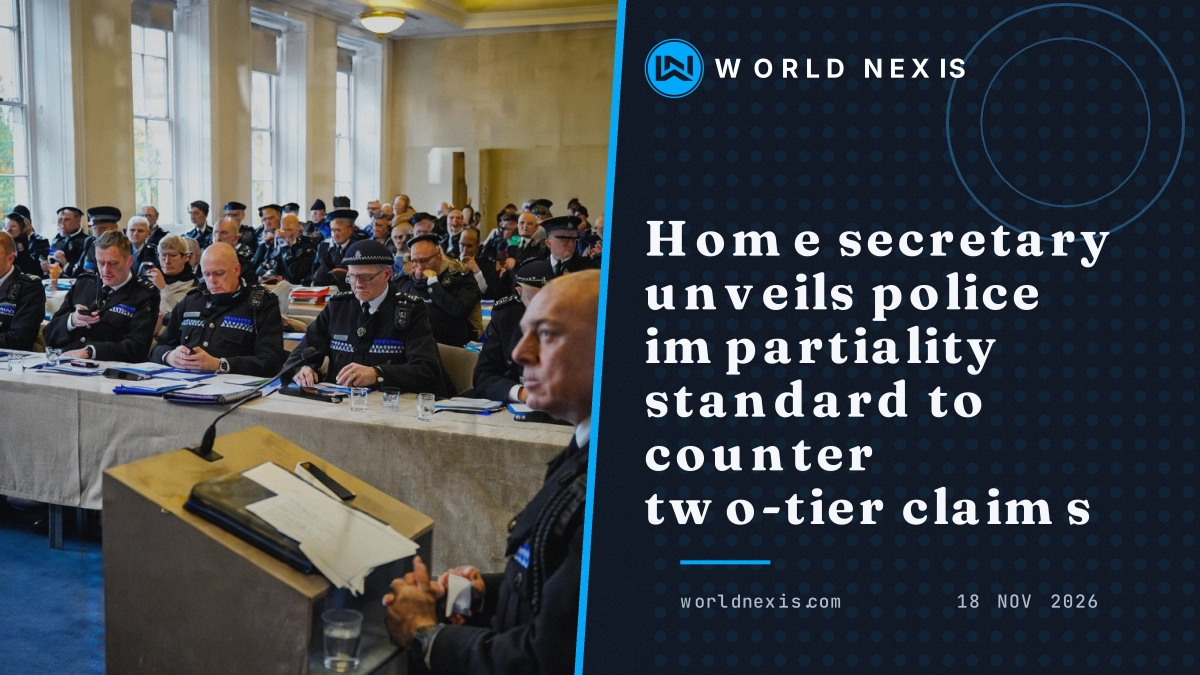
The “corrosive and growing perception of two-tier policing” will be confronted head-on by the home secretary on Wednesday, when Shabana Mahmood tells police chiefs that a new impartiality standard is being drawn up to guarantee equal treatment. Addressing the National Police Chiefs’ Council, she will argue that “misguided attempts at course correction” have produced “differential treatment” and handed “motivated actors” the material to claim the law is applied unevenly.
Key points
- Shabana Mahmood speaks to the National Police Chiefs’ Council on Wednesday, before chief constables and police and crime commissioners.
- She will say the perception of two-tier policing is “corrosive and growing” and must be tackled head-on.
- A new “impartiality standard” is being developed by the College of Policing, with consultation due next year.
- She will warn officers against engaging with “activist groups”, telling them: “Leave the politics to the politicians.”
Why the two-tier policing claim is back at the top of the agenda
Henry Nowak was fatally stabbed by Vickrum Digwa in December 2025. He was handcuffed by officers as he lay dying, after his attacker falsely accused him of racial abuse. The case triggered fresh accusations of two-tier policing and far-right protests. Reform UK leader Nigel Farage then delivered an emergency address, urging the public to respond with “pure cold rage” and demanding an end to what he called two-tier policing.
The argument has moved public opinion. A More in Common poll this year found a third of Britons believed police treat people from minority ethnic backgrounds more favourably than white people — a share that has doubled in two years, according to the Guardian. Yet the BBC reports that some senior police figures have strongly rejected the claim that two-tier policing exists.
Mahmood will walk a narrow line in her speech to police chiefs. She will defend the “vast majority of officers” who, she says, “police impartially” and treat “policing without fear and favour” as their creed. However, she will concede that “there have been examples of differential treatment and they have harmed policing”, feeding the two-tier policing narrative.
‘Patently absurd’
The home secretary will also take aim at language used inside forces. Some “well-intentioned approaches”, she will say, including the Police Anti-Racism Commitment, “have risked undermining confidence in impartial policing”. She is expected to add: “To the public, it was patently absurd to tell police officers that fair policing does not mean treating everyone the same.”
She will stress her own stake in the argument. “As a Muslim home secretary, no one can doubt that equality in policing, and in our forces, matters to me,” she is to say. She will add that “we must also be wary of misguided attempts at course correction, where the pursuit of equality leads instead to differential treatment”.
She will also call it “shameful” that, 33 years after the murder of the black teenager Stephen Lawrence, the proportion of black officers remains virtually unchanged.
The police impartiality standard, and a push on leadership
At the centre of the speech sits the new police impartiality standard, which the Home Office says is being developed “to ensure all members of the public are treated equally”. It will gather guidance on key principles into one place, giving officers confidence in handling cases regardless of someone’s race, faith or other characteristics. It also aims to give the public confidence they will be treated fairly.
The standard will cover practical scenarios, such as wearing symbols on badges and lanyards, and how officers should behave at community-led events. Jo Noakes, who leads the College of Policing, said the body will issue fresh guidance on impartiality in spring. “Policing must act in a way that maintains public confidence, which is dependent on officers and staff exercising their powers without fear or favour,” she said.
Mahmood will pair the guidance with a warning against drifting into activism. Community engagement “can be over tea and biscuits, or tea and samosas, but it doesn’t mean engaging with activist groups and campaigners who are pushing an agenda and not representing a community”, she will say. Her message is blunt: “Leave the politics to the politicians — and we will leave the policing to you.”
She will also set out plans to fast-track talented recruits, including applicants from outside policing, into senior ranks to address sometimes “inadequate” leadership, the Herts Advertiser reported.
Analysis
Having covered public services and local democracy for WNN, I look first at what guidance actually changes on the ground, and the honest answer is less than the rhetoric suggests. Mahmood is right that a handful of visible failures — Nowak handcuffed as he lay dying is the obvious one — can do more damage to confidence than a decade of strategy documents. She is also right that telling officers fair policing “does not mean treating everyone the same” was a communications own goal.
In my view the evidence supports Mahmood’s diagnosis far better than it supports the loudest version of the two-tier policing claim. Senior officers reject the idea of two separate justice systems, and the poll measures mood, not practice. But mood decides whether people call the police or handle things themselves. The strongest counter-argument is that framing this as “perception” quietly tells a public who watched the Nowak footage that they misread it, and that a standard built around lanyards and community meetings manages language rather than outcomes.
So I side with the home secretary on the problem and stay sceptical about the remedy. The measure that will matter is the one she calls shameful: the share of black officers, barely shifted in three decades. If that number moves, the two-tier policing argument loses its oxygen. If it does not, no amount of written guidance will settle the row.
What happens next
The impartiality standard will go to consultation next year, with the College of Policing due to publish its guidance for officers in spring. Mahmood’s plans to fast-track recruits into senior ranks form the second half of the reform package. The political argument, meanwhile, shows no sign of fading.
Related coverage
- Nvidia earnings double to $115.8bn as board rules out Huang
- Jensen Huang testimony: Congress sets 1 December showdown
- Canary Islands migrants: 2,200 arrivals surge in two days
Sources
- Home secretary plans to tackle ‘perception of two-tier policing’ (bbc.co.uk)
- Shabana Mahmood to set out plans to tackle ‘corrosive’ perception of two-tier policing (theguardian.com)
- Mahmood sets out plans to tackle ‘corrosive’ perception of two-tier policing (hertsad.co.uk)
- Mahmood sets out plans to tackle ‘corrosive’ perception of two-tier policing (dudleynews.co.uk)
- Mahmood sets out plans to tackle ‘corrosive’ perception of two-tier policing (dailyecho.co.uk)
About the author: Liam O’Connor is World Nexis News’s UK Politics Reporter, covering uk politics. The analysis section reflects the writer’s view.

Liam O'Connor
Liam O'Connor is UK Politics Reporter at World Nexis News, covering Westminster, devolved politics and the issues that matter to voters across England, Scotland, Wales and Northern Ireland. Based in London, he reports from primary sources — Hansard, official statements, published data — and explains…



