Reform UK polling: Farage third as populism stalls at 21.3%
Reform UK polling has slipped to third behind the Conservatives and Labour, with populist support across Europe stuck at 21.3 per cent, a columnist argues.
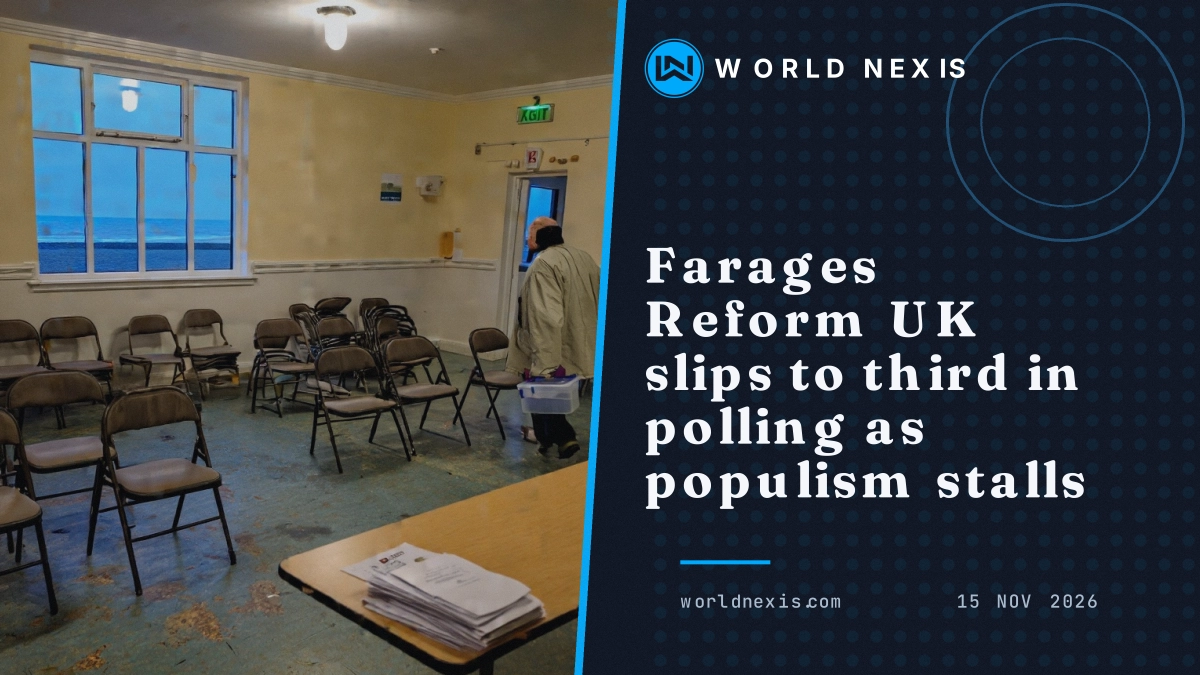
Reform UK polling has slipped far enough to leave Nigel Farage’s party in third place behind the Conservatives and Labour, according to a columnist’s assessment published on 16 November 2026 across Australian Community Media’s regional titles. Writing under the headline Populism might have reached its peak, Nigel, John Hanscombe argues the shift is large enough that The Economist suggested last week Britain may be returning to its traditional two-party model.
Key points
- Reform UK polling places the party third, behind the Conservatives and Labour, after a period in which it was treated as a threat to both.
- The Authoritarian Populism Index found support for populist parties in Europe reached 21.3 per cent last year and held at that level in 2026.
- Sweden’s right-wing populist Swedish Democrats lost 11 seats as their popularity faltered.
- In Australia, One Nation has converted a support surge into wins in South Australia and the federal seat of Farrer, with Victoria and NSW next.
Reform UK polling slides as standards scrutiny builds
The column links the fall in Reform UK polling to a run of self-inflicted difficulties. Farage accepted a multimillion-dollar gift from a Thailand-based crypto billionaire and failed to declare it, which the columnist calls bad enough in itself. Worse, in his view, was forcing a byelection that saw him face off against a man dressed as a bin.
A parliamentary standards investigation may now force another byelection, a prospect the column describes as filled with dread for long-suffering voters. Watchers of Reform UK polling will note how quickly the party moved from insurgent threat to third place once those stories took hold.
The columnist treats the sequence as more damaging than any single episode, because each one undercuts a party that sells itself as a break from the old system. That framing matters for anyone tracking Reform UK polling closely: the damage is cumulative rather than episodic.
Populist leaders under strain from Washington to Budapest
Hanscombe places Farage alongside populist leaders he describes as either circling the drain or already down it. Donald Trump and Benjamin Netanyahu fall into the first group. Brazil’s Jair Bolsonaro, Hungary’s Viktor Orban and Serbia’s Aleksandar Vucic sit in the second, together with Republicans who lost their seats around the US midterms.
In Sweden, the right-wing populist Swedish Democrats lost 11 seats as their popularity faltered, the column notes. Support for populist parties in Europe nonetheless reached 21.3 per cent last year, according to the Authoritarian Populism Index, and has stayed there in 2026.
“It hasn’t gone backwards but it might have reached its ceiling.”
Hanscombe warns that none of this means supporters of reasoned, centrist politics should break out the bubbly. The index reading shows a floor as well as a ceiling.
One Nation’s support faces its first major tests
Australia provides the second half of the argument. One Nation has turned a surge in support into electoral wins in South Australia and in the federal seat of Farrer, and recent polling suggests its support is plateauing. The first major tests come in Victoria this month and in NSW in March.
That may explain why Barnaby Joyce has already downplayed One Nation’s chances in Victoria. There, the column says, the sensible-centre everywoman Jess Wilson appears from the outside to be far more electable than Warren Pickering.
In NSW, Pauline Hanson’s party faces Chris Minns, whom the column describes as so centre-right that some say he is the most Liberal-style premier Labor has ever offered voters. Accusations from former insiders that One Nation is at the beck and call of mining magnate Gina Rinehart have added to its difficulties.
The party has also failed to properly vet candidates and staffers, according to the column. Scrutiny has unearthed criminal pasts, neo-Nazi sympathies and wild conspiracy theories, and support has softened as a result. Its long-standing backing for Donald Trump was quietly removed from the One Nation website after his electoral drubbing.
Analysis
I think the evidence here supports the ceiling reading rather than the collapse one, and the Reform UK polling is the clearest part of it. Having covered Westminster for WNN, I watch for whether a dip is about message or machinery, and Farage’s problems are machinery problems: an undeclared gift, a byelection fought against a man in a bin costume, and a standards inquiry that could trigger another vote.
Insurgent parties rarely die from a single scandal. They weaken when scrutiny becomes routine, because their pitch depends on being cleaner than the incumbents, and that is now the pattern in Britain and, on this account, in Australia too. The strongest counter-argument is that 21.3 per cent support across Europe has not dropped at all, and a ceiling can hold for years before it becomes a decline.
Even so, I side with those who read these numbers as a peak rather than a reversal of fortune. Sitting third in the Reform UK polling is a long way from the breakthrough Reform promised, and on the Australian evidence the burden of proof has moved to the populists.
What happens next
The parliamentary standards investigation could force another byelection in the UK, according to the column. In Australia, One Nation’s support faces its first major test in Victoria this month, followed by NSW in March.
Hanscombe concludes it is too early to say whether the European ceiling will hold in Australia. On Westminster, the open question is whether Reform UK polling holds at third place once the standards process concludes.
Related coverage
- Youth jobs crisis: Burnham vows action for 981,000 NEETs
- Age of consent review urged as Brand denies offences from prison
- Royal visit India: William and Kate’s major 3-day trip
Sources
- Populism might have reached its peak, Nigel (bordermail.com.au)
- Populism might have reached its peak, Nigel (portnews.com.au)
- Populism might have reached its peak, Nigel (naroomanewsonline.com.au)
- Populism might have reached its peak, Nigel (northweststar.com.au)
- Populism might have reached its peak, Nigel (ulladullatimes.com.au)
About the author: Liam O’Connor is World Nexis News’s UK Politics Reporter, covering uk politics. The analysis section reflects the writer’s view.

Liam O'Connor
Liam O'Connor is UK Politics Reporter at World Nexis News, covering Westminster, devolved politics and the issues that matter to voters across England, Scotland, Wales and Northern Ireland. Based in London, he reports from primary sources — Hansard, official statements, published data — and explains…



