Youth jobs crisis: Milburn to urge National Insurance cut for under-25s
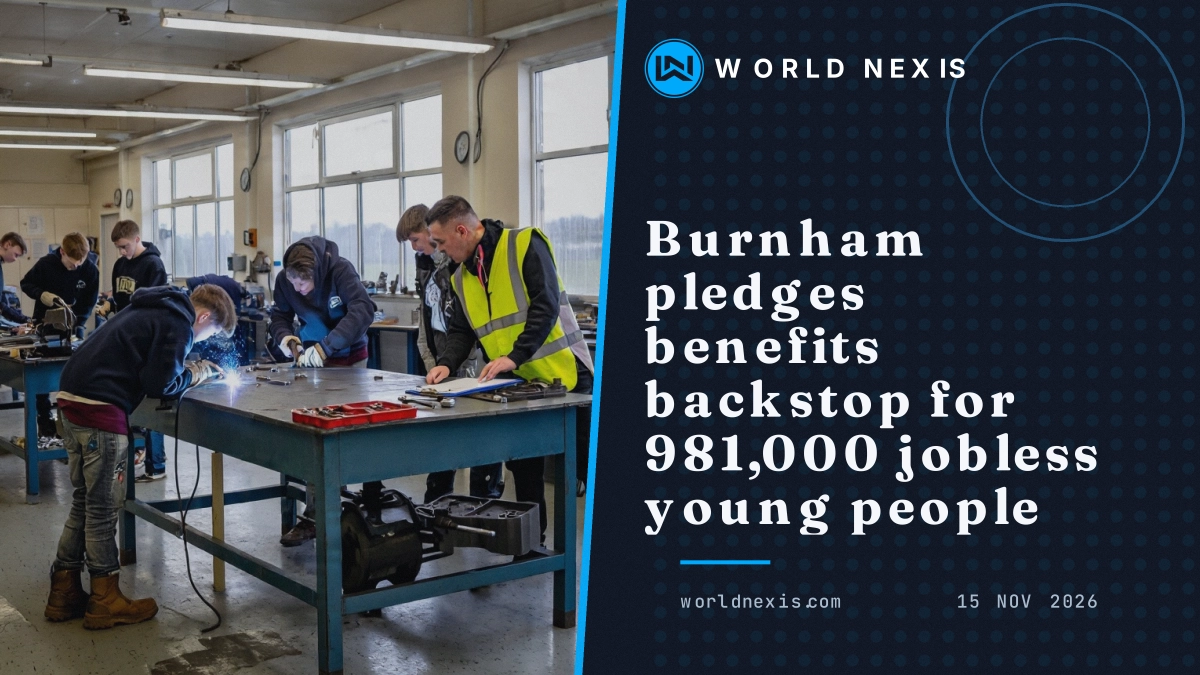
Andy Burnham has vowed to fix the youth jobs crisis with early intervention and a benefits backstop, as 981,000 young people are outside work or training.
Updated 16 Nov 2026, 07:55 (UK time): The contents of the Alan Milburn review have emerged ahead of Tuesday’s publication, with plans to phase down employer National Insurance for under-25s cutting the threshold cost and to strip under-25s of the health element of Universal Credit and PIP.
The Alan Milburn review will recommend cutting National Insurance costs for businesses that hire young people, the BBC reported ahead of Tuesday’s publication. Employer NI for 21- to 24-year-olds should be reduced gradually over five years, starting in retail and hospitality, and the threshold at which firms begin paying should double from £5,000 to £10,000, though Milburn says that should happen only when fiscal conditions allow.
The report also proposes that under-25s should no longer be able to claim the health element of Universal Credit or Personal Independence Payment, the main disability benefit in England and Wales. Instead, Milburn wants a legal guarantee of a job, training or employment support, with benefits withdrawn from those who refuse to take up help. He said the government spends £22bn a year supporting young people who are economically inactive.
The BBC reported that Milburn will argue an immediate across-the-board NI cut is not the best use of several billion pounds, citing Resolution Foundation research putting the cost of axing NI for 21- to 24-year-olds at £5.1bn. He told the BBC he supported the chancellor’s slower approach to equalising the minimum wage across age bands. Shadow work and pensions secretary Helen Whately said the government should just stop doing the taxing.
Separately, details of the government’s £805 PIP plan were confirmed, with the change reported to start in April 2027. My take: the sequencing problem I flagged has not gone away, because the benefit savings are set out in detail while the hiring incentives are conditional on the public finances.
Andy Burnham has said the youth jobs crisis that has left an estimated 981,000 young people outside work, education or training is the fault of politicians, not of the generation it has trapped. Writing in the Guardian on Sunday, the prime minister promised a “generational response” and a “benefits backstop”, ahead of the publication of the Alan Milburn review next week.
Burnham argued that 16 years of policy had forced young people to “bear the brunt” of spending cuts, turning the youth jobs crisis into both an economic and a moral catastrophe. He put the number of 16- to 24-year-olds not in education, employment or training at “a million”, close to the 981,000 estimated in UK figures.
Key points
- About 981,000 people aged 16 to 24 are estimated to be not in education, employment or training.
- The Alan Milburn review of young people and work is published next week and will advise sweeping changes to some benefits.
- Burnham has promised early intervention and a “benefits backstop”, rejecting the welfare cuts proposed by the Conservatives.
- The welfare bill rose by £114bn under the Conservatives, the prime minister said.
Why the youth jobs crisis built up over 16 years
Burnham traces the youth jobs crisis to a deliberate decision by the Conservative government 16 years ago to make young people carry the heaviest share of its cuts. In his account, four-year-olds started school already behind after Sure Start centres closed, and 12-year-olds lost youth clubs, libraries and leisure centres from their communities.
Teenagers who needed mental health support were told to wait months or even years, he added. Millions, he wrote, passed through an education system that told them their technical talents were worth less than the abilities of academic peers.
“A country focused on the future would make young people its priority for investment – not the target for cuts,” Burnham wrote. The Guardian, which published the article, has said Britain is at risk of creating a lost generation and is following eight young people in their search for work.
The government’s answer is what Burnham calls a “whole-childhood approach”. It would give every child a proper start in the early years, build support for wider needs such as mental health into education, and value all talents. The aim is to reach young people long before they become reliant on the state.
He added that welfare and childhood “cannot be separated”, because the country has waited until young people reach adulthood before confronting problems that built up over years. He also attacked the Conservative response, saying proposed welfare cuts would drive children into poverty, raise family homelessness and pile pressure on councils and the NHS.
Benefits backstop as the youth jobs crisis deepens
Burnham describes welfare as a backstop rather than a destination and has promised a “root-and-branch rethink” of how Britain supports childhood. The Alan Milburn review will recommend sweeping changes to some benefits, and reports before publication warned that some young people will lose benefits in the welfare reset.
The BBC said the Neets review “won’t be for the faint-hearted” and will test the prime minister’s appetite for a welfare fight. A union leader has separately warned Labour not to drop an equal minimum wage for young people, according to Politics Home, while the Observer argued that Britain’s welfare crisis needs more than a tribal battle between left and right.
Beyond welfare, Burnham’s wider position is contested. The Independent Business Network has published a report, The Great Betrayal, saying he has no mandate to take Britain closer to the EU, and the senior Conservative MP Dame Priti Patel said his “delusional thinking” on the subject carried serious financial and undemocratic implications.
A Labour Party spokesperson said the government has “clear red lines” on the EU and is focused on a closer relationship that makes trade smoother and cuts bureaucracy for exporters. The spokesperson added that “no sensible person thinks the deal negotiated by the Tories is working for the country”.
Analysis
Having covered public services for WNN over the past year, I look first at sequencing rather than slogans. I think Burnham’s diagnosis is largely right: the youth jobs crisis did not appear overnight, and closed Sure Start centres, shuttered youth clubs and long mental health waits are exactly the upstream failures that surface a decade later in the benefits caseload. On the evidence he sets out, early help is cheaper than crisis management.
My concern is what “backstop” means once the Alan Milburn review lands. If benefits are trimmed now while better support is promised in five or ten years, the young people losing money are the same ones Burnham says the state failed. The strongest counter-argument, and it deserves respect, is that the welfare bill cannot rise indefinitely and that payments alone rarely move someone into work.
Even so, I side with those who say the test is the order of events. Front-load the support, treat benefits as a genuine floor, and the whole-childhood language means something. Front-load the savings, and the youth jobs crisis is simply handed to the next government, exactly as it was handed to this one.
What happens next
The Alan Milburn review is due to be published next week, and Burnham has said it should be a watershed moment for welfare and for childhood policy. He is expected in Brussels on Friday for a summit, days after business leaders attacked his approach to the EU.
Related coverage
- Peoria bomb evacuation: 5,000 residents return after FBI search
- Age of consent review urged after Brand’s 10-year term
- Royal visit India: William and Kate’s major 3-day trip
Sources
- The crisis facing Britain’s young people is politicians’ fault. To fix it, we need a generational response | Andy Burnham (theguardian.com)
- Labour blasted over Brexit betrayal in damning report – ‘poorer and less free!’ – AOL (aol.co.uk)
About the author: Liam O’Connor is World Nexis News’s UK Politics Reporter, covering uk politics. The analysis section reflects the writer’s view.

Liam O'Connor
Liam O'Connor is UK Politics Reporter at World Nexis News, covering Westminster, devolved politics and the issues that matter to voters across England, Scotland, Wales and Northern Ireland. Based in London, he reports from primary sources — Hansard, official statements, published data — and explains…



