Prince Harry Ukraine visit: 150,000 wounded veterans hailed
Prince Harry Ukraine visit: the Duke of Sussex met wounded veterans in Lviv, hailed them as role models and said the country will win the war.
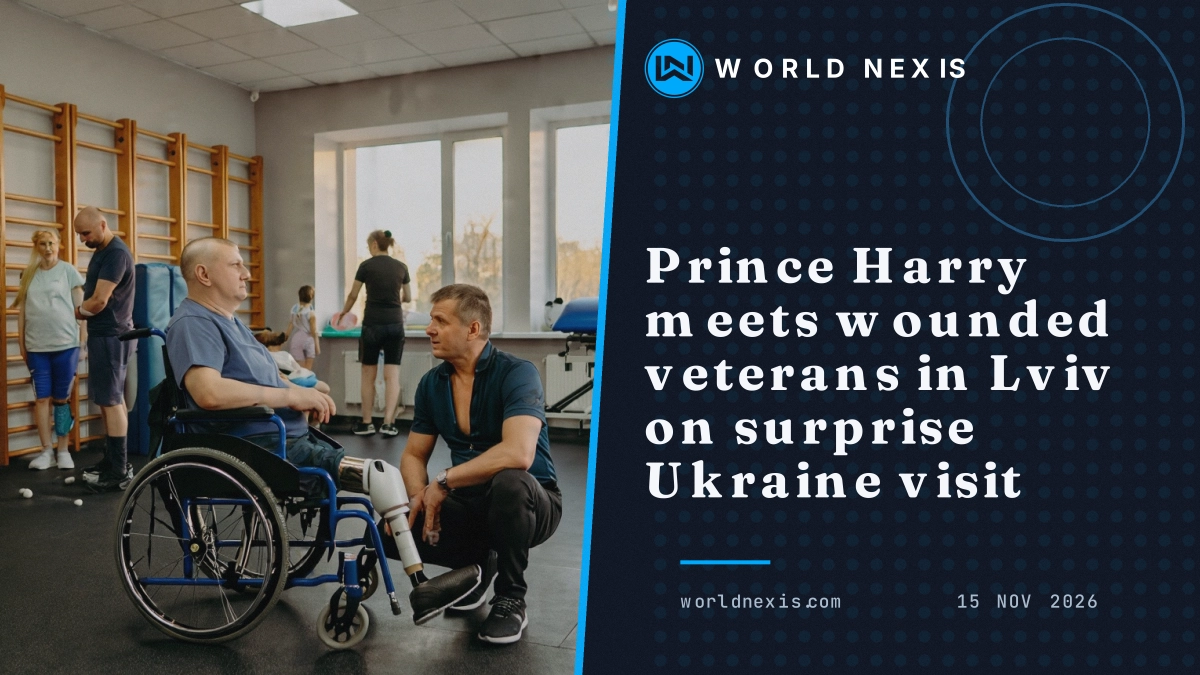
Prince Harry Ukraine visit: the Duke of Sussex made a surprise two-day trip to Lviv, where he met wounded Ukrainian veterans, described them as “role models” and told an audience of injured servicemen and women: “You’re going to win the war.” The trip, his fourth to Ukraine since Russia’s full-scale invasion in February 2022, was held under a press blackout for security reasons until he had left the country.
Key points
- Harry spent two days in Lviv meeting injured veterans and medics, on his fourth visit since 2022.
- He told a conference at the Superhumans Center that Ukraine will win the war and could one day host the Invictus Games.
- Ukraine has more than 150,000 injured war veterans, many treated at clinics in the west of the country.
- He met Ukrainian competitors hoping to reach the Invictus Games Birmingham 2027, where Ukraine aims to send about 60 athletes.
Prince Harry Ukraine visit: emotional scenes at the Superhumans Center
During the Prince Harry Ukraine visit, the most striking scenes came at the Superhumans Center near Lviv, a clinic that fits prosthetic limbs and runs rehabilitation for people injured in the fighting. The duke sat at the bedside of Konstiantyn Vlasenko, a soldier airlifted from the front line by drone last month in a rescue described as the first of its kind. According to the BBC, he had been alone for more than 200 days and held his position despite losing both his feet. Harry told him he represented the spirit of Ukraine’s resilience.
The duke also met Mykhailo Damaskin, an air assault forces veteran so badly hurt in fighting in Kherson that he was never expected to walk again. An experimental spinal cord stimulator implanted in his back now allows him to move, although it must be recharged every 12 hours and he controls his steps with his eyes. He jokes that he is “like a demo model of a Tesla”. “My goal is to go to the Invictus Games,” he said, explaining that he had promised his father, who was later killed, that he would represent Ukraine internationally.
Ukrainian expertise now travels outwards
Harry told the conference that Ukraine was experiencing elements of war no other country had faced, from drone combat to protecting cities and treating the injured. International experts once travelled to Ukraine to help, he said, but “now that has flipped”, with Ukrainian medics holding the greater expertise in trauma and rehabilitation care. He added that the country would be “set up for success” once the fighting ends.
‘You’re going to win the war’: the message to Invictus hopefuls
At a noisy sports centre, the duke watched wheelchair rugby, with the BBC reporting thunderous collisions between the players. He hugged Valery Odainyk, a 41-year-old who uses prosthetic legs and competed at the Invictus Games in Canada in 2025. Odainyk, who describes himself as still an active serviceman, told the Guardian that his involvement in sport “all started and continues with the Invictus Games”.
Ukraine is aiming to send about 60 competitors to the Invictus Games Birmingham 2027, which would be its largest team since it began taking part. Harry, who founded the tournament for wounded military personnel in 2014, said it could one day be staged in Ukraine itself. “When the war is over and when Ukraine wins, we will be ready to support you in holding an Invictus Games,” he promised.
Elsewhere he met Ivan Voinov, who lost a leg and suffered head injuries and is using sport to rebuild his life, including learning to dance again with his wife. The duke was presented with a T-shirt commemorating prisoners of war held by Russian forces, tried his hand at pickleball, and was greeted at an awards ceremony with chants of “Harry, Harry, Harry”. “Every single time I come back to Ukraine, I feel welcome, I feel warmth, I feel encouragement,” he said.
Risk, resilience and a family in mourning
The prince acknowledged that travelling to a country under missile attack carried risk, and his team kept the schedule secret until he had crossed back out of Ukraine. The 42-year-old spent a decade in the British army and served in Afghanistan, including as a helicopter pilot, and has called those years the happiest of his life. His earlier wartime trips took him to Kyiv in September 2025 and again in April this year, when he described Ukraine as a country “bravely and successfully defending Europe’s eastern flank”.
The visit came as both royal brothers were reported to be grieving the death of Jessie Webb, their childhood nanny, who took up her duties when William was about seven and Harry four. The royal commentator Robert Jobson, who reported the news, called her a “cheerful lady with a big heart and plenty of common sense”. According to the account carried by AOL, Prince William has already been informed.
Analysis
Having covered the royal family’s public duties for WNN, I look first at what a trip like this actually delivers on the ground rather than at the palace paperwork. On that test, the Prince Harry Ukraine visit holds up better than most royal travel. The Superhumans Center is not a backdrop: Ukrainian clinicians are now training others in trauma and prosthetic care, and the duke used his platform to say so in plain terms.
In my view, the veterans and the organisers have the better of the argument, and the “royal photo opportunity” critics are wrong. The evidence is scale and continuity — four visits since 2022, a team of roughly 60 heading to Birmingham, and more than 150,000 injured people whose rehabilitation depends on donors who pay attention to coverage like this. The strongest counter-argument, that a celebrity visit changes nothing at the front and that commercial deals blur the line between service and self-promotion, is fair as far as it goes, but it does not survive contact with what the clinic and the team actually receive.
There is a domestic angle I would flag too. The gap between this kind of work and the estrangement from the Prince of Wales is now the defining fact of the monarchy’s public story. The Invictus model shows what Harry can do without a palace role at all, and for the institution that is a far more interesting question than any rift gossip.
What happens next
Ukraine’s Invictus squad will continue preparing for the Games in Birmingham next year, with the aim of fielding its largest team yet. Harry has promised backing for a future Games staged on Ukrainian soil once the war is over, although no timeline or host city has been set. For now, the only firm commitment from the trip is continued support for the rehabilitation projects he toured in Lviv.
Related coverage
- Youth jobs crisis: Burnham vows action for 981,000 NEETs
- Royal visit India: William and Kate’s major 3-day trip
- Nvidia scandal: Megaspeed denies smuggling 240,000 AI chips
Sources
- Prince Harry praises war veterans on surprise visit to Ukraine (bbc.co.uk)
- Prince Harry tells Ukrainians they are ‘going to win war’ on surprise trip to Lviv (theguardian.com)
- Huge blow for Prince William and Prince Harry as they’re hit by heartbreaking loss – AOL (aol.co.uk)
- Prince William (geo.tv)
- Meghan Markle (thenorthernecho.co.uk)
About the author: Liam O’Connor is World Nexis News’s UK Politics Reporter, covering uk politics. The analysis section reflects the writer’s view.

Liam O'Connor
Liam O'Connor is UK Politics Reporter at World Nexis News, covering Westminster, devolved politics and the issues that matter to voters across England, Scotland, Wales and Northern Ireland. Based in London, he reports from primary sources — Hansard, official statements, published data — and explains…



