Mandelson appointment: PM admits political culture not fixed
Andy Burnham says political culture has not changed enough since the Mandelson appointment, as new files reveal light-touch vetting of his conflicts.
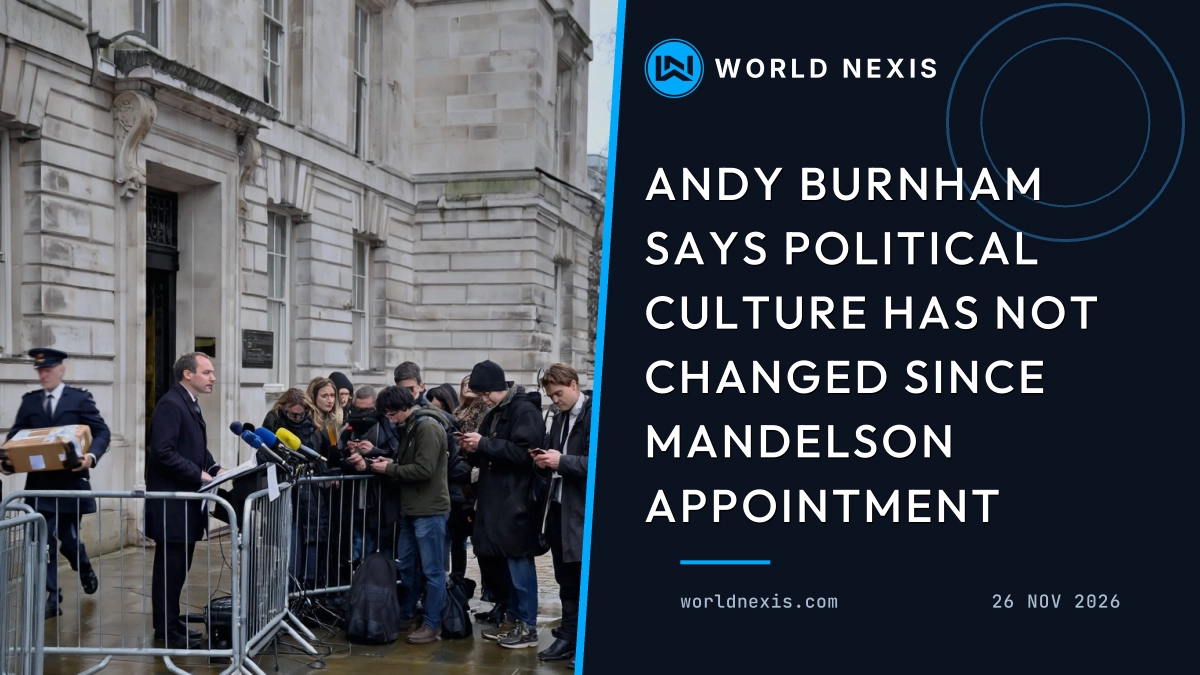
Andy Burnham has said the political culture behind the Mandelson appointment has not changed enough since he entered office, after the Government published another tranche of documents on Thursday. The Prime Minister pledged “political reform” so that “vested interests aren’t running large within the system”. Security minister Dan Jarvis said the Government will strengthen its conflicts-of-interest policy on public appointments.
The files show a “light touch” approach was taken to vetting Lord Mandelson’s business interests when he became Britain’s ambassador to Washington. He was dismissed from the post in September last year after further details emerged of his close links to the financier Jeffrey Epstein.
Key points
- Ministers released a further batch of files on Thursday about the Mandelson appointment and the peer’s time in Washington.
- The papers reveal light-touch vetting of his conflicts of interest, including his stake in the consultancy Global Counsel.
- Dan Jarvis said conflicts-of-interest rules for public appointments will be strengthened.
- Lord Mandelson was arrested in February on suspicion of misconduct in public office; no charges have been made and he denies all allegations.
Mandelson appointment files reveal light-touch vetting
Much of the new material concerns Global Counsel, the consultancy Lord Mandelson helped to found. During the Mandelson appointment process he came under pressure to distance himself from the firm, whose clients included the Chinese-owned video app TikTok, the US technology company Palantir and the pharmaceutical group GSK.
Emails also show the peer was initially unhappy with the sum offered for his shares in the business. As the process dragged on, he wrote that the company should “pull their fingers out and buy my shares”.
Warmer language on China and Trump
One director at Global Counsel suggested Lord Mandelson use “warmer language” about China and tone down “parts of your apologia of the Trump administration”. The message was sent in August last year, before his Ditchley Foundation annual lecture.
It warned that scepticism was now “so deep” among policy-minded people outside government that appearing to have “drunk the Kool Aid” would be “counterproductive/unpersuasive”.
The tranche also shows a White House official telling Lord Mandelson in April last year that his “Prince of Darkness” label could not be “farther from the truth”.
How the Foreign Office saw vetting
Internal correspondence sets out how officials framed the exercise. On 11 September last year, the day Lord Mandelson was dismissed, chief property and security officer Ian Collard wrote to Downing Street’s private secretary for foreign affairs, Alisa Terry.
The exchange offers an unusually clear window into how the ambassador vetting process works in practice. Mr Collard said the system “predominantly looks at one’s close contacts of recent years”, and was not intended, in all areas of review, “as a retrospective on someone’s whole life”.
Political culture “has not changed enough”, says the PM
Mr Burnham used the publication to argue that the culture which produced the Mandelson appointment had not shifted sufficiently since he took office. His political reform pledge, made as the files landed, is aimed at curbing the influence of vested interests in the machinery of government.
The row has a long tail. Questions about how much Sir Keir Starmer knew of the peer’s ties to Epstein when he made the Mandelson appointment played a significant part in the former prime minister’s eventual resignation.
Thursday’s release follows more than 1,500 pages published earlier this year. Some material has been withheld at the request of the Metropolitan Police, which is investigating the former Labour minister and spin doctor.
Lord Mandelson was arrested in February on suspicion of misconduct in public office. No charges have been brought, and he has denied any allegations and is co-operating with police.
Why it matters
Ambassadors carry British interests abroad, and public appointees spend public money, so the rules governing who gets those jobs, including the Mandelson appointment, are a direct test of how power is handed out. When vetting is described inside government as “light touch”, readers are entitled to ask who was protecting whom.
The practical consequence is trust. If the strengthened conflicts-of-interest policy has real teeth on shareholdings and outside clients, future appointments become harder to fix quietly. If it does not, the Mandelson appointment will be remembered as a warning that was filed and forgotten.
Analysis
From a Westminster desk, the temptation is to treat this as a story about a prime minister’s regret. I think that reading misses the substance. What the Mandelson appointment exposes is procedural: a system whose own officials describe it as looking at recent contacts rather than a whole career, applied to a man who was trying to sell a consultancy with TikTok, Palantir and GSK on its books while preparing to represent Britain in Washington.
I side with Dan Jarvis’s emphasis on tightening conflicts-of-interest rules rather than with the broader language of political culture. Culture claims cannot be tested; a rule on shareholdings, divestment deadlines and client lists can be. The strongest counter-argument is that no rulebook stops a prime minister who wants a famous name badly enough, and that the culture is precisely what allows a rule to be waived.
Even so, rules are where accountability actually lands. My test for the promised reform is simple: does it cover financial interests at the point of appointment, and does it publish enough for the public to check?
What happens next
The Government has said it will strengthen its conflicts-of-interest policy for public appointments, but has not published a draft or a timetable. The Metropolitan Police inquiry continues, and the force has already asked for some material to be withheld from release.
Any charging decision in the Mandelson case would follow that investigation, and no date has been given for one.
What we don’t know yet
It is not clear what the strengthened policy will cover, when it will be published, or whether further tranches of documents will follow. Nor is there any indication of when the police inquiry will conclude.
Related coverage
- Mandelson files: major release of 1,500 pages due to MPs
- Motor finance redress delayed again as FCA admits errors
- Aaron Rodgers feud: McCarthy admits Packers slip and cites ultimatum
Further reading
- PM says political culture since Mandelson appointment has not changed enough
- PM says political culture since Mandelson appointment has not changed enough
About the author: Liam O’Connor is the UK Politics Reporter at World Nexis News (WNN), covering uk politics. The analysis section reflects the writer’s view.

Liam O'Connor
Liam O'Connor is UK Politics Reporter at World Nexis News, covering Westminster, devolved politics and the issues that matter to voters across England, Scotland, Wales and Northern Ireland. Based in London, he reports from primary sources — Hansard, official statements, published data — and explains…



