Hotel security review: Premier Inn deploys undercover staff
Premier Inn has begun sending undercover teams into its hotels as part of a UK hotel security review ordered after a woman was attacked in Maidenhead.
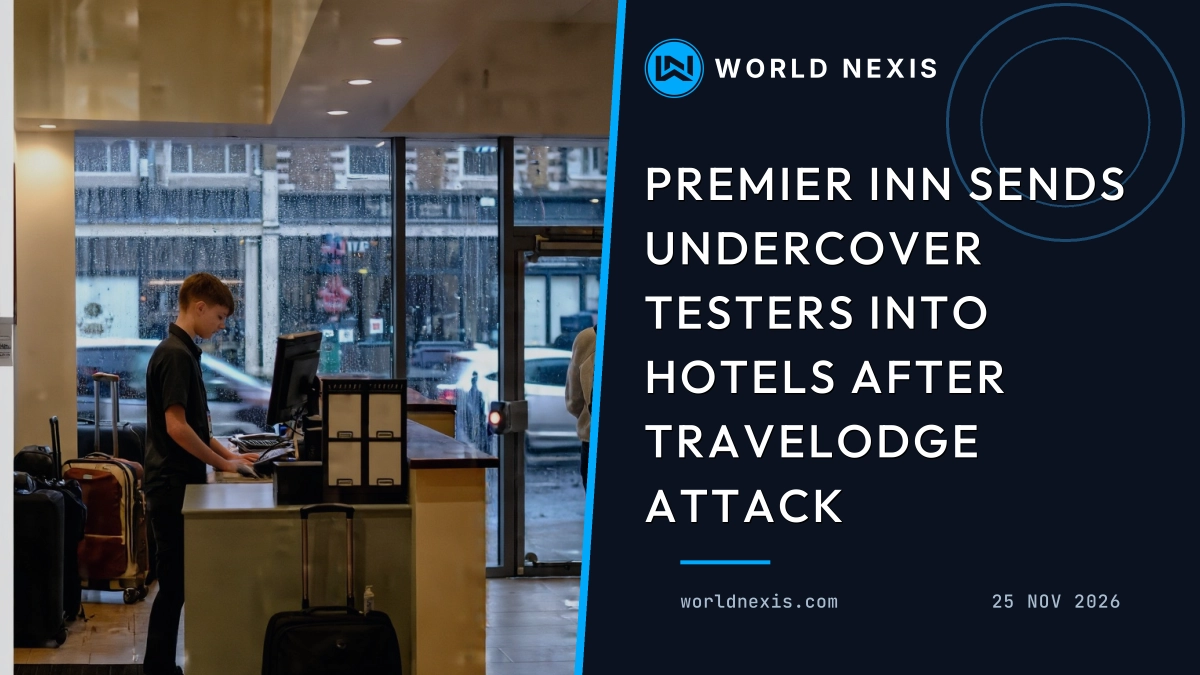
The UK hotel security review triggered by a sexual assault at a Travelodge has moved into spot checks. Premier Inn now sends an undercover company into its own properties to test whether staff follow the rules. Simon Ewins, managing director for the UK and Ireland at Whitbread, which owns Premier Inn, told the Women and Equalities Committee on Wednesday that the chain introduced penetration testing after the review reported. The group has double locks on 89,000 doors and says all 20,000 of its team members have passed a retraining audit since March.
Key points
- Premier Inn undercover testing uses an external firm to try to get around room-key and access protocols without warning hotel teams.
- The hotel security review was commissioned earlier this year after a woman was attacked at a Travelodge in Maidenhead, Berkshire.
- Kyran Smith was jailed for seven and a half years in February over the December 2022 assault.
- Travelodge’s interim chief executive told MPs he apologises “unreservedly” to guests “where we have failed”.
Hotel security review: what MPs were told
Mr Ewins said training alone cannot prove that front-desk rules are being followed in practice. He described the external firm as providing “unannounced insights to prove not only does the team member know… what they’re supposed to be doing, but they are then actually doing it”. The exercises are designed to catch lapses before a guest is put at risk.
Whitbread has also made the double lock on every room door “more obvious to guests” since the hotel security review. An emergency key can still open a double-locked room, but Mr Ewins said those keys are “subject to management scrutiny and a set of stringent protocols”. A key for an occupied room is issued only to guests named on the booking with all the required information, unless the occupant goes to reception and authorises it.
Mr Ewins said the protocols had always been in place, and the review simply let the company look at them again in light of the attack. He told MPs that all 20,000 team members have passed the retraining audit. He has held his post for 11 years.
How the Travelodge Maidenhead attack happened
Barrister Paul Greaney KC, who led the hotel security review, found that the woman at the centre of it — referred to in his report as “Lily” — was “fundamentally failed by Travelodge as an organisation at every stage”. The assault took place at a Travelodge in Maidenhead in December 2022. Kyran Smith lied to a junior member of staff on the desk that he was Lily’s boyfriend and was handed a key to her room less than three minutes later.
Smith was jailed in February for seven and a half years. Ray Reidy, Travelodge’s interim chief executive, told the committee: “I apologise unreservedly on behalf of Travelodge to all guests where we have failed, and particularly to Lily.”
Wider failures prompt new industry guidance
Mr Greaney said he had received evidence that security problems were widespread and not restricted to one business. Bosses from Travelodge, Z Hotels and Whitbread, plus the chief executive of the trade body UKHospitality, set out their responses to the hotel security review at the session.
UKHospitality has recently published new guest security guidance for the sector. It covers how staff should handle requests for replacement room keys, access by people not named on a booking, and the management of group and corporate bookings.
Mr Ewins told the panel that the review accepted human failure can never be ruled out. He argued that the new key policy should stop the Maidenhead situation from happening again.
Why it matters
For anyone who stays in a hotel, the evidence showed how much of their safety rests on one receptionist’s judgment at a busy desk. The Travelodge Maidenhead attack exposed how fast that judgment can be exploited, with a stranger handed a key in under three minutes. The hotel security review has at least made the mechanics of that failure public.
The changes touch guests in small, practical ways. Double locks are now more visible on the door, and a room can be opened for someone else only when the named occupant walks to reception to authorise it — a detail that matters for families, carers and colleagues sharing a booking.
Analysis
Having covered Westminster committees for World Nexis News, I look first at what companies volunteer before anyone forces them to. The striking part here is that Premier Inn undercover testing is self-imposed: the company being tested designs it, pays for it and reads the results. That is better than nothing, and saying it out loud to MPs deserves credit.
Even so, I think the facts support the argument that voluntary guidance is too thin on its own. Mr Greaney’s hotel security review found problems across the sector, not inside a single brand, which points to a systemic gap rather than one rogue desk. Testers hired by the business can catch lapses, but they tell the public nothing about the hotels that never commission a test.
The industry’s strongest counter-argument is that statutory rules would take years, while retraining and clearer key policies act now. That is fair, and UKHospitality’s guidance has clearly moved faster than legislation would have. But guidance carries no independent inspection and no penalty, and in my view the standard Lily was owed is one that is checked from outside.
What happens next
Whitbread says the penetration testing is now a running process, and its retraining audit is complete. UKHospitality’s guidance is in circulation for hotel operators to adopt. The Women and Equalities Committee has now taken evidence from three hotel groups and the trade body on the hotel security review.
What we don’t know yet
Open questions remain over how the results of Premier Inn’s external testing will be shared with guests, regulators or the committee. It is also unclear whether the session will lead to a formal report from MPs, or to pressure for rules on room-key handling that apply to every operator.
Related coverage
- Watford fire attack: woman, 80, dies as murder probe opened
- Eurostar strike: 25 November Paris-London travel warning
- Chloe Mitchell murder trial: jury sworn in over 2023 death
Further reading
- Hotel chain deploys undercover company to test staff security measures, MPs told
- Hotel chain deploys undercover company to test staff security measures, MPs told – AOL
About the author: Liam O’Connor is the UK Politics Reporter at World Nexis News (WNN), covering uk politics. The analysis section reflects the writer’s view.

Liam O'Connor
Liam O'Connor is UK Politics Reporter at World Nexis News, covering Westminster, devolved politics and the issues that matter to voters across England, Scotland, Wales and Northern Ireland. Based in London, he reports from primary sources — Hansard, official statements, published data — and explains…



