Google AI Overview blocked for 500,000 Los Angeles students
Los Angeles schools have blocked Google AI Overview summaries on half a million student devices, as Google warns it may cut search access for districts.
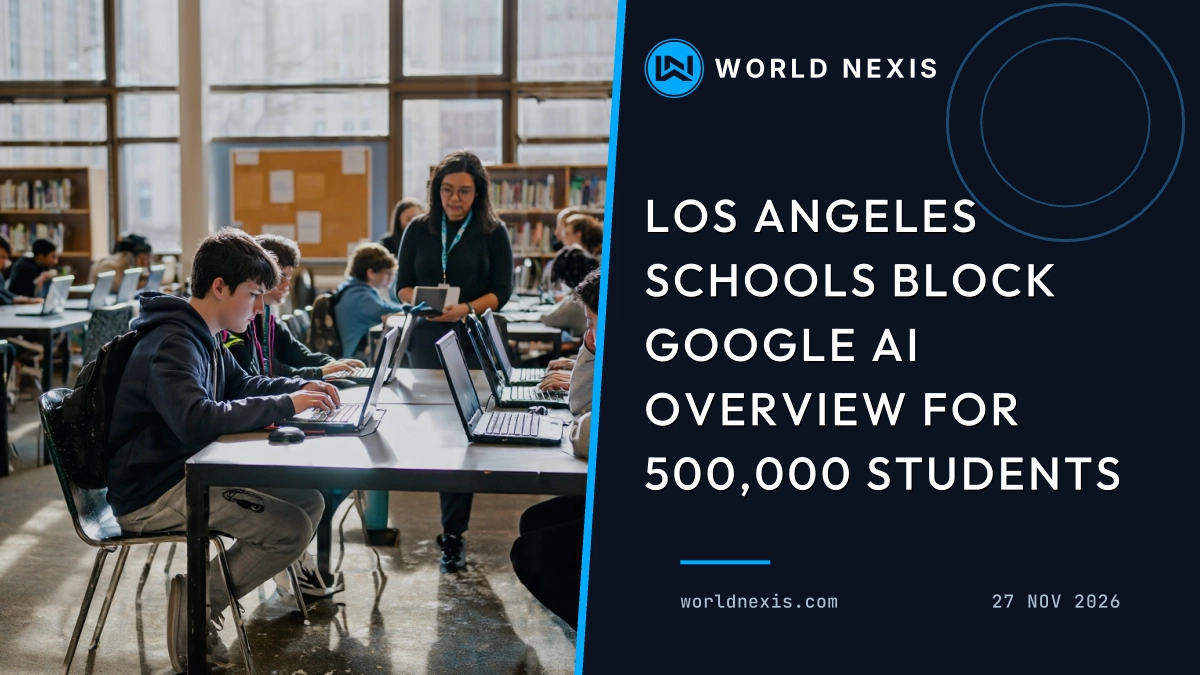
Los Angeles school officials have switched off Google AI Overview, the AI-generated summaries that sit above search results, on devices issued to students, making Los Angeles Unified the largest district in the country to sideline the feature. The district enrolls about half a million students and has made no formal announcement. The change was confirmed in mid-November, after parents began comparing what their children’s school laptops showed when they searched.
The move lands as school systems nationwide weigh whether to drop Google products altogether unless the company offers a permanent way to bypass AI features on school devices. Google says that is not possible, and warns it will restrict districts’ access to its search tools unless they turn those features on.
Key points
- Los Angeles Unified has disabled Google AI Overview on school-issued devices, the biggest district to do so.
- The district calls the suspension temporary and says it is meant to keep student searches “age-appropriate and safe.”
- Google says AI cannot be separated from its search products and may limit search access for districts that refuse.
- New York and Los Angeles announced one-year moratoriums on student use of generative AI in September.
Google AI Overview vanished days after a committee meeting
Members of Schools Beyond Screens LA, a group pressing the district for screen-time limits and tighter oversight of classroom technology, spoke at a meeting of the Los Angeles school board’s artificial intelligence committee on Friday, Nov. 13. By the following Monday, the summaries were gone from district devices.
The group asked parents to record what their children’s laptop screens looked like during a search. The clips showed that Google AI Overview was no longer an option. Activists then approached the district, which confirmed the feature had been disabled. Parents and students had been given no warning, said Bridie Lee, a leader of the group.
“We’re thrilled LAUSD did this,” Lee said. “AI is seeping into everything. It’s dangerous. It’s hurting learning. And it’s a corporate overreach into public schools.”
Lee said the group had no further detail on how the change was made or how long it is meant to last. Los Angeles Unified said in a statement that it had temporarily suspended AI Overview to ensure student experiences were age-appropriate and safe. The district added that it continually reviews its digital safeguards, including third-party tools, and it was likely one of those tools that let it switch the feature off.
Why schools are turning against AI in the classroom
Google is the dominant supplier of technology to American classrooms. Its low-cost Chromebooks are the most widely used student laptops, and its education apps, including Docs and Classroom, are woven into classwork, homework and messages between teachers and students. That reach is what makes the fight awkward for districts.
The argument over AI in schools has been building for more than a year. In August, Google said it had turned on its Gemini chatbot for many K-12 students using Google Classroom, putting the company at the center of a public dispute. In September, the two largest districts in the country, New York and Los Angeles, announced one-year moratoriums on student use of generative AI.
The backlash follows a wider revolt against screens in schools, which began with mobile phones and screen time and has now reached tools that critics say let students outsource their thinking.
Google’s warning on school search access
The standoff has a hard commercial edge. Google has told districts that AI cannot be pulled out of its search products, and that it will limit school search access unless the AI features stay enabled. For a district that wants a clean, AI-free search box, that leaves two options: accept the summaries, or find another search provider.
Los Angeles appears to have taken a third route. Rather than wait for Google to change its product, the district filtered the feature out with a third-party tool of the kind it says it already reviews. Districts that cannot switch Google AI Overview off are, in effect, handing the decision to a vendor.
Why it matters
For parents, the change is a small but visible test of who controls what a child sees at school. Search is the front door to the internet for most homework, and a Google AI Overview panel at the top of the page is read as fact by children with no reason to doubt it.
For school budgets, the deeper risk is cost and continuity. Chromebooks and Google’s classroom apps are cheap and familiar; removing them would mean new hardware, new training and new logins for hundreds of thousands of families. The dispute is less about one feature than about whether public schools can set their own terms with the companies that run their classrooms.
Analysis
Having covered AI policy for World Nexis News, I look first at whether a company’s technical claim is really a product choice. Google’s position that AI cannot be separated from search is, in my view, a decision about how it wants to ship Search rather than a law of physics. Districts are not asking Google to remove the technology from the world. They are asking for a version of a product they already buy that does not place a generated answer above every result a nine-year-old sees. On that argument the schools have the better case, and the fact that Los Angeles could filter the Google AI Overview summaries out within days suggests the wall the company describes is thinner than it sounds.
The counter-argument deserves a hearing. Districts get an enormous amount of capability for very little money, and a patchwork of local filters is not a serious safety framework. A plug-in that hides one box today can break with the next update, and no parent should have to rely on an activist with a screen recording to discover what a school laptop displays.
That is why I think the sharpest criticism here lands on process as much as principle. Los Angeles did the right thing quietly and told nobody. A decision affecting half a million students should have come with a letter home and a published timeline. Transparency would also strengthen the districts’ hand against Google, because a public rule is harder for a vendor to route around than a silent block.
What happens next
The one-year moratoriums announced by Los Angeles and New York in September remain in force, and other districts are still weighing whether to leave Google’s products entirely. Los Angeles has described its block on Google AI Overview as temporary and has not said when, or on what conditions, the summaries would return.
What we don’t know yet
It is not clear which tool the district used, how long the suspension will last, or whether Google will treat a filter of this kind as grounds for restricting search access. Nor has the company said what a permanent AI-free option for schools would look like, if it ever offers one.
Related coverage
- Central Park rain record broken as 900,000 lose power
- Thanksgiving storm knocks out power to 900,000 on East Coast
- Macy’s parade postponed: storm warning, family out $7,500
Further reading
About the author: Priya Nair is the Technology Correspondent at World Nexis News (WNN), covering technology. The analysis section reflects the writer’s view.

Priya Nair
Priya Nair is Technology Correspondent at World Nexis News, covering artificial intelligence, cybersecurity, consumer devices and the companies building them. Based in London, she explains how new technology works, who it affects and what the evidence actually shows, with attention to privacy, competition and the…