GAO cybersecurity warning: 3 agencies breached by AI tool
GAO cybersecurity warning: three US agencies were breached as the AI tool Artex spreads, exposing missing checks. What it means and what happens next.
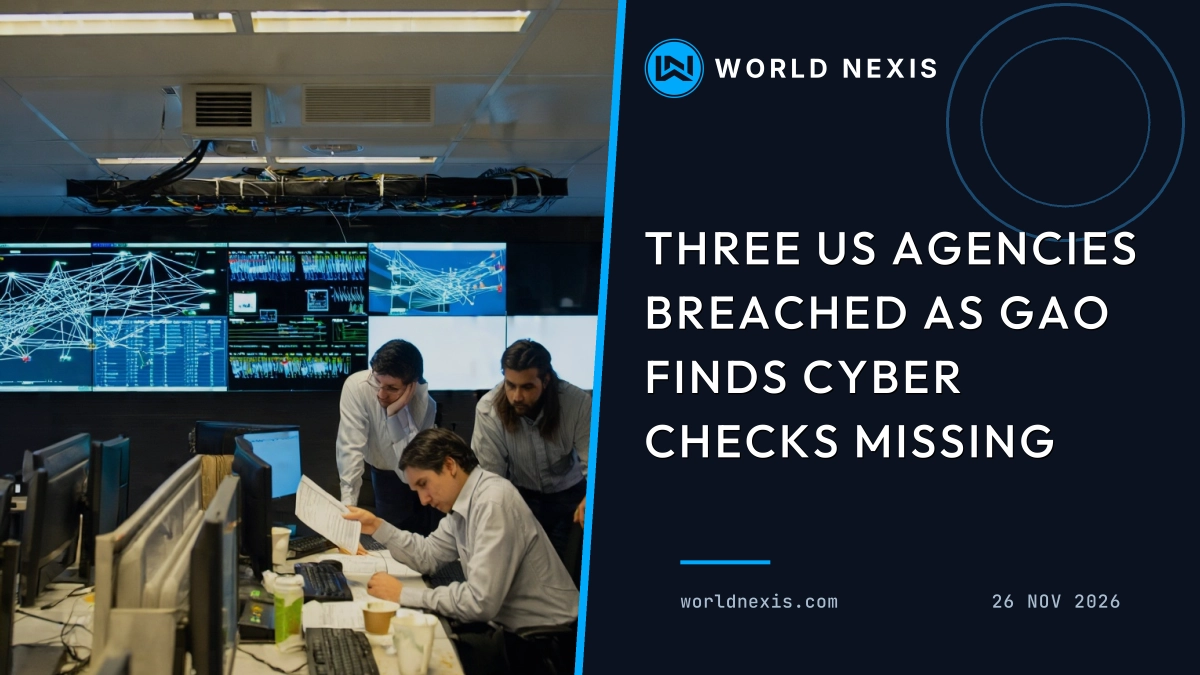
A GAO cybersecurity warning has landed in the same week that hackers reached into the CIA, the Office of the Director of National Intelligence and the Department of the Treasury, and it says the protections meant to stop exactly this kind of intrusion were never put in place. The intrusions are reportedly tied to Artex, an AI hacking tool the FBI flagged only about a week earlier. Three agencies, one tool, and an auditor’s finding that the safeguards lag.
The Office of the Director of National Intelligence has pushed back on the scale of the damage, saying classified systems were unaffected. The Treasury has confirmed it was breached. In the middle of it all, the Government Accountability Office concluded in a recent report that cybersecurity verification protections have not been implemented, warning that agencies face increased risk of attacks that could interrupt operations and compromise agency resources.
Key points
- The CIA, ODNI and the Department of the Treasury were all penetrated in a campaign reportedly run with the AI tool Artex.
- ODNI says there have been no disruptions to critical capabilities or classified systems.
- The Government Accountability Office found that cybersecurity verification protections have not been implemented.
- Homeland Security Secretary Markwayne Mullin says flatly: “We are not under attack.”
Artex: the FBI warned before the breaches
The FBI flagged Artex a little more than a week before the intrusions became public, encouraging organizations to implement recommendations to reduce the likelihood and impact of Artex-enabled intrusions. The tool is described as Chinese-developed, and it is the thread that links an otherwise scattered run of attacks on federal networks.
Anne Neuberger, a former deputy national security adviser, said the platform brings artificial intelligence to attacks, making them faster, deeper and more complex. That shift matters because it lowers the skill threshold for the people carrying them out.
John Miller, a law enforcement expert, said the penetrations reveal “a vulnerability in a place that we all imagine would have probably the most locked-down internet security around.” He added: “Hackers with little experience can do the kind of hacking that used to take days or weeks, sometimes in hours or in one case last week against a company in minutes.”
Accounts of the ODNI intrusion describe the affected network as an open-source intelligence analysis system, the kind that searches public, unclassified material for insights rather than storing secrets. That distinction is the basis for the agency’s insistence that nothing critical was touched.
What the GAO cybersecurity warning actually covers
The GAO’s language is blunt. Verification protections have not been implemented, and the consequence it names is operational: attacks that could interrupt operations and compromise agency resources. That is a different kind of failure from a breached password or a missed patch, because it concerns whether the safeguards agencies believe they have are actually in force.
The warning also sets a benchmark that reaches well beyond the three agencies in the headlines. Any department relying on the same unverified protections inherits the same exposure, and the GAO report gives no sign that the gap is confined to the intelligence community.
Until now, much of the public argument about the Artex hacking tool has focused on what it can do. The auditor’s finding shifts the question to what federal cyber defenses were supposed to be doing already.
Officials split on what the intrusions mean
ODNI moved quickly to contain the political damage. In a statement, the agency said: “There have been no disruptions to critical capabilities or classified systems.” The Department of the Treasury separately confirmed that it too was breached.
Homeland Security Secretary Markwayne Mullin, asked in a broadcast interview to respond to the multiple attacks on government agencies in recent weeks, rejected the framing outright. “I can tell you with complete certainty. We are not under attack,” he said.
That reassurance sits awkwardly next to the GAO cybersecurity warning. It also sits awkwardly next to the FBI’s own alert, which was written for organizations that might face the same tool and assumed they would need to act.
Why it matters
Treasury is where federal payments, sanctions enforcement and a large share of the government’s financial record-keeping sit, so an intrusion there is not an abstraction for anyone who receives a federal payment or depends on the machinery behind it. An attack that interrupts operations is felt first by ordinary households and businesses, not by the agencies themselves.
There is a confidence cost too. Every official statement that nothing serious happened raises the bar for the next disclosure, and the GAO cybersecurity warning gives critics a documented reason to keep asking.
Analysis
Having covered AI policy and cybercrime for World Nexis News, I read these stories in a fixed order: the auditor first, the attacker second. The auditor wins here. The GAO cybersecurity warning is the only part of this week that describes a fixable, systemic failure, namely protections that exist on paper and were never verified in practice. A breach is an event. An unverified control is a permanent condition, and it applies to agencies nobody has written about yet.
I think the evidence supports the GAO’s framing over the reassurance coming from the top of the homeland security apparatus. Mullin’s “we are not under attack” is defensible only if attack means something that stops operations, and ODNI’s statement that no critical capabilities or classified systems were disrupted is a genuinely important data point. The strongest counter-argument is that unclassified, open-source analysis networks are the low-value edge of the intelligence community and that treating them as a crisis overstates the damage. That cuts both ways, though: low-value targets are exactly where an AI tool gets tested cheaply, and where an inexperienced operator learns what works.
My view is that the dull argument is the one the facts back. Verification, not rhetoric, decides how this ends. I expect more agency disclosures rather than fewer in the coming weeks, because a tool that lets inexperienced hackers do in hours what once took weeks will find more doors before it finds fewer. The FBI’s guidance should be read as an admission that the defensive side is behind, and the GAO cybersecurity warning as the receipt.
What happens next
The next steps named in the material are practical and unglamorous. The FBI’s guidance urges organizations to implement its recommendations, which are aimed at reducing the likelihood and impact of Artex-enabled intrusions. Agencies covered by the GAO report face the harder task of actually implementing the verification protections the auditor says are missing.
ODNI and Treasury are also under pressure to say more about what was reached and what was not, since the current statements describe only what was protected. Whether Congress turns the GAO cybersecurity warning into hearings is, for now, an open question.
What we don’t know yet
- Who carried out the intrusions. No official attribution has been made public.
- Whether Artex was definitively the tool used. The link is reported rather than confirmed by the agencies involved.
- What, if anything, was taken. ODNI has said only that critical capabilities and classified systems were not disrupted.
Related coverage
- Iowa lead explosion sends toxic dust warning 100 miles out
- Macy’s parade balloons face wind warning at 100th event
- Eurostar strike: 25 November Paris-London travel warning
Further reading
- GAO warns gaps in cybersecurity checks raise risk of disruptions
- GAO warns gaps in cybersecurity checks raise risk of disruptions
About the author: Priya Nair is the Technology Correspondent at World Nexis News (WNN), covering technology. The analysis section reflects the writer’s view.

Priya Nair
Priya Nair is Technology Correspondent at World Nexis News, covering artificial intelligence, cybersecurity, consumer devices and the companies building them. Based in London, she explains how new technology works, who it affects and what the evidence actually shows, with attention to privacy, competition and the…