Iowa lead explosion response ran through overnight White House calls
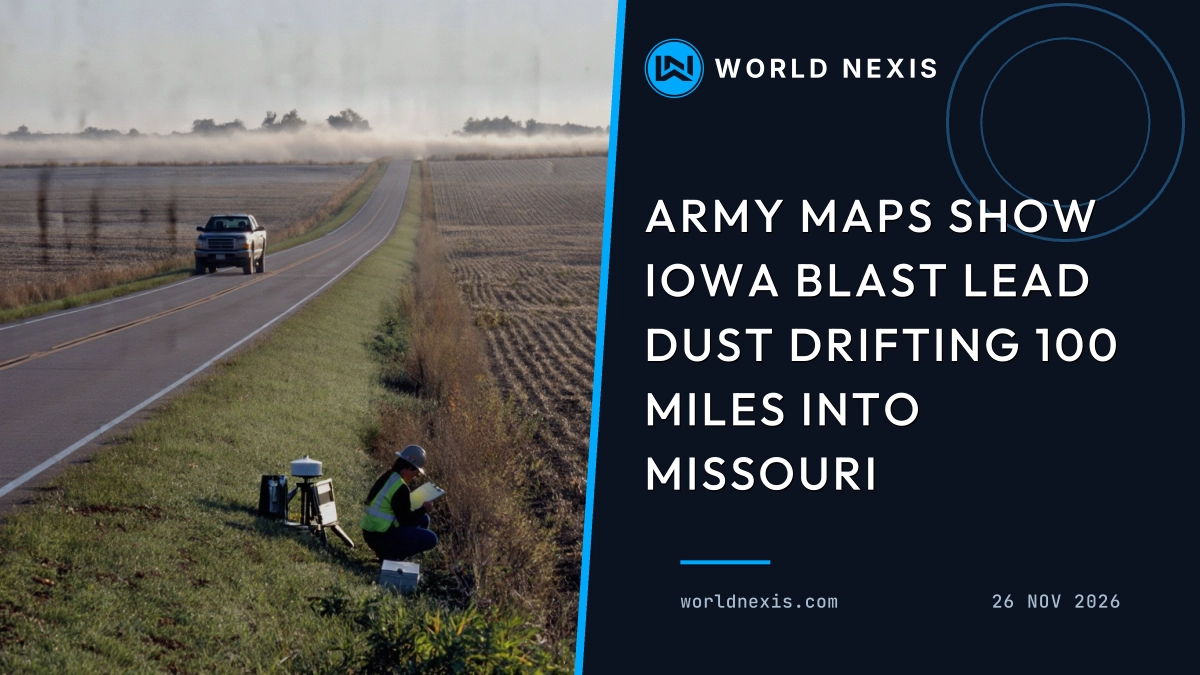
The Iowa lead explosion sent a toxic dust plume Army maps say could drift 100 miles into Missouri, and residents want proof their air is safe.
Updated 26 Nov 2026, 20:37 (UK time): A new public account says the Iowa lead explosion response was coordinated at the top of the White House, with chief of staff Stephen Miller making overnight calls, while three federal agencies issued a joint statement that all air monitoring available showed no detectable lead.
The Iowa lead explosion was coordinated at the highest level of the White House, according to the most detailed public account yet of the hours before the blast. Zach Lahn, an Iowa Republican who lost his bid for governor, said on a podcast that White House chief of staff Stephen Miller was telephoning officials in the middle of the night with a blunt instruction: get out of bed, get back to work. Lahn called Miller the “unsung hero” of the operation, and Katie Miller shared the praise on social media.
The account is a process story, not a monitoring result. Lahn did not say what prompted the overnight calls or which agencies were phoned, and he offered no data on what the blast left behind. What it does establish is that a rural county’s controlled detonation became a White House-level operation in its final hours.
Separately, the Army, the Environmental Protection Agency and the Health Department issued a joint statement saying the agencies coordinated at an unprecedented level, that the threat from the decaying material was eliminated, and that all air monitoring results available at the time showed no detectable lead. President Trump publicly praised the Army and others involved in Iowa.
None of that answers the question residents downwind have been asking since Wednesday. Air results near the plant remain clean; the soil and water numbers still are not public. Speed of response and proof of safety are different things, and the second one still arrives as a document nobody has seen.
The Iowa lead explosion on Wednesday morning destroyed nearly five tons of degraded lead azide at an Army ammunition plant near Middletown, and Army maps project that the resulting toxic dust could drift up to 100 miles into northeastern Missouri. The blast was over in seconds. The argument about what it left in the air, soil and water is only starting.
Federal and state officials describe the operation as contained. Families downwind say they have been handed maps and assurances, but not the evidence they asked for.
Key points
- The lead azide detonation destroyed about five tons of degraded material at the Middletown plant in southeast Iowa on Wednesday morning.
- Army maps projected dust drifting southeast up to 100 miles into northeastern Missouri, past the towns of Memphis and Edina.
- The Environmental Protection Agency reported no lead in the air around the plant, and the Army called the detonation a success.
- Residents who evacuated or sealed their windows want proof that their air, water and soil are safe.
What the Iowa lead explosion sent into the air
Lead azide is a bomb-trigger chemical, and this stockpile had degraded badly enough that the Army said it could no longer be stored safely. The service said the material risked detonating on its own in freezing temperatures, which is why the destruction went ahead now.
Army maps released before the blast showed a plume tracking southeast across the state line, settling along a corridor of roughly 150 square miles. The projection put the leading edge of the dust up to 100 miles from the site by late afternoon, hours after the detonation.
A court cleared the last obstacle
The Iowa lead explosion was contested to the end. A federal appeals court cleared the way on Monday, finding that the Environmental Protection Agency had built adequate safeguards into the plan to limit lead dust and the risks of exposure.
The Army described the operation as a success, and the Environmental Protection Agency said monitoring found no lead in the air around the plant. Missouri Governor Mike Kehoe said early analysis pointed the same way. “Initial analysis shared with us by federal partners and Iowa Homeland Security and Emergency Management indicates that the mitigation measures appear to have been successful and the explosion was well-contained,” he posted on X.
Why the plume should thin out
Not everyone expects lasting contamination at the far edge of the path. David Gay, former coordinator of the National Atmospheric Deposition Program, said the dust is likely to dilute quickly and that concentrations at the outer limit of the Army’s projection will probably be low. He said most of the lead will mix with other particles and fall near the plant, and that dust reaching the Mississippi River is unlikely.
“It’s always possible, but unlikely and very dilute concentrations.”
That distinction matters. The Army’s maps show where particles could travel. They do not show how much lead a person standing under them would breathe.
Why residents want proof, not assurances
For households near the plant, the question this morning is simpler than the modelling. Some families left before the detonation. Others stayed and sealed their windows, then waited for word on whether the dust was dangerous.
Campaigners supporting those communities have said the families deserve more than assurances, and want documented proof that their air, water and soil are safe. That demand is now the central political fact of the Iowa lead explosion. The agencies hold the monitoring equipment; the residents want the numbers, not a summary of them.
The blast landed days before Thanksgiving, so many of those families are waiting for word on the dust rather than settling into a holiday at home.
Why it matters
The Iowa lead explosion has turned an airborne event into a land question. Residents are focused on exposure, particularly for children, and on whether lead came down on fields, gardens and water supplies. The results released so far cover the air around the plant, not the ground beneath it.
There is a second cost that is harder to measure. A federal agency decided that a chemical too unstable to store had to be destroyed in a controlled blast, and a rural county was given a map and a forecast. How this one is documented will decide whether people accept the next such decision.
Analysis
Having covered pollution and extreme-weather plume forecasts for World Nexis News, I look first at the monitoring, not the explosion. The detonation was a technical problem with a technical answer, and the early air readings around the plant are genuinely encouraging. The harder problem is the one nobody can photograph: demonstrating safety across roughly 150 square miles of farmland and small towns.
In my view the agencies are on the right side of the science and the wrong side of the communication. The dilution argument set out by David Gay is credible and consistent with the clean readings near the plant. But when a plume is projected to cross a state line, a containment line posted on social media is not evidence. Publishing raw monitoring data, including every site that registers a detection, would settle this faster than any statement. The strongest counter-argument is that half-finished numbers get misread and cause unnecessary alarm, and that is a fair concern. It is still the smaller risk next to a county deciding it cannot trust the next warning it receives.
I expect the soil and water results, whenever they land, to be where this gets difficult. Air clears. Ground does not, and farmland is where an abstract plume becomes somebody’s livelihood.
What happens next
After the Iowa lead explosion, attention moves from the detonation to verification. The plume was projected to reach its furthest extent within hours and then settle, which means the story is now about what is measured on the ground. Air results near the plant are clean so far; the tests that will decide the argument are the ones covering soil, water and the towns along the path in Missouri.
What we don’t know yet
Three questions are open. How much lead actually came down on farmland along the corridor? Will soil and water results be published in full, and by which agency? And will any independent testing be commissioned, given that the assurances so far come from the bodies behind the operation?
Related coverage
- Iowa lead azide blast cleared as Rob Sand declines sign-off
- Macy’s parade balloons face wind warning at 100th event
- Eurostar strike: 25 November Paris-London travel warning
Further reading
- Iowa lead explosion’s toxic dust could drift up to 100 miles from blast site
- U.S. Army Detonates Toxic Lead in Iowa; Protests Statewide
About the author: Hannah Lindqvist is the Climate & Environment Reporter at World Nexis News (WNN), covering climate & environment. The analysis section reflects the writer’s view.

Hannah Lindqvist
Hannah Lindqvist is Climate & Environment Reporter at World Nexis News, based in London. She covers climate policy, extreme weather, the energy transition, conservation and climate finance, grounding stories in scientific research, official data and documented commitments rather than slogans. She is interested in how…