CIA breach exposes unclassified data on open-source network
A CIA breach has exposed unclassified data on an open-source intelligence network shared with ODNI, officials say no classified systems were affected.
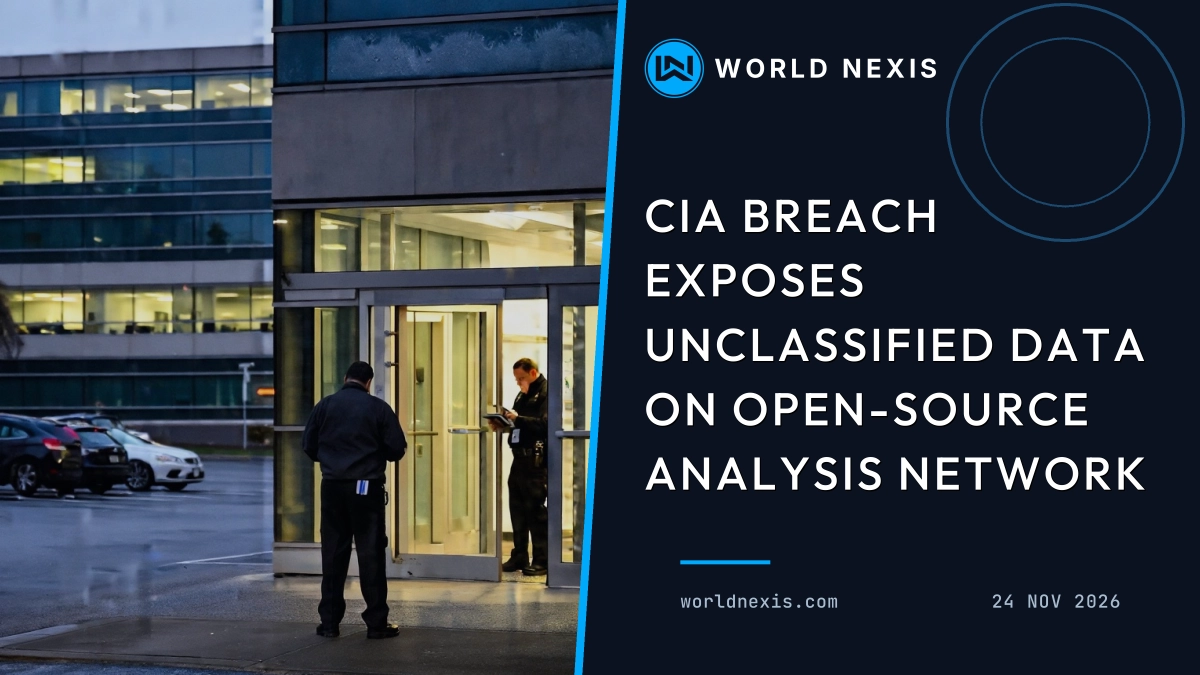
A CIA breach has exposed unclassified information held on an internal network used to analyse publicly available material, with the Office of the Director of National Intelligence confirming that no classified systems or critical capabilities were disrupted. The Central Intelligence Agency and the ODNI discovered the intrusion recently, and it became public on Tuesday, 24 November.
Key points
- Unclassified material was exposed on a network used for open-source analysis.
- The ODNI said the CIA breach caused no disruptions to critical capabilities or classified systems.
- It is not known what specific material was taken, or who carried out the intrusion.
- The incident follows separate breaches at the FBI and the Department of Agriculture and an outage on an internal National Security Agency network.
What the CIA breach exposed
The CIA breach centred on a system built to handle open-source intelligence, the branch of analysis that draws on publicly available information rather than secrets gathered through spying. Analysts use such networks to work through open material at a scale no individual could manage alone.
People familiar with the matter said information held at other federal agencies may also have been exposed, though the specific material has not been identified publicly. The affected system did not hold classified data, and the issue has since been addressed.
Asked about the incident, the ODNI said there had been “no disruptions to critical capabilities or classified systems”. The agency has not elaborated on what the open-source intelligence network held, or how long an intruder may have had access to it.
It remains unclear who was responsible for the intrusion, or whether it is connected to the other cyber incidents disclosed in recent days.
A wider run of cyber incidents
The CIA breach did not happen in isolation. Two separate breaches have recently been disclosed at the FBI, a breach has been reported at the Department of Agriculture, and the Department of Homeland Security has also been caught up in recent cyber incidents.
The FBI database hack
The FBI is investigating an apparent hack of a national law enforcement database it maintains. Databases of that kind are used by police agencies across the country to share and look up records, so any exposure raises questions for officers and for the public whose details they hold.
The NSA outage
Separately, an internal National Security Agency network used to communicate classified information was offline for a period last week. The agency has not said publicly whether that outage was linked to any of the intrusions under investigation.
The administration has said the recent run of outages is not the product of a single coordinated cyberattack. Jay Clayton, the Director of National Intelligence, has said publicly that the disruptions largely reflect the pressure agencies face to patch and upgrade systems fast enough to stay ahead of hackers using sophisticated artificial intelligence tools.
Why it matters
A CIA breach of this kind is easy to dismiss as low-value, because nothing involved is secret in the way a stolen cable or a list of sources is secret. In practice, these systems aggregate material at a scale no analyst could manage alone, and they show what an agency is watching, which questions it is asking and where its analysts see risk. An adversary can learn a great deal from that even when no classified file moves.
For readers, the more important signal is the pattern. Back-to-back incidents across intelligence, law enforcement and federal agencies suggest that the digital plumbing governments depend on is being tested repeatedly, and each disclosure makes it harder to assume the next failure will be contained.
Analysis
Having covered cybersecurity for World Nexis News, I look first at what an intrusion like this gives an attacker rather than what it did not. The reassurance that no classified systems were touched is accurate and it matters: no sources, methods or intercepts appear to be in play. But “unclassified” is doing an enormous amount of reassuring work in that sentence, and I think readers should treat it with more scepticism than the official language invites.
The facts here support the view that open-source networks deserve the same defensive seriousness as classified ones. They sit on top of open web material, public records and commercial data about people and organisations, and they reveal the shape of an agency’s thinking. The strongest counter-argument is that security budgets are finite and that hardening secrets first is a defensible choice; I still think the cluster of simultaneous incidents shows the priority list has been too narrow for too long.
The CIA breach is also a test of the language officials have chosen. If a review confirms the exposed material was genuinely mundane, the ODNI’s framing holds up and critics should say so. If it turns out the network carried more than press cuttings and public filings, the line about unclassified data will look like a shield rather than a fact.
What happens next
Investigations are under way at the agencies involved. Neither the CIA nor the ODNI has set out a timetable for completing its review or for publishing findings, and no suspect has been publicly identified in connection with the CIA breach.
What we don’t know yet
Several central questions remain open. It is not known what specific unclassified material was accessed, how long an intruder had access, which other agencies’ information may have been exposed, or whether the CIA breach is linked to the FBI and Department of Agriculture incidents. Officials have also not described how the intrusion was detected.
Related coverage
- Next cyber attack: retailer warns over supplier data breach
- Heat deaths in England pass record 5,000, data shows
- Meta Muse launch: six UK brands on board as regulators warn
Further reading
- CIA hit by cyber breach that exposed unclassified data on intelligence analysis network: sources
- Cybersecurity breach exposes unclassified CIA and ODNI information | Cedar News
About the author: Priya Nair is the Technology Correspondent at World Nexis News (WNN), covering technology. The analysis section reflects the writer’s view.

Priya Nair
Priya Nair is Technology Correspondent at World Nexis News, covering artificial intelligence, cybersecurity, consumer devices and the companies building them. Based in London, she explains how new technology works, who it affects and what the evidence actually shows, with attention to privacy, competition and the…