Shenzhou 24 docking marks Pakistan’s historic first in orbit
Shenzhou 24 has docked at Tiangong, making Pakistan's Zeeshan Ali the first foreign astronaut on China's station, with 90-plus experiments ahead.
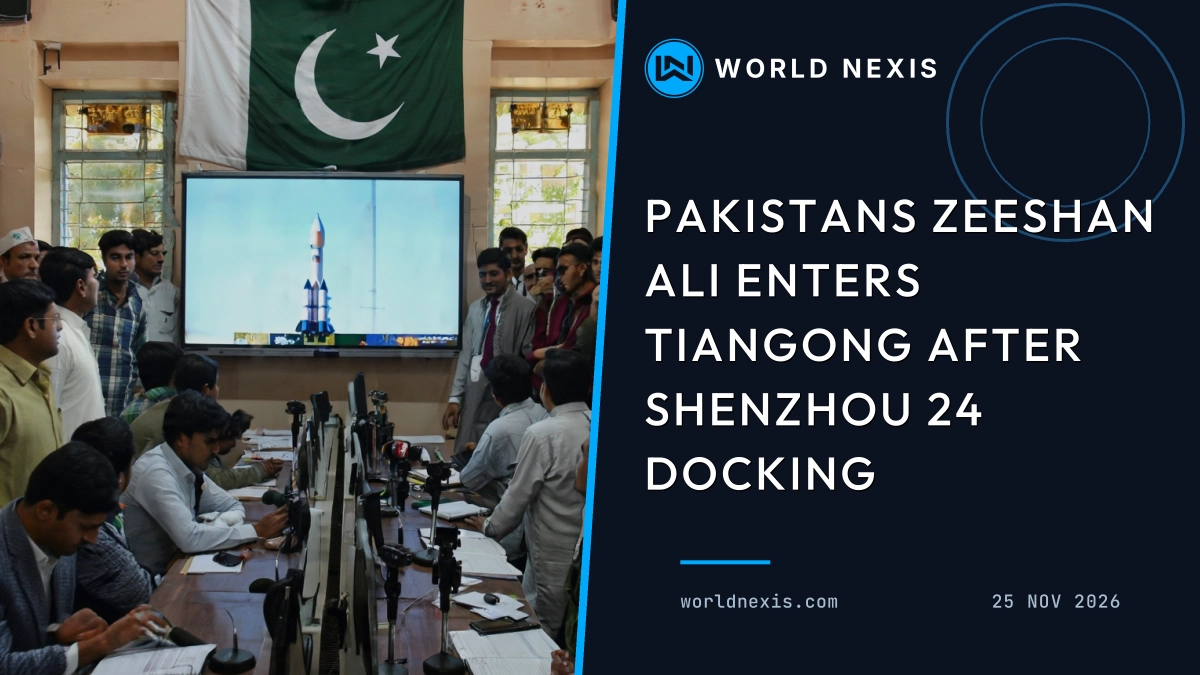
Shenzhou 24 has docked at China’s Tiangong space station with Muhammad Zeeshan Ali aboard, making the 40-year-old the first Pakistani and the first foreign national ever to enter the outpost. He is joined by commander Tang Hongbo and flight engineer Wu Yi after a flight of roughly three and a half hours from the Jiuquan Satellite Launch Centre in north-west China. Ali will stay between five and 10 days before returning to Earth aboard the Shenzhou-23 spacecraft.
Key points
- The Shenzhou 24 crew is Tang Hongbo, Wu Yi and Pakistan’s Muhammad Zeeshan Ali, who lifted off on Wednesday morning from Jiuquan.
- The docking completed China’s first crewed joint flight with a foreign astronaut, under an agreement the two countries signed in February 2025.
- More than 90 scientific experiments and technology tests are planned, including an in-orbit cyanobacteria study by Ali.
- Ali trained for seven months in Beijing and returns on Shenzhou-23; his two Chinese crewmates stay about six months.
What Pakistan gains from the Shenzhou 24 flight
For Islamabad, the mission is being presented as a national turning point rather than a single trip. It makes Ali the first Pakistani in orbit and gives the country laboratory time on a crewed station for the first time.
Prime Minister Shehbaz Sharif congratulated the nation and framed the flight as an inspiration for young Pakistanis. “This is not just one astronaut’s journey, but the journey of 240 million Pakistanis,” he wrote on X, thanking China for including a Pakistani crew member.
Planning minister Ahsan Iqbal, speaking at the launch centre, thanked China’s leadership, scientists and engineers and said he hoped the mission would open the way to wider cooperation. Asked whether Pakistan could one day send astronauts independently, he replied: “Certainly that day will come.”
Pakistan’s president, Asif Ali Zardari, and China’s Xi Jinping exchanged letters of congratulation, Zardari’s office said, describing the flight as a milestone in relations between the two countries.
Inside Tiangong with the Shenzhou 24 crew
The working schedule is dense. More than 90 experiments and technology tests are planned across space life sciences, materials science, microgravity fluid physics, combustion science, fundamental physics, space medicine and new space technology.
Ali’s own assignment on Shenzhou 24 is a photosynthetic cyanobacteria experiment, run in orbit during his short stay. He works as a payload specialist, and the Shenzhou-23 vehicle that carried the previous crew to the station will bring him home.
Preparation was demanding. Ali spent seven months training in Beijing, taking intensive Chinese-language classes, learning Chinese songs and reading Chinese poetry, and he also practised calligraphy and played table tennis.
Tang said at a news conference on Tuesday that differences in language, culture and psychology had made learning to work together harder on this mission, but that both sides’ efforts were paying off. The commander and Wu will remain in orbit for roughly six months.
Why Beijing is opening its station to foreign crews
This is the first time a non-Chinese astronaut has joined a Chinese crewed flight, and Beijing is presenting the Tiangong space station as an international science platform. Xi described it as a “boat” for peace, friendship and cooperation, and said China was willing to deepen cooperation on the peaceful use of outer space, according to Chinese state media.
Hosting a partner’s astronaut costs China relatively little and buys visible goodwill in a country with which it already has close ties. For Pakistan, the return is both symbolic and practical: a seat on a crewed vehicle, a defined experiment and a training pipeline that did not exist before this mission.
Why it matters
Crewed space is increasingly a diplomatic instrument, and the countries able to offer seats on a station decide who gets to train scientists and run experiments. That shapes technical capacity for decades, well beyond the news cycle of a single launch.
For readers in Britain and the United States, the Shenzhou 24 docking is a reminder that the small club of crewed spacefaring nations now has a queue forming outside China’s door. For Pakistan, it is a credible, government-backed route into space science for a generation of students.
Analysis
Having covered space policy for World Nexis News, I look first at what a flight like this does to the sending country’s capability, not at the photographs. On that test, the Shenzhou 24 docking is more than a photo opportunity but less than a breakthrough. It puts a Pakistani payload specialist in orbit for days, with a defined experiment, under a government-to-government agreement.
I think the sceptics have the weaker case when they dismiss this as pure prestige. The strongest counter-argument is fair: a five-to-10-day stay is short, and Pakistan still cannot launch or recover a crew of its own, so it has bought a seat rather than built a programme. But training, language skills and laboratory time are exactly what turn into domestic capability later, and Iqbal’s answer about independent flights points that way.
What most coverage is missing is the queue behind Ali. If Beijing can offer partners a working station, a reliable rocket and a short stay at modest cost, it gains a diplomatic tool that is hard to match. I will be watching which country signs the next agreement far more closely than I watch the docking replays.
What happens next
Ali’s return is the next fixed point. After five to 10 days of joint work, the Shenzhou 24 payload specialist will come home aboard the Shenzhou-23 spacecraft with two members of that mission’s crew. Tang and Wu stay in orbit for about six months.
Beyond that, the pace depends on how quickly the February 2025 agreement between the two governments is followed by fresh commitments. Iqbal said he hoped the flight would be the beginning of greater cooperation in future, without setting a timetable.
What we don’t know yet
Neither government has published the cost of the flight or the full terms of the agreement. It is also unclear how many Pakistani astronauts will follow Ali, or when the country might attempt a mission of its own.
Related coverage
Further reading
- China launches Shenzhou 24 spacecraft carrying 2 Chinese and 1 Pakistani astronaut
- Shenzhou-24 carrying Pakistan
About the author: Noah Kim is the Science & Space Correspondent at World Nexis News (WNN), covering science & space. The analysis section reflects the writer’s view.

Noah Kim
Noah Kim is Science & Space Correspondent at World Nexis News, covering research, space missions, discovery and the science behind the headlines. Based in London, he explains findings accurately, credits the researchers and institutions responsible, and distinguishes peer-reviewed results from preliminary announcements and speculation.