FCC SpaceX approval: Musk and SpaceX pledge two shares to every US child
The FCC SpaceX approval lets Elon Musk deploy up to 1 million orbital data center satellites by 2040, though astronomers warn of debris and cost risk.
Updated 26 Nov 2026, 18:56 (UK time): SpaceX and Elon Musk said they will give two SpaceX shares to every U.S. child with an active Trump Account, doubling Musk’s October pledge and putting the giveaway at roughly $18 billion on the company’s latest stock price.
SpaceX and Elon Musk said they will give two SpaceX shares to every U.S. child with an active Trump Account: one newly issued Class A share from the company, and one matched personally by Musk. The commitment doubles a pledge Musk made in October, which he described at the time as the first of many. SpaceX also said its president and chief operating officer, Gwynne Shotwell, will donate more than 2 million of her own shares to U.S. children.
The company valued the giveaway at about $18 billion based on its most recent stock price, with roughly 70 million children eligible for the accounts the White House created. Treasury Secretary Scott Bessent said contributions from friends and family had passed $1 billion per individual accounts as of Tuesday, with total assets in the programme above $9 billion. None of this alters the Starmind order itself: the FCC SpaceX approval licenses satellites, while the giveaway moves private equity, not spectrum or orbital slots.
What it changes is the politics of the approval rather than the physics of it. A constellation that the American Astronomical Society warns would brighten the night sky now arrives in public conversation as a stake in the future for every child. Two things deserve saying plainly. These are shares in a private company, not cash, and their worth in 2040 rests on a build-out whose first working station is not due until 2033. I would still rather see the debris plan than a stocking filler.
Updated 26 Nov 2026, 16:27 (UK time): The FCC’s licence for SpaceX’s Starmind constellation restricts the satellites to altitudes below roughly 600 km (373 miles) until SpaceX files an orbital debris plan, holding back higher orbits.
The clearance the FCC gave SpaceX is narrower than the headline number suggests. Starmind’s orbital data-centre satellites are licensed to operate only below roughly 600 km (373 miles) for now, with higher altitudes held back until SpaceX files an orbital debris plan.
That changes how the approval actually works. Our earlier reading treated the debris question as settled, because the commission concluded the constellation operates consistently with its existing rules. On the record now available, the order is tiered instead: a cleared low band, and an upper band waiting on a filing from the company.
The wider objections have not moved. Astronomers and rival operators asked the regulator to refuse the application, and the commission still dismissed environmental matters as outside its remit. What is new is that debris is no longer only a talking point in the preamble; it is a condition attached to altitude.
A 600 km ceiling is a real concession, but a debris plan is paperwork, not physics. Heat rejection, brightness and collision cascades do not get easier lower down — the crowded band is the low one. I would rather see the plan than the promise of one.
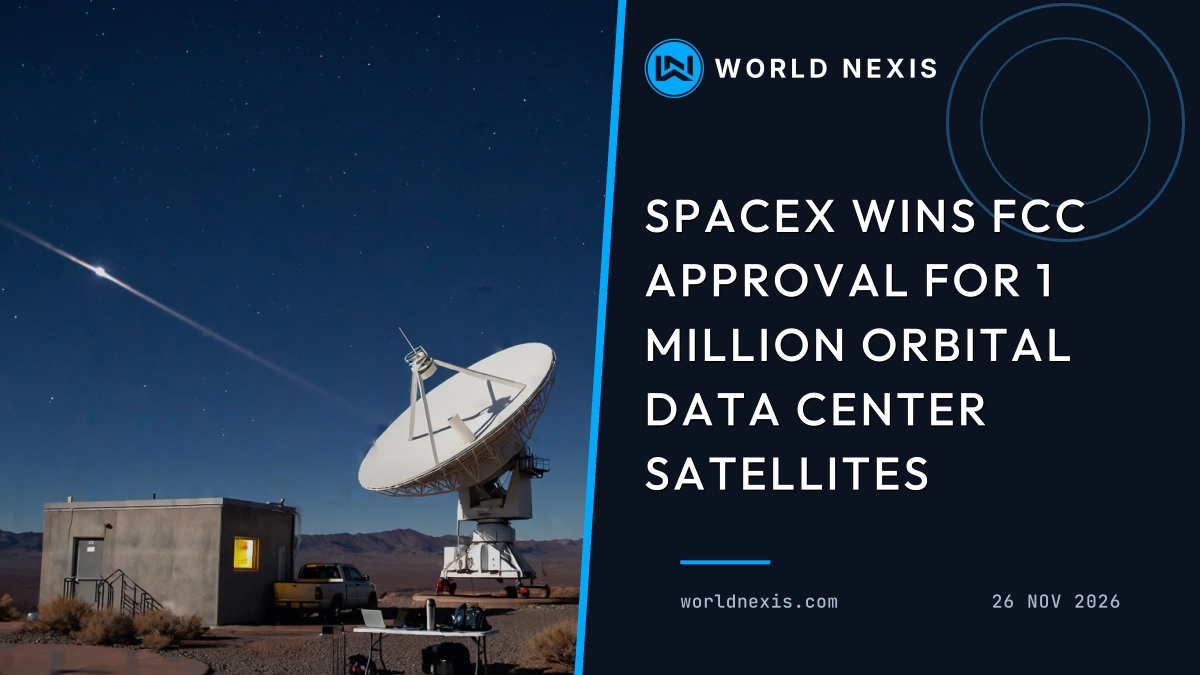
The FCC SpaceX approval granted on Wednesday authorizes up to 1 million “orbital compute modules” in a constellation named Starmind, and the order carries the project’s first hard deadline: at least one working station in orbit by 2033, with the rest of the build phased in through 2040.
The US Federal Communications Commission presented the decision as a historic first in the artificial intelligence race. Because the FCC SpaceX approval is a licensing decision rather than a funding commitment, however, it settles very little about whether the hardware can work at that scale.
Key points
- The FCC SpaceX approval allows up to 1 million satellites described as orbital data centers, grouped under the name Starmind.
- SpaceX must deploy at least one authorized space station by 2033, then add capacity gradually through 2040.
- Astronomers and rival operators, including the American Astronomical Society, Viasat and Amazon-owned Kuiper Systems, had asked the regulator to refuse.
- The commission said the deployment serves the public interest and set aside issues it said fell outside its authority, including environmental concerns.
What the FCC SpaceX approval actually permits
Under the order, the million modules would process large volumes of data that customers would use back on Earth. The commission argued the constellation brings humanity closer to harnessing “the full power of the sun,” because hardware above the atmosphere can collect solar energy without the land, weather and cooling-water limits that constrain orbital data centers on the ground.
“America is leading the world into the era of super intelligence,” FCC Chairman Brendan Carr, who was appointed by President Donald Trump, said in a statement. He added that the decision “opens a bold new frontier.” Elon Musk welcomed the ruling on social media.
The regulator did not wave the request through without friction. It acknowledged a “substantial number” of public comments, including petitions to deny the application, and said it had dismissed topics it had no authority over, such as environmental effects. On orbital debris, it concluded that the proposed Starmind constellation operates consistently with its rules.
Why scientists call the plan a fantasy
Adam Becker, an astrophysicist and author, described the prospect of launching a million satellites to build orbital data centers as “a fantasy.” The obstacle he keeps returning to is heat. Space is cold, but it is also a vacuum, which traps warmth inside objects much as a thermos keeps tea hot.
Radiating that heat away runs into what Becker called “basic physical limits.” Spreading the load across many smaller satellites could, in principle, carry enough radiating material between them, but it would be expensive and difficult to engineer.
He also points to atmospheric pollution from launches and reentries, and to collision risk in the most crowded part of near-Earth space. “You could end up with a cascading set of space junk collisions,” he said, warning of “a cloud of debris” in low Earth orbit, where many weather and telecommunications satellites also sit.
Astronomers have a separate complaint. The American Astronomical Society said it was “disheartened and dismayed” by the decision, arguing that a constellation on this scale would undermine decades of federal investment in observatories and “the ability of astronomers and the public to enjoy and study the night sky.” The society said the Starmind constellation involves “larger (and therefore brighter) and more numerous objects,” which “would therefore be visible as extremely bright objects for longer periods in the night sky.” Becker put it more simply: “It also is pollution of the night sky to the naked eye.”
Supporters of space computing argue the opposite ledger. Harnessing solar power above the atmosphere, they say, would relieve pressure on strained electricity grids and cut demand for sprawling computing warehouses on Earth, along with the water used to cool them.
Why it matters
For households and businesses, the argument is less about satellites than about who absorbs the cost of the AI boom. The FCC SpaceX approval does not settle that, but it makes the trade-off concrete: ground data centers compete for power and water in the towns that host them, while orbital ones push the demand into a shared space nobody owns.
Then there is the debris risk. Low Earth orbit already carries much of the weather and communications hardware behind forecasting, navigation and mobile coverage. A collision chain there would show up in everyday services long before it showed up in a courtroom.
Analysis
Having covered space policy for World Nexis News, I read orders like this one for what they leave unanswered, and the FCC SpaceX approval leaves the biggest question untouched. The commission was asked whether SpaceX may transmit from orbit. It was not asked whether a million-unit constellation is a sensible way to run artificial intelligence, and it said so by dismissing environmental matters as outside its remit.
In my view the burden of proof should sit with the applicant. Heat rejection at this scale, the brightness of the hardware and the long-term debris profile are engineering problems with known failure modes, and one station by 2033 is a remarkably soft gate for a project whose endpoint is a million. The counter-argument deserves respect: space-based solar could genuinely ease pressure on grids and water supplies, and refusing a license would simply hand the field to a rival. But “someone else might do it” is not a safety standard.
What I take from the ruling is that the real decision has been deferred rather than made. The physics will settle it eventually, and physics does not read press releases.
What happens next
The FCC SpaceX approval now moves into a construction phase with a long fuse. SpaceX has until 2033 to place at least one authorized station in orbit, and the order envisages steady additions through 2040, giving engineers roughly seven years to prove the thermal design before the constellation reaches any meaningful size.
In the meantime, the company must show that the deployed hardware does not breach the debris rules the commission relied on when it approved the request.
What we don’t know yet
The order does not resolve the heat rejection, brightness or collision-avoidance questions scientists raised, because the commission treated those as outside its remit. How SpaceX intends to fund a buildout on this scale is also unstated. Whether opponents of the decision take it to court remains open.
Related coverage
- Shenzhou 24 docking marks Pakistan’s historic first in orbit
- ABC license ruling: judge blocks FCC review of 8 stations
- DEA fentanyl pills: 1.4 million left to flow in major probe
Further reading
- FCC says SpaceX can deploy 1 million satellites for data centers in space. Scientists are skeptical
- SpaceX earns billions renting AI compute to Anthropic and Google
About the author: Noah Kim is the Science & Space Correspondent at World Nexis News (WNN), covering science & space. The analysis section reflects the writer’s view.

Noah Kim
Noah Kim is Science & Space Correspondent at World Nexis News, covering research, space missions, discovery and the science behind the headlines. Based in London, he explains findings accurately, credits the researchers and institutions responsible, and distinguishes peer-reviewed results from preliminary announcements and speculation.