Democratic primary debates: 12 confirmed as 2028 race opens
The Democratic primary debates will number 12, starting in June 2027, with a dark money pledge for candidates. Here is what it means for the 2028 race.
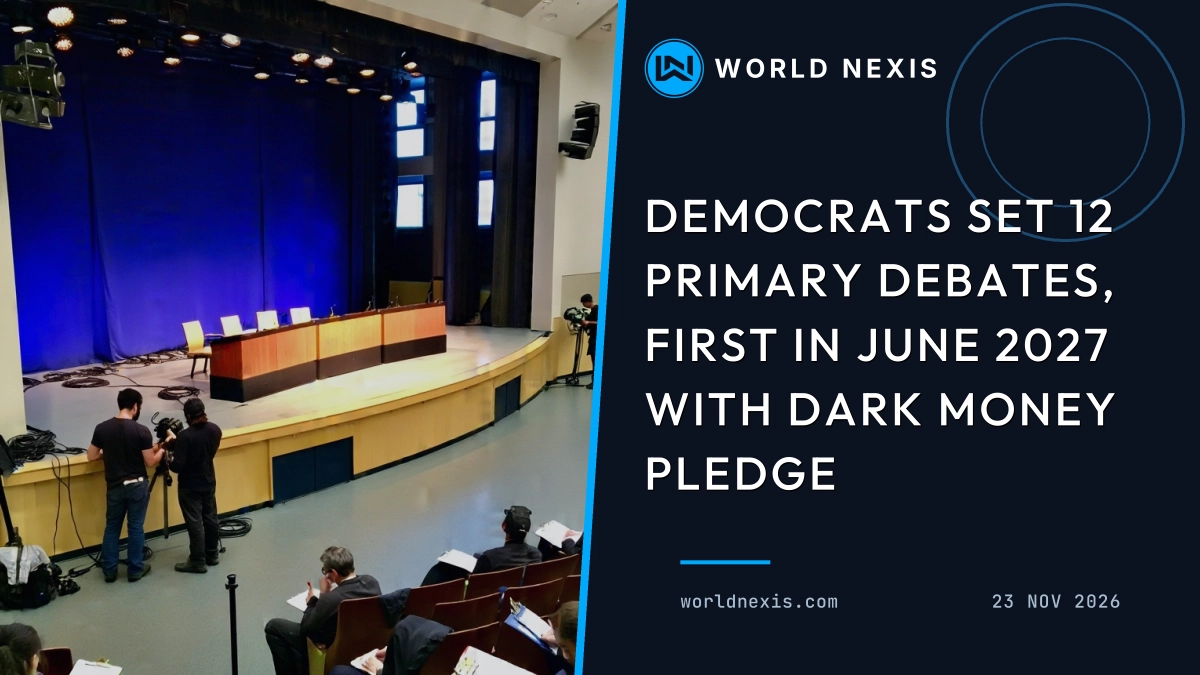
Updated 25 Nov 2026, 02:31 (UK time): DNC Chair Ken Martin publicly conceded that the dark-money pledge tied to the Democratic primary debates is difficult to enforce and ‘not a perfect solution’, and Senator Elizabeth Warren became the first prominent Democrat to publicly endorse the rule.
The Democratic National Committee’s debate framework now has its first on-the-record caveat from the top. Chair Ken Martin, in a broadcast interview on Monday, acknowledged that the pledge candidates must sign to reach the stage would be difficult to enforce. “This is a hard thing,” he said. “This is not a perfect solution, but I really believe we have to live our values.”
The rule also picked up its first prominent Democratic endorsement. Senator Elizabeth Warren of Massachusetts, who ran in 2020, said on social media that voters have made clear dark money should have no place in politics and that the party must listen. The party has said qualification will rest on polling and grassroots fundraising, as it did in 2020, with thresholds, dates and media partners still due in January.
What changes is less the rule than the record around it. The chair has now said aloud what the framework implied: the pledge binds candidates, not the groups spending for them, and enforcement runs through a complaint and review process rather than any penalty the party can impose. That candour is useful and slightly damaging at once, because it hands rivals a quotable admission before anyone has qualified for a single night. I would rather a party chair say plainly where the limits are than oversell a promise he cannot police, and Warren’s backing gives the rule a defender with credibility on the issue. But a public admission that the central condition is hard to enforce is exactly the sentence a super PAC will repeat in a mailer two years from now.
The Democratic primary debates will total 12 in the 2028 cycle, the Democratic National Committee announced on Monday, with the first in June 2027 and the last in March 2028. Five will be held next year and seven in 2028. Anyone who wants a place on the stage must now publicly disavow super PAC and dark money support.
The announcement opens a race with no declared candidates, to succeed a term-limited Republican president, Donald Trump. It lands less than a month after a midterm election in which Democrats flipped both chambers of Congress and won their largest majority in decades.
Key points
- 12 Democratic primary debates: five in 2027 and seven in 2028, opening in June and closing in March 2028.
- Each night is capped at 20 qualifying candidates; if more qualify, the party splits the debate over two nights and assigns candidates at random.
- For the first time, qualification depends on a pledge to denounce super PAC and dark money spending on a candidate’s behalf.
- Polling and grassroots fundraising will decide who qualifies, as in 2020, with thresholds, dates and media partners due in January.
What the Democratic primary debates will decide
No Democrat has declared a campaign. Several prominent figures have indicated their interest, and the party is planning for a crowded field.
The Democratic primary debates are the party’s main instrument for sorting that field. They give lesser-known candidates a national platform, push front-runners into unscripted moments and thin the stage as polling and fundraising bars rise.
Ken Martin, the DNC chair, cast the schedule as momentum. “The DNC is keeping our foot on the gas as we head into the 2028 cycle,” he said in a statement.
The DNC debate schedule echoes the last competitive race. The 2020 cycle also featured a dozen debates, opening in June 2019, and that format shrank an unusually large field month after month.
The dark money pledge at the centre of the plan
Martin has made ending dark money in politics a signature cause, and the framework puts it into the qualifying rules. Candidates who benefit from certain advertising by super PACs and dark money nonprofits would have to publicly denounce that support.
The politics explain the timing. Corruption in government ranked among voters’ top concerns at this month’s midterms, so a rule written for activists also speaks to swing voters.
The limits are just as clear. The party acknowledges that it cannot prohibit outside spending, which means the pledge binds candidates rather than the groups spending for them.
Alongside it, the DNC said campaigns would be barred from joint fundraising agreements with Democratic Party committees during the primary, and could not authorise coordinated spending by state or local parties on their behalf. Officials say the intent is to limit dark money and keep the party neutral in a competitive race, and the party said it will run a complaint and review process so campaigns can raise alleged violations before qualification closes.
The Democratic primary debates will be the first real test of whether any of it holds.
Why it matters
For voters, the Democratic primary debates set the terms of the argument. A 20-person stage spread across two nights hands long-shot candidates a national hearing they could never buy, and gives front-runners 12 chances to make a mistake.
For the party, the 2028 presidential primary rules are an attempt to avoid the factional fights that have damaged past contests. A nominee who survives a procedural war arrives in the general election with a divided base and a thinner message.
The debate plan is one of the two decisions the DNC watches most closely, alongside the choice of convention city. Earlier this year the party narrowed that list to Boston, Denver and Philadelphia.
Analysis
I have covered election data and accountability for World Nexis News, and I look first at what can actually be policed. The dark money pledge is the headline, yet the party says plainly that it cannot stop outside groups spending. A promise nobody can enforce tests character, not compliance.
In my view the quieter provisions carry more weight. Blocking joint fundraising agreements between campaigns and party committees during the primary, and coordinated spending by state parties, targets the machinery that decides close nomination fights. Money routed through party committees moves faster and with less scrutiny than a public ad buy, and the neutrality rules are where the facts best support the reformers.
The strongest counter-argument is that all of this is performance: a candidate can denounce a super PAC on Monday and welcome its advertising on Tuesday. I still think the pledge is worth having, because a public promise creates a record that rivals and reporters can hold against a nominee for two years.
What happens next in the Democratic primary debates
January is the next milestone. The DNC has said it will publish exact dates, times, locations, media partners and the polling and fundraising thresholds candidates must meet.
The convention city is still undecided, with Boston, Denver and Philadelphia in contention. Candidates are expected to declare through 2027, before the Democratic primary debates open in June and close with a final clash in March 2028.
What we don’t know yet
Nobody outside the party knows the qualifying numbers, and they will decide how many candidates share a stage. It is also unclear whether the dark money pledge will be tested before the first debate, and which broadcasters will carry the 12 nights.
Related coverage
- Turkey pardon 2026: two birds at Willard as final vote opens
- Nvidia rehire call: Trump backs Jensen Huang’s return
- Pregnant workers ruling: 9-8 court blocks enforcement
Further reading
- Democrats announce plans for 12 debates starting in June for 2028 race
- Democrats plan 12 debates for their 2028 presidential primary, with the first in June
About the author: Ayesha Rahman is the Senior Political Correspondent & Columnist at World Nexis News (WNN), covering politics & opinion. The analysis section reflects the writer’s view.

Ayesha Rahman
Ayesha Rahman covers politics and opinion for World Nexis News from London, focusing on elections, legislatures and the policy choices that shape everyday life in the US and UK. She writes analysis and columns that separate what is confirmed from what is claimed, working from…



