Lead azide detonation in Iowa halted by federal appeals court stay
The US Army has pushed the lead azide detonation in Iowa to Monday, Nov 23, warning 5 tons of unstable chemical could send lead dust over two states.
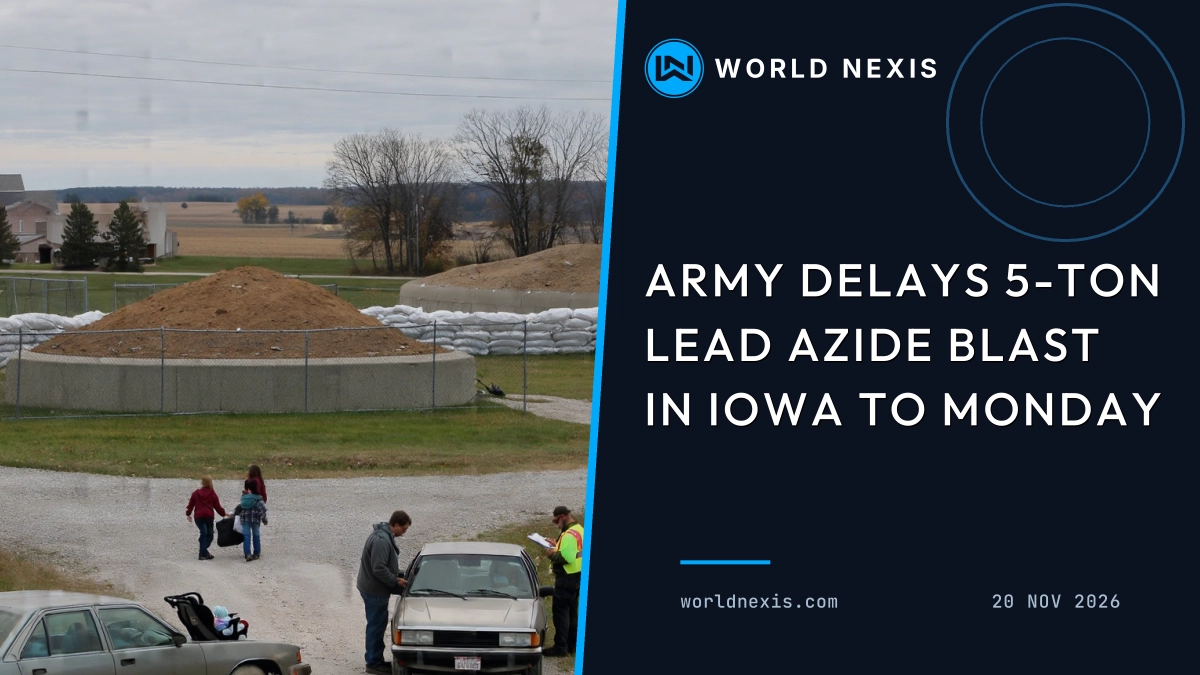
Updated 20 Nov 2026, 23:51 (UK time): A federal appeals court stayed the EPA emergency permit late Thursday, indefinitely suspending the planned Monday lead azide detonation near Middletown, Iowa, until it rules.
The 8th U.S. Circuit Court of Appeals late Thursday put the EPA emergency permit on hold, indefinitely suspending the planned lead azide detonation at the Iowa Army Ammunition Plant until the court rules. The Army cannot carry out the blasts while the permit is stayed, Earthjustice attorney Thien Chau said.
The court had not issued a schedule as of Friday, and federal attorneys said they would respond on or before Sunday. They argued the Army can treat hazardous waste without a permit in emergencies when there is an immediate threat to health, safety, property or the environment.
The Army, EPA and Department of Health and Human Services said Friday they had planned the operation since March and were working to ensure it is conducted as safely as possible. The stay does not resolve the underlying dispute over whether the five tons of degraded material should be destroyed in place.
I think the pause gives Middletown residents room to press for a fuller safety review, but it does not make the unstable stockpile any less dangerous.
The lead azide detonation at the Iowa Army Ammunition Plant will now go ahead on Monday, November 23, after the Army postponed two controlled blasts of about 5 tons of unstable explosive that had been due at noon on Friday. Acting Secretary of the Army Adam Telle announced the delay on Thursday evening, saying it runs to “the latest possible moment” before a forecast temperature drop that could make the material more dangerous. Middletown, the community of about 360 people closest to the plant, now has a weekend to prepare for a plume of dust carrying lead particles that could drift across eastern Iowa and into Illinois.
Key points
- Two rapid explosions will destroy 68 drums of degraded lead azide inside earth-covered concrete magazines at the plant.
- Residents have been asked to leave home or stay indoors from 08:00 to 14:00 local time, and old windows nearby could shatter.
- The Army says lead dust could settle on farmland, playgrounds and other surfaces across eastern Iowa and northwest Illinois.
- The operation moved from Friday to Monday because colder weather could destabilize the chemical further.
What the lead azide detonation means for residents
Households in the path have been asked to vacate for about six hours, between 08:00 and 14:00 local time, while the blasts go ahead and the dust settles. The Army has warned that “all humans” should avoid outdoor activities in the affected areas. The two consecutive, rapid detonations will be loud enough to be felt as vibrations, and officials have said they could damage buildings and break windows in town.
Maps showing where the plume may travel have been reissued as the forecast shifts. Some schools in the path had already canceled or changed their Friday classes before the delay landed, and the same decisions now fall to be made again for Monday. The Army has advised residents to clean cars, windowsills and outdoor surfaces once the dust has passed.
Engineers will saturate the soil above the magazines with water before the blast and surround the barrels with sand-filled barriers, in an effort to keep lead out of the air. The lead dust plume is still expected to be visible from surrounding farmland, and its direction depends on wind speed on the day.
How 5 tons of unstable explosive ended up in Middletown
The lead azide detonation was first scheduled for noon on Friday, November 20, at a plant that sits about four hours west of Chicago near the Mississippi River. Lead azide is a highly sensitive compound used to trigger larger charges, and the stock in Middletown has been in storage for more than 20 years.
Justine Barati, a public affairs specialist at Army Sustainment Command, said the material is kept in a bath of ethanol and water to hold it stable, but that a routine check earlier this year found some of the water had evaporated. That left drums of material judged too unstable to move safely. Military and environmental officials concluded that destroying it where it stands was the least dangerous option.
The Environmental Protection Agency granted an emergency permit for the work on November 13, saying the explosion risk “presented an imminent and substantial threat to human health and the environment”. Lt Col Daniel Nosse, commander of the plant, has said: “The safety of our people and our neighbors is non-negotiable.”
Court challenge and anger from Iowa leaders
The delay followed a legal move by environmental groups seeking to block the blasts and questioning the validity of the emergency permit. Michael Schmidt, general counsel at the Iowa Environmental Council, said: “The EPA itself admits that there is no safe level of lead exposure for humans.” He added that Iowans “deserve to know that every available alternative was considered before choosing this method of disposal”.
Iowa’s political leadership learned of the plan at roughly the same time as the public. The office of Governor Kim Reynolds said it was first briefed on Monday about the public advisory. Governor-elect Rob Sand wrote on X that “an unacceptable lack of communication and clarity has made Iowans understandably concerned and angry”, and asked why other options would have been worse if this is the safest one.
Telle acknowledged the criticism, writing that “public communication is essential to public trust” and that he was engaging state officials.
Why it matters
For families in and around Middletown, Monday is now a day of disrupted work, school runs and sealed windows, followed by cleaning that may need repeating. Lead has no known safe exposure level, and the people most at risk, young children and pregnant women, are the least able to judge whether the dust has settled.
The bigger question is precedent. A federal agency has authorized a release of toxic dust into open air on public safety grounds, and the paperwork behind that decision will shape how similar stockpiles at other munitions sites are handled. Whatever happens on Monday, the lead azide detonation has exposed a gap between federal emergency powers and local information.
Analysis
Having covered emergency response for World Nexis News, I look first at the notice people were given, because that is the part of this story that failed. The explosive hazard is real, and the Army’s engineers may well be right that moving degraded lead azide is more dangerous than destroying it in place. But residents were told days, not weeks, before a plume was due over their farmland, and the governor’s office says it learned of the advisory only on Monday.
On the evidence in front of us, the case for a longer pause is stronger than the case for speed. The Army itself says colder weather could destabilize the material, so this weekend delay carries its own risk, but a court, a state health department or an independent monitor could have reviewed the alternatives in that time, and none has.
The counter-argument deserves air: nobody wants a truck carrying 5 tons of sensitive explosive on a highway, and a slow, staged removal could put more people in danger than two blasts inside a bunker. That is exactly why the Army should publish the modeling behind its choice rather than assert it. In my view, trust here is a public health instrument, not a courtesy.
What happens next
The lead azide detonation is now set for Monday, November 23, with the six-hour protection window opening at 08:00 local time. The Army says it will keep updating plume maps as the forecast firms up, and Iowa health officials have issued safety guidance for people living near the site.
Environmental groups are still pursuing their challenge to the emergency permit. Schools and employers in the path must decide whether to close again, residents who leave need somewhere to go for the day, and anyone who stays will be watching the wind.
What we don’t know yet
It is not clear whether a court will intervene before Monday, or whether state officials will press for a longer hold. The plume’s exact path depends on weather that will not settle until the weekend. No one has said publicly what monitoring will be in place to measure lead levels in the hours after the blasts.
Related coverage
- Glastonbury 2027: Styles and Eilish lead youngest headliners
- War powers resolution defeated 48-51 in Senate Iran vote
- Fiona the hippo dies at nine as zoo director says staff are in shock
Further reading
- US army warns detonation of unstable explosives will create toxic plume
- US army postpones plan to detonate bomb-making chemical amid outcry
About the author: Tariq Al-Mansoori is the Breaking News Reporter at World Nexis News (WNN), covering breaking news. The analysis section reflects the writer’s view.

Tariq Al-Mansoori
Tariq Al-Mansoori is a Breaking News Reporter at World Nexis News, covering major incidents, official statements and developing stories across the UK, US and internationally. Based in London, he works to confirm details before publication, attributes information to named sources where possible and updates stories…



