FAA ground stop: NTSB joins investigation into FedEx Miami overrun
A FedEx cargo jet overran a runway at Miami International Airport, prompting an FAA ground stop and 3-hour delays on the eve of the Thanksgiving rush.
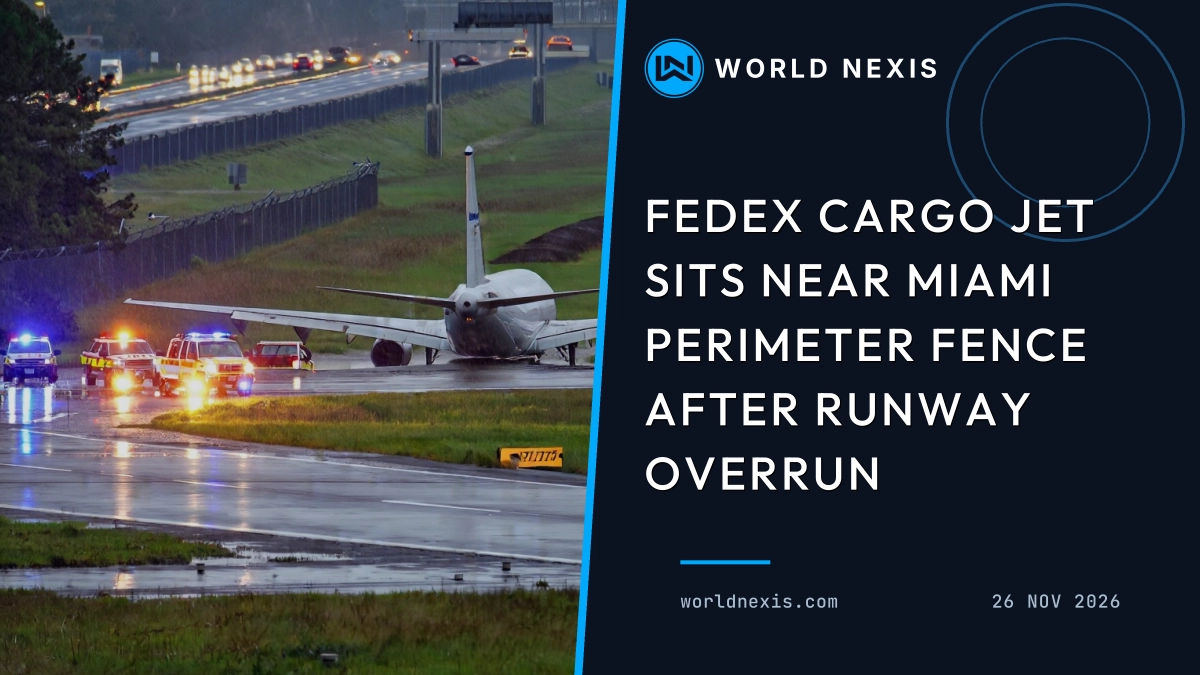
Updated 26 Nov 2026, 20:16 (UK time): The National Transportation Safety Board is now investigating the FedEx MD-11 overrun at Miami, widening federal scrutiny beyond the FAA’s initial inquiry.
The investigation into Wednesday night’s FedEx cargo jet overrun at Miami International Airport now has a second federal agency attached to it. The National Transportation Safety Board has been notified and says it is investigating the incident, alongside the Federal Aviation Administration’s own inquiry into how the McDonnell Douglas MD-11 left the runway while arriving from Memphis.
Airport officials said the jet came to rest upright and intact with no fire, and FedEx has confirmed its crew was safe. The aircraft was stabilized where it stopped while crews checked the surface, and at least one runway was back open by Thursday morning, though carriers were still repositioning aircraft and crews.
What changes is the scale of the scrutiny. Before Thursday, this was an FAA runway-incident file opened on the eve of Thanksgiving; with the NTSB involved, investigators are expected to pull flight data, runway condition reports and air traffic communications, which is a slower and more public process.
I think the second agency matters less for what it will find than for when it will say it. Two cargo jets off Miami’s western runway ends in under three months is the question travelers will keep asking, and a full federal docket is the only place that answer can be tested properly.
An FAA ground stop halted flights bound for Miami International Airport on Wednesday night after a FedEx cargo jet overran a runway in heavy rain, closing all but one runway on the eve of Thanksgiving. The McDonnell Douglas MD-11 had arrived from Memphis when it left the runway surface. No injuries have been reported, and the Federal Aviation Administration has opened an investigation.
Key points
- A FedEx MD-11 arriving from Memphis overran a runway at Miami International Airport shortly after 8 pm local time on Wednesday.
- An FAA ground stop took effect at 8:16 pm, and all but one runway was closed.
- Miami-Dade Fire Rescue reported no injuries and no transports from the scene.
- FAA advisories later put average delays at 3 hours 34 minutes as the disruption ran into Thursday.
What happened on the runway
The aircraft came to rest near the airport’s perimeter fence, close to a busy road that runs along the edge of the airfield. All but one runway was shut while fire crews and airport staff secured the scene, and inbound flights were held on the ground at their departure airports.
Federal officials said the jet had been arriving from Memphis. FedEx confirmed that the aircraft experienced a problem on landing and said its crew was safe.
“We are grateful that our crew is safe and there are no reported injuries.” — FedEx spokesperson
The company said it was coordinating with investigators. Miami-Dade Fire Rescue confirmed that nobody was hurt and that no one was taken to hospital.
Why the FAA ground stop was ordered
The FAA ground stop took effect at 8:16 pm local time, with the agency’s command center citing a disabled aircraft on the airfield. The agency flagged a medium probability that the restrictions would be extended.
A ground stop holds aircraft at their departure airports until the receiving field can accept them again. Flights bound for Miami were held for more than an hour before the FAA said they would be resuming shortly, and capacity was restored in stages overnight.
“We appreciate our passengers’ patience as we work to safely resume normal operations,” the Miami-Dade Aviation Department said in a statement.
A second cargo overrun at the same west end
The Miami airport runway overrun happened almost three months after a Prime Air cargo jet overran another runway at the same airport and crashed through the perimeter fence. Five people on the ground were killed on 6 September when that aircraft struck a vehicle on a road beside the airfield.
Both jets went off the western ends of adjacent runways before reaching the perimeter. The FedEx aircraft stopped inside the fence; the September jet did not.
Thanksgiving travel delays after the FAA ground stop
Wednesday is one of the busiest travel days of the year in the United States, so a runway closure at a major South Florida hub moves through the network within hours. Delays at Miami initially ran to about an hour and appeared to be easing late in the evening.
They did not stay that way. By early Thursday, FAA advisories put average delays at 3 hours 34 minutes, and the FAA ground stop had pushed a single landing incident well beyond the airport boundary.
Weather was already working against the field. A flood watch covered the Miami-Dade area into Wednesday night, with forecasters warning of heavy rain and flooding across the region.
Why it matters
For travelers, the FAA ground stop meant rebooking, missed connections and long lines during the most crowded flying week of the year. Cargo and passenger schedules share the same concrete, so a freight jet parked at the fence slows everyone behind it.
For Miami, the deeper question is geography. The airport’s western runway ends sit close to public roads, and two heavy jets have now gone off the end there in under three months.
Analysis
Having covered emergency response for World Nexis News, I look first at what did not happen on Wednesday: nobody was hurt, nothing caught fire, and the jet stopped inside the fence. That is partly luck and partly margin, and margin is exactly what an investigation should be measuring.
I think the pattern matters more than the individual landing. Two cargo jets, two adjacent western runway ends, under three months apart, at an airport ringed by roads — and one of those events killed five people on the ground. The strongest counter-argument is that heavy rain and a wet surface may explain a single overrun, and that with no casualties it is premature to talk about systemic failure. That argument would carry more weight if the two aircraft had used unrelated corners of the airfield.
In my view, the airport and the FAA should treat runway-end protection at Miami as an urgent piece of infrastructure work, not as a pair of unlucky landings to be filed away when each inquiry closes.
What happens next
The FAA is investigating the overrun, and FedEx says it is working with investigators. The airport is expected to keep restoring runway capacity through Thursday as crews inspect the surface and move the aircraft.
The FAA ground stop has lifted, but Thanksgiving travel delays will linger for carriers repositioning aircraft and crews. Passengers flying through Miami should confirm their flight status with their airline before leaving for the airport.
What we don’t know yet
Investigators have not said why the jet left the runway. It is not yet clear whether surface water, braking performance, aircraft systems or something else played a part, and no findings have been published.
Related coverage
- ABC license ruling: judge blocks FCC review of 8 stations
- Macy’s parade postponed: first Saturday show in 100 years
- Iowa lead explosion sends toxic dust warning 100 miles out
Further reading
- FedEx plane overshoots Miami runway, causing temporary ground stop at airport
- FedEx cargo jet overshoots runway at Miami International Airport and stops just short of busy road
About the author: Tariq Al-Mansoori is the Breaking News Reporter at World Nexis News (WNN), covering breaking news. The analysis section reflects the writer’s view.

Tariq Al-Mansoori
Tariq Al-Mansoori is a Breaking News Reporter at World Nexis News, covering major incidents, official statements and developing stories across the UK, US and internationally. Based in London, he works to confirm details before publication, attributes information to named sources where possible and updates stories…



