Batmobile auction: 1992 Batman Returns car eyes $7m record
A 1992 Batman Returns Batmobile goes under the hammer at a Batmobile auction on Monday, with Julien's eyeing $5m-$7m and a 2013 record in play.
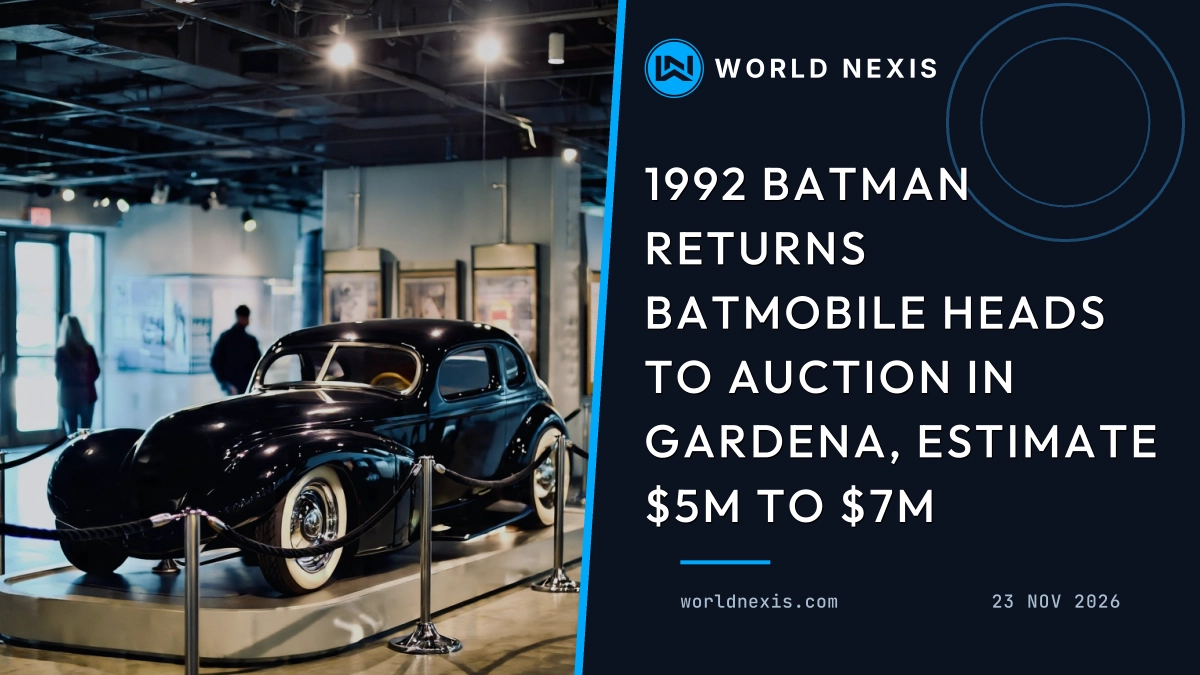
The Batmobile auction that collectors have been circling all week lands on Monday, when a screen-used car from Tim Burton’s 1992 film Batman Returns goes under the hammer at Julien’s Auctions in Gardena, near Los Angeles, with a preauction estimate of $5 million to $7 million. It is the headline lot in a sale that also features dozens of pieces of Batman and other superhero memorabilia.
Key points
- The Batman Returns Batmobile is one of three custom-made versions built for the film and is listed in the catalog as the “Number One Hero car”.
- Julien’s expects $5 million to $7 million, against the $4.6 million paid in 2013 for the 1960s television Batmobile.
- It keeps its original paint, a Chevrolet V-8 engine and a radio-controlled flaming exhaust system.
- The buyer cannot drive it: the car is not street legal and must stay stationary during public displays.
- The Batmobile auction takes place on Monday in Gardena, near Los Angeles.
Inside the Batmobile auction
Just under 20 feet long and finished with two sweeping tail fins, the glossy black car appeared in most of the film’s driving sequences. Julien’s, in notes published on its website, calls it one of the most recognized and important cinematic vehicles in Hollywood history.
Three custom versions were built for the production, and this is the one the catalog treats as the principal hero car. That designation is the detail collectors will weigh first, because the notes tie this vehicle directly to the driving work on screen.
On screen the car was hijacked by the Penguin and careened through Gotham’s streets, and in the story it was kept beneath Wayne Manor. Michael Keaton’s Batman used the flaming exhaust to torch one of the Penguin’s circus goons.
Since filming ended the car has spent years on display at the Marconi Automotive Museum in Tustin, California, where it was photographed on Friday, days before the Batmobile auction. Its original paint survives, although Julien’s says the engine and transmission have been tested only a limited number of times since production wrapped.
Why the Batmobile auction could break a record
The benchmark is the 1960s television car driven by Adam West, which sold in 2013 for $4.6 million including fees. The bottom of the new Batmobile auction estimate already sits above that figure, so a strong result on Monday would set a fresh mark for a screen Batmobile.
Julien’s points to the influence of Burton’s darker aesthetic on modern superhero movies when it sets out the car’s significance. Batman Returns followed Burton’s 1989 Batman, and its version of Gotham is the one the auction house has in mind when it talks about that aesthetic.
The sale is built around the car, with the rest of the catalog made up of Batman and other superhero items. Bidders will read the final figure as a marker for the wider memorabilia trade, because the lot has been priced as the star of the room.
The catch for the winning bidder
Nobody is driving this car home. Julien’s states plainly that the vehicle is not street legal, which rules out any use beyond display and private storage.
Ownership also carries conditions set out in an agreement with Warner Bros. Consumer Products Inc., the company that handles DC Comics’ intellectual property rights. The buyer must secure approval before exhibiting the car at special events, and the vehicle must remain stationary when it is shown to the public.
In practice the winning bid at the Batmobile auction buys a piece of cinema history that has to be handled like a museum object. Any owner who wants to show it will be dealing with two sets of rules: the studio’s approval process and the limits of a car built for cameras rather than roads.
Why it matters
For most readers the Batmobile auction is spectacle, but the price will be watched closely across the market for film and television props. A big number lifts expectations for insurance values, museum loans and the smaller Batman lots that share the same catalog.
The sale also decides where a piece of 1990s cinema ends up. The car has been on public view in Tustin for years, and a private owner could take it out of regular display.
For fans who never saw Batman Returns on a big screen, the vehicle remains one of the few physical objects from that production that can still be visited, bought or argued about.
Analysis
I think the $5 million to $7 million range is realistic, and I side with Julien’s over the collectors who call a car that cannot be driven an expensive statue. Having covered the film industry for World Nexis News, I look first at what a vehicle actually did on camera. This one carried most of the driving shots, with the paint and the flame rig that made those scenes land.
The strongest counter-argument is practical. A machine you cannot drive, cannot show without approval and must keep stationary has lost the function that makes a car valuable in the first place. Buyers at this level are not shopping for transport, though. They are buying a display object with documented provenance, and the years it spent at a public museum give it exactly that.
What I will watch at the Batmobile auction is the gap between estimate and final bid. If the car clears $7 million, the 1990s blockbuster generation has been formally repriced at the top of the market. If it stalls near the low end, the lesson is that nostalgia has a ceiling once the keys are taken away.
What happens next
Monday’s Batmobile auction takes place at Julien’s Auctions in Gardena, with the car leading the Julien’s Auctions Batman sale. The final price, including fees, will settle whether the preauction range held.
What we don’t know yet
No buyer has been identified, and it is not yet clear whether the car will stay on public view once it changes hands. The result will also show how heavily the Warner Bros. restrictions weigh on bidders.
Related coverage
- Carnaval de Luz: U2 album scores record 12th UK number one
- Jolene billion streams: Dolly Parton classic sets record
- Titanic ring auction: rare diamond sells for £150,000
Further reading
- Buying Batman’s ride may take a Bruce Wayne budget as 1992 Batmobile heads to auction
- Buying Batman’s ride may take a Bruce Wayne budget as 1992 Batmobile heads to auction
About the author: Emily Carver is the Culture & Entertainment Writer at World Nexis News (WNN), covering culture & entertainment. The analysis section reflects the writer’s view.

Emily Carver
Emily Carver is Culture & Entertainment Writer at World Nexis News, covering film, television, music, gaming, books and the creative industries from Los Angeles. She writes about the business and craft behind the work — streaming economics, production decisions, criticism and the way culture travels…