Carbon farming award: 430-farm breakthrough lands top prize
Carli Davis has won the carbon farming award at Australia's national agriculture honours, with her 430-farm payment model set to expand in 2027.
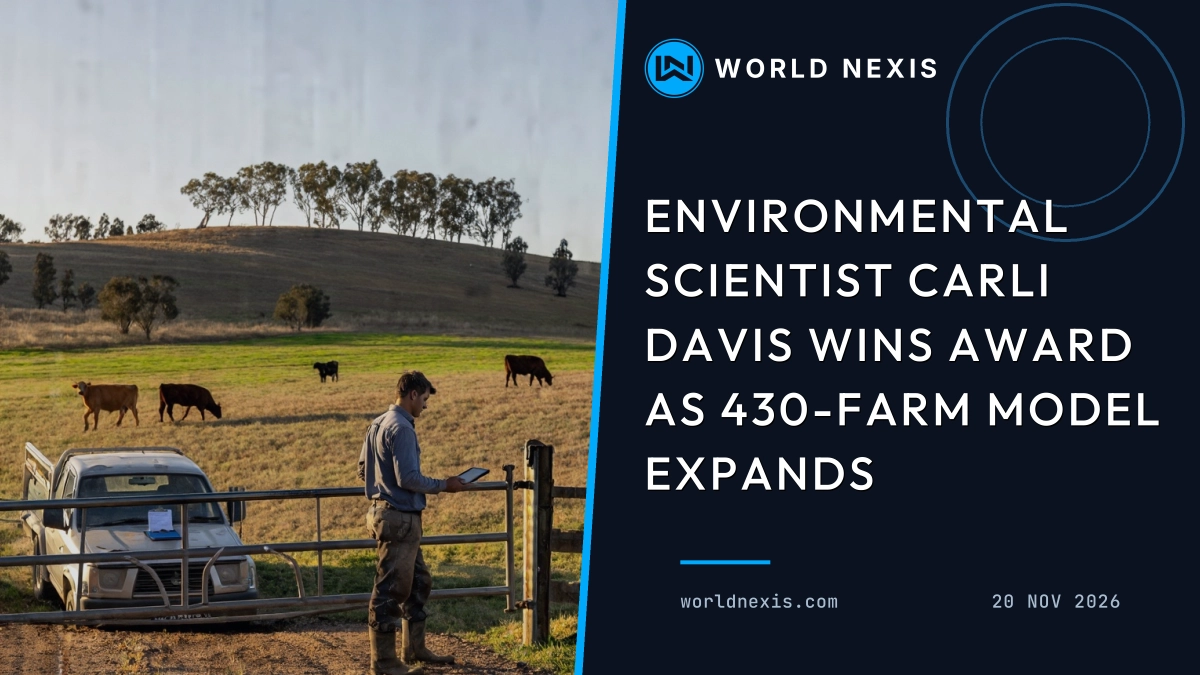
The carbon farming award at Australia’s national agricultural honours has gone to an environmental scientist whose payment model already spans more than 430 farms across 12 regions, with three new Australian regions due to come online in early 2027. Carli Davis was named national Nutrien NextGen Leader at the Australian Agricultural Awards on Thursday, 19 November, collecting a $5,000 cash prize and a handcrafted medal.
Ms Davis, who is based in the Northern Rivers of New South Wales, was recognised for building a route for farmers into Australia’s carbon marketplace — one that begins with the unglamorous questions of who pays, how much and on what terms.
Key points
- Carli Davis is the national Nutrien NextGen Leader at the Australian Agricultural Awards, announced on Thursday, 19 November.
- She takes home $5,000 and a handcrafted medal for a funding model that pays farmers for environmental work.
- More than 430 farms in 12 regions already take part, and three Australian regions start in early 2027, including the Hunter and Mid-Coast.
- The approach was first developed in the United Kingdom with consultancy partner 3Keel.
How the carbon farming award winner gets money to farmers
The carbon farming award recognises Landscape Enterprise Networks, known as LENs, which pools investment from large companies and directs it to landholders who need funding to adopt or keep sustainable practices on farm. The model takes on payment structures, red tape and funding gaps at the same time.
The design leans on short-term contracts and on recognising work a farm has already done, rather than asking landholders to start again from scratch. Planning around farmers “on their terms, from the start” was, in her account, central to getting them engaged.
“Landscape Enterprise Networks acknowledge that sometimes farmers have been doing rotational grazing, diverse pastures, and similar things for several years, that doesn’t mean they shouldn’t be remunerated,” she said.
She also presents the contracts as a form of protection as well as payment. Farmers weighing a change of practice can use the arrangement to limit their exposure: “If you’re thinking of doing innovative things on your farm, this is a way you could de-risk it.”
Her wider case is that Australian agriculture has room for a mechanism that rewards good practice directly. “There’s space in Australian agriculture for an option for farmers to get involved and be rewarded for doing the right thing,” she said.
Corporate buyers, a UK partner and a state-level gamble
Behind the carbon farming award sits a funding chain that runs from multinational food companies to individual paddocks. Investment from corporations including Nestlé and PepsiCo is connected to landholders who need capital for more sustainable practices.
None of this is untested. Before the Australian launch, Landscape Enterprise Networks were already operating in the United Kingdom with consultancy partner 3Keel, giving Ms Davis a working template to adapt rather than a theory to sell.
Public backing followed a similar pattern. She credits New South Wales Local Land Services with taking “a little bit of a gamble on us”, after which the NSW Department of Climate Change, Energy, the Environment and Water pushed the concept from a feasibility study into an actual pilot.
Commercially, the project runs through SEAOAK Consulting, which Ms Davis founded with business partner Ebony Graves. She thanked Ms Graves, her partner Michael Shenker and the wider team for their work.
“It takes a team to deliver on what we’re doing, everyone is interested in improving the environment we live in, and doing innovative things,” she said.
She said the company had been deliberate about its hires. “We wanted to create something different, and we have been very deliberate about who we’ve hired to come on board, we’re like family.”
Why it matters
For British readers, the carbon farming award is closer to home than the venue suggests. The network model being honoured in Australia was running in the UK first, so the machinery now in the spotlight — corporate money, short contracts, payments for practices already in place — is the same machinery British landowners and food companies are already using.
The carbon farming award also puts a number on the idea. More than 430 farms across 12 regions take part internationally, according to Ms Davis, which is enough to show that corporate environmental budgets can reach individual holdings through a network rather than through one-off deals.
Analysis
Having covered climate finance for World Nexis News, I look first at who pays and what they get for it, because that is where most nature-market schemes quietly fail. On the evidence here, the strongest part of Ms Davis’s case is the plumbing: short contracts, payment for existing good practice, and public agencies willing to fund a pilot before a market exists. Those are the details that decide whether a farmer signs.
I think the carbon farming award is well aimed for that reason. Carbon markets have spent years promising farmers a price for carbon and delivering paperwork instead; a model that starts by cutting red tape and de-risking the first step is more likely to change behaviour than another crediting methodology. The strongest counter-argument is that paying landholders for rotational grazing and diverse pastures they have run for years rewards business as usual. That is a fair challenge, and it is the one the model must answer as it scales.
The likely next test is not the trophy but the second and third wave of regions, where buyers’ appetite and farmers’ willingness have to hold at the same time.
What happens next
Beyond the carbon farming award itself, three Australian regions are scheduled to come online in early 2027, with the Hunter and Mid-Coast named as part of the rollout. Several further regions are underway for 2028. Ms Davis said the $5,000 prize would be invested back into her team.
What we don’t know yet
The award announcement did not set out the total value of payments reaching farmers, or how much land is covered. It also did not name the regions planned for 2028, or explain how results will be measured as the network expands.
Related coverage
Further reading
- Young leader recognised for carbon farming innovation at national awards
- Young leader recognised for carbon farming innovation at national awards
About the author: Hannah Lindqvist is the Climate & Environment Reporter at World Nexis News (WNN), covering climate & environment. The analysis section reflects the writer’s view.

Hannah Lindqvist
Hannah Lindqvist is Climate & Environment Reporter at World Nexis News, based in London. She covers climate policy, extreme weather, the energy transition, conservation and climate finance, grounding stories in scientific research, official data and documented commitments rather than slogans. She is interested in how…