International student enrollment falls 9% in sharp US drop
International student enrollment fell 2.7% nationally and 5.8% in California, new data shows, as visa rules and a proposed OPT fee deter students.
Updated 17 Nov 2026, 11:56 (UK time): New IIE snapshot data from 809 colleges put the autumn drop at 9% with graduate numbers also down 15%, and educator groups for the first time estimated the decline will cost the US $2.4 billion and more than 31,000 jobs.
New figures released on Monday give the sharpest read yet on international student enrollment this autumn. The Institute of International Education’s Fall 2026 Snapshot, drawn from 809 colleges and universities, found overall enrollment down 9% and new enrollment down 15%, according to the Guardian. The IBTimes reported that graduate numbers also fell 15% — a shift from last year, when a 14.1% rise in Optional Practical Training participants cushioned the national decline.
The development that changes the story is money. Educator groups, working with the international education firm JB International, estimate the decline will cut international students’ contribution to the US economy by $2.4 billion and support more than 31,000 fewer American jobs, IBTimes reported. Of the colleges surveyed, 88% blamed the visa application process and 70% blamed travel restrictions, while 95% predicted students would look elsewhere if OPT work options are limited.
The Guardian also reported that Homeland Security finalized a rule this summer barring international students from staying more than four years without federal approval, though a judge has temporarily blocked it, and has proposed a $70,000 fee per OPT participant. Mirka Martel of the institute said global competition and the rising cost of a US degree are also pulling students away, and NAFSA chief executive Fanta Aw pointed to uncertainty over research funding.
My take: the $2.4 billion figure turns a campus admissions story into a household-income story, and that is far harder for policymakers to wave off as a post-pandemic correction.
International student enrollment in the United States fell again last academic year, and California lost the top spot it had held for decades, according to the Institute of International Education’s annual report published this week.
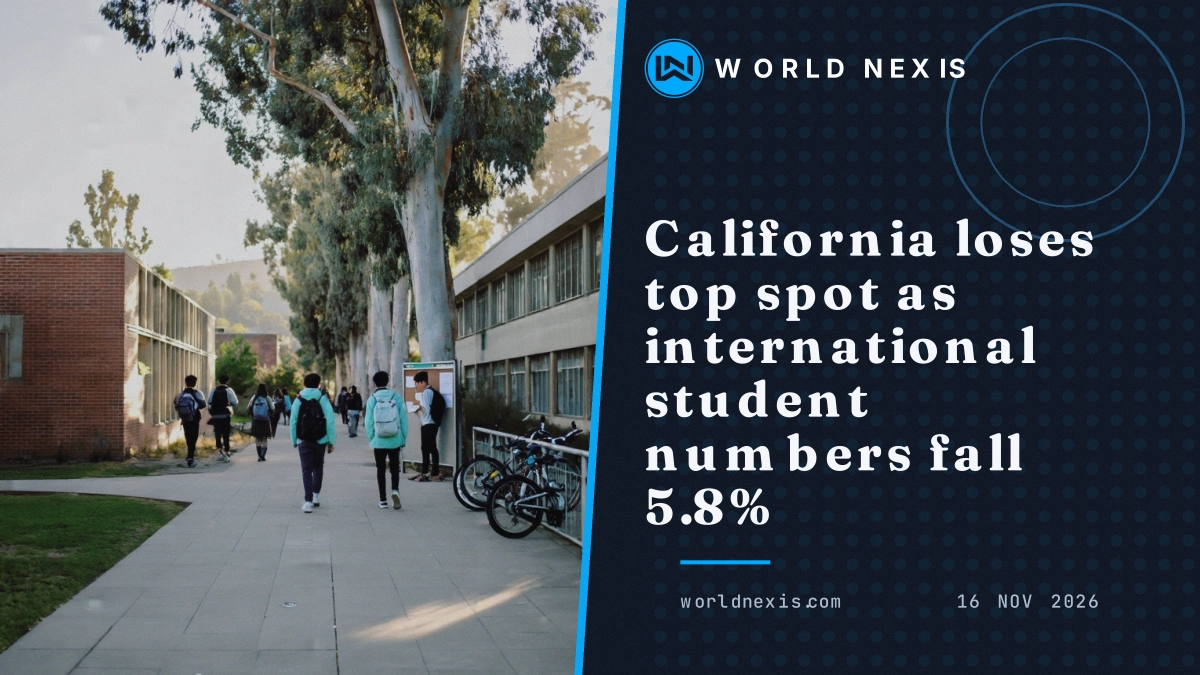
California’s figure dropped 5.8% to 131,276, more than twice the national decline, the Los Angeles Times reported. New York moved ahead with 133,715 students. Texas gained 1.9% to 98,902 and stayed third.
Key points
- California’s count fell 5.8% to 131,276, its lowest in more than a decade and below the pandemic-era total.
- Nationally, numbers fell 2.7% to 1,146,163, the biggest drop since 2020-21.
- A separate IIE survey found international student enrollment down 9% this autumn, with first-time entrants down 15%.
- New York overtook California; Texas rose 1.9% to 98,902.
California loses its lead as international student enrollment slips
The decline in California international students runs deeper than the national picture. Chinese students are the state’s largest group and their numbers have fallen over the same period, according to the Times. Growth in Indian students kept the state’s overall share climbing until last year.
The state’s total now sits below its pandemic-era count, when borders closed and classes moved online. It is the lowest in more than a decade.
Nationally, the annual report counted 1,146,163 international students, a fall of 2.7%. That was the largest drop since the 2020-21 school year.
This autumn looks weaker still. The same institute’s survey of international student enrollment found an overall fall of 9% on last year, the Associated Press reported. The number of new students arriving in the US for the first time dropped 15%.
Graduate numbers ease after a post-pandemic surge
Mirka Martel, head of research, evaluation and learning at the Institute of International Education, said the pattern was partly a correction. “Over the last five years, international graduate numbers first soared following the COVID-19 pandemic, particularly at the master’s level, for three years, and have since eased,” she said.
Optional Practical Training cushioned the fall. The number of graduates on the programme rose 14.1%, helping keep the overall decline smaller.
The programme lets graduates work in the US for one year, or up to three in science, technology, engineering and maths fields. IIE counts participants because the work is “an essential component of an international student’s academic experience”, Martel said.
Why international student enrollment is falling
Since returning to office in 2025, President Donald Trump’s administration has required student visa applicants to make their social media public for screening. It has barred or restricted travel from dozens of countries and sought to deport non-citizen students over pro-Palestinian speech.
Those steps came alongside wider restrictions on legal immigration and a crackdown on illegal immigration. The Times said the report offers early evidence on whether the enforcement drive would keep students away.
NAFSA, an association of international educators, warned that new international enrollment could fall 30% to 40% in autumn 2025. The actual drop was 17.7% — below the prediction, but steep.
Detention case raises concern at Berkeley
At UC Berkeley, one case has unsettled staff and students. Paula Albornoz Hernandez, a Colombian student, was detained by immigration agents last month at San Francisco International Airport while travelling to Oregon, the Times reported.
The Department of Homeland Security said she had overstayed her visa. Her lawyer said she had a pending asylum case and a valid work permit. She was released this month after a federal judge ruled her arrest unconstitutional.
Veena Dubal, general counsel for the American Association of University Professors, told the AP: “No one aspires to send their kids to get educated in the U.S.” Her father travelled from India to attend Tuskegee University.
Separate headline reports this week said US universities are opposing a proposed $70,000 OPT fee and asked whether Indian students could lose post-study work options.
Analysis
Having covered education and social affairs at WNN, I look first at who carries the cost when a state loses its share of overseas students. California’s public universities lean on non-resident tuition, so a 5.8% fall concentrated among Chinese students is a funding problem before it is a diplomatic one. In my view, the evidence supports those who say policy is the main driver here.
The argument that this is simply a post-pandemic correction does not explain why California fell more than twice as fast as the country, or why first-time entrants dropped 15% this autumn. Visa screening, travel bans and deportation attempts over speech are choices, and students read them as signals. I side with the educators who say those choices, not global demand, are doing the damage.
The strongest counter-argument is Martel’s: graduate numbers soared for three years after the pandemic and had to ease, and last year’s drop came in well below NAFSA’s warning. That is fair. Even so, a correction that lands hardest on one state, and hardest on new arrivals, looks shaped by policy as much as by the cycle.
What happens next
The annual report covers the 2025-26 school year, while the autumn survey gives a first read on 2026-27. Colleges will watch whether the 15% fall in first-time entrants carries into the spring intake.
The proposed $70,000 OPT fee reported this week is being contested by universities. Visa screening requirements and travel restrictions remain in place. NAFSA reported last year that colleges were fielding more questions from students worried about US immigration actions, and that some were choosing other countries.
Sources
- Reports of AI-related child sexual abuse material rise 8,400% in two years, data shows (theguardian.com)
- California loses international students at twice the U.S. rate (latimes.com)
- Fewer students are traveling from abroad to study at US universities, report shows (wral.com)
- Fewer students are traveling from abroad to study at US universities, report shows (clickorlando.com)
- Fewer students are traveling from abroad to study at US universities, report shows (2news.com)
About the author: Isabella Rossi is World Nexis News’s Education & Social Affairs Reporter, covering education & social affairs. The analysis section reflects the writer’s view.

Isabella Rossi
Isabella Rossi is Education & Social Affairs Reporter at World Nexis News, based in Manchester. She covers schools, universities, family policy, immigration and the social issues that shape opportunity, working from official statistics, institutional data and direct accounts, and giving institutions a fair opportunity to…