Florida execution sets record as 20th inmate dies in 2026
Florida execution: Thomas Mitchell Overton put to death as state's record 20th of 2026, hours before Texas killed Reinaldo Dennes in a drawn-out procedure.
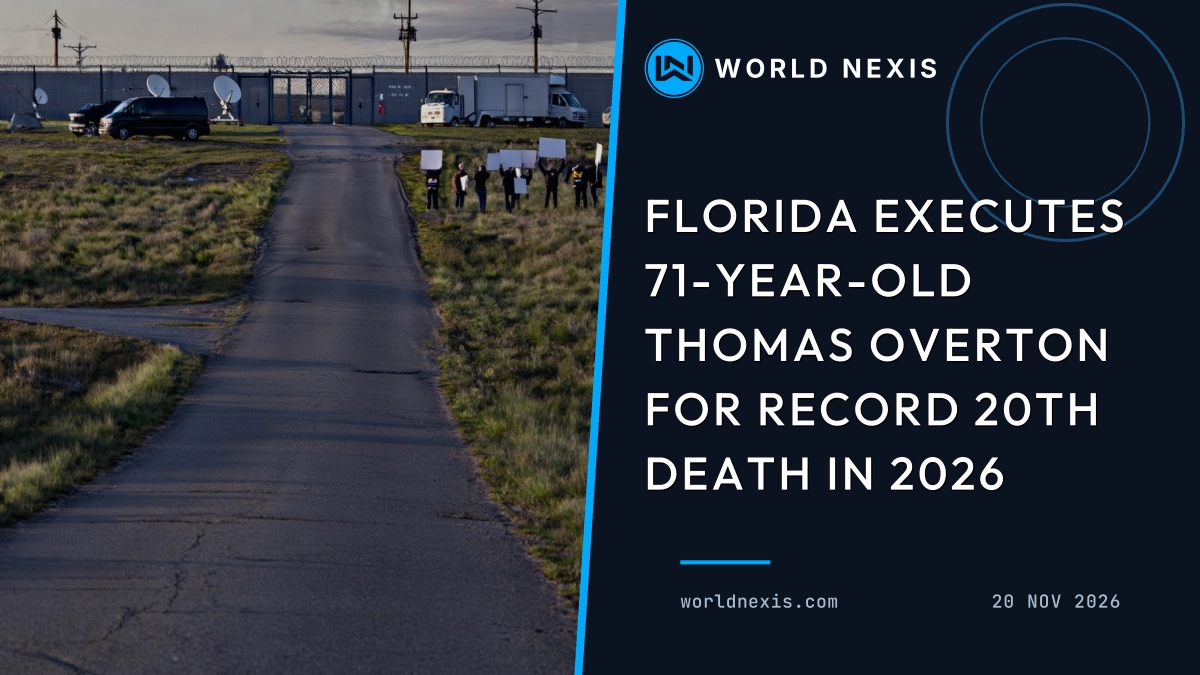
The record 20th Florida execution of 2026 was carried out on Thursday evening, when Thomas Mitchell Overton, 71, was pronounced dead at 6:19 p.m. at Florida State Prison in Raiford after a three-drug lethal injection. Hours later, Texas executed Reinaldo Dennes, 70, for the 1996 shooting of a Houston diamond dealer, in a procedure that ran well past its scheduled start. Two men in their seventies, two states, one night: the double execution showed how fast America’s busiest death-penalty states are now moving.
Overton was convicted of killing Michael and Susan MacIvor and their unborn child during an August 1991 break-in at their home in Tavernier, in the Florida Keys. In his final statement he denied the attack, saying: “I never killed anyone.”
Key points
- Florida carried out its 20th execution of the year, beating the modern state record of 19 set in 2025.
- Thomas Mitchell Overton, 71, was pronounced dead at 6:19 p.m. at Florida State Prison in Raiford.
- Texas executed Reinaldo Dennes, 70, the same evening, its ninth execution of 2026.
- Two more Florida executions are scheduled for December, and an appeal in the Texas case was unresolved when Dennes died.
Inside the record Florida execution
Overton’s final day was calm. He woke at 5 a.m. and remained compliant throughout, and he did not meet any visitors or a spiritual adviser, Florida Department of Corrections spokesperson Jordan Kirkland said.
The 71-year-old became the 20th prisoner put to death in Florida this year, passing the 19 executions carried out in 2025, the highest annual total in the state since the death penalty was reinstated in 1976. Every Florida execution this year rested on a warrant signed by Ron DeSantis, the outgoing Republican governor, who has said he wants to bring justice to families who have waited decades for sentences to be carried out.
DeSantis leaves office in January, but the calendar is not closed. Two further Florida executions are already set for December, which would push the state’s total for the year still higher at the very end of his term.
Texas follows hours later with its ninth execution
Dennes was convicted of capital murder in the death of Janos Szucs, a diamond dealer found shot multiple times in his Houston office in January 1996, during a $3.6 million diamond heist.
His death made him the ninth person executed by Texas this year, far below the state record of 40 set in 2000 but enough to keep Texas among the few states that still carry out executions regularly. Accounts of the Reinaldo Dennes Texas execution described a drawn-out procedure in which he groaned and complained of pain while staff worked to establish intravenous access. Texas prison officials said afterwards that all procedures had been followed appropriately.
Scrutiny grows as the Florida execution count rises
Florida has now carried out more than half of all executions in the United States this year. Published tallies of the national total have differed slightly, but on any count the state’s share is dominant, and no other governor has signed warrants at a comparable rate.
The two executions also came amid renewed scrutiny of capital punishment after the failed execution of Christa Pike in Tennessee this autumn. Pike survived an attempt to put her to death, and her lawyers say the drugs did not enter her bloodstream properly, leaving her arms burned and blistered.
Courts moved quickly on Thursday. The US Supreme Court denied a final appeal in the Florida case, while an appeal in the Texas case was still pending as Dennes was prepared for execution, leaving his lawyers without a ruling before the Thomas Mitchell Overton execution and his own were completed.
Why it matters
For the families involved, the meaning is concrete. The relatives of Michael and Susan MacIvor waited 35 years for Thursday’s execution. The relatives of Janos Szucs waited 30. Supporters of capital punishment will see two states finally carrying out sentences that courts upheld repeatedly.
For everyone else, the record matters because of what it reveals about power. One governor’s willingness to sign warrants now sets the national pace of executions, and the strain is visible: two men in their seventies were put to death within hours of each other, and one of those deaths did not go to plan.
Analysis
Having covered accountability and constitutional law for World Nexis News for five years, I read this story less as a moral argument than as a story about discretion. American executions are no longer driven by crime rates; they are driven by which governors sign warrants and which courts let those warrants stand. On that measure, Ron DeSantis has shaped the death penalty in 2026 more than any legislature in the country.
I think the evidence here favours the critics. The strongest argument against the current pace is not philosophical but procedural: a 70-year-old man in Texas groaned in pain as staff tried to find a vein, and a woman in Tennessee survived her own attempted execution weeks earlier. When the method fails in public, the claim that capital punishment can be administered humanely becomes harder to defend, and hardest in the states that use it most.
The counter-argument deserves its due. Families in these cases have waited three decades, and a governor who delays indefinitely is also making a choice with real victims behind it. But speed and scrutiny are not opposites: the answer to a flawed protocol is a better one, not a fuller calendar. That is where I part company with the DeSantis approach.
What happens next
Florida is due to carry out two more executions in December, which would take its 2026 total to 22 before DeSantis leaves office in January. His successor will inherit both the warrant queue and the litigation that comes with it. In Texas, the appeal that was pending when Dennes was executed remains unresolved, leaving the legal question it raised without an answer.
What we don’t know yet
- Whether the next Florida governor will sign warrants at the same rate.
- Whether courts will impose new conditions on lethal injection protocols after the Tennessee episode.
- How much the December executions will add to the national total for 2026.
Related coverage
- CMA Awards 2026: Ella Langley ties record as Swift returns
- Fiona the hippo dies at nine as zoo director says staff are in shock
- Nike valedictorian giveaway goes nationwide for 2026-27
Further reading
- Texas botches execution of Reinaldo Dennes as staffers struggle to find vein
- Florida officials carry out a record 20th execution of 2026
About the author: Ayesha Rahman is the Senior Political Correspondent & Columnist at World Nexis News (WNN), covering politics & opinion. The analysis section reflects the writer’s view.

Ayesha Rahman
Ayesha Rahman covers politics and opinion for World Nexis News from London, focusing on elections, legislatures and the policy choices that shape everyday life in the US and UK. She writes analysis and columns that separate what is confirmed from what is claimed, working from…



