FAA ground stop: 12,400 flights hit as chief says blame me
The FAA ground stop cancelled thousands of flights; now the FAA chief says blame me, not Sean Duffy, as Congress questions a major $50bn upgrade.
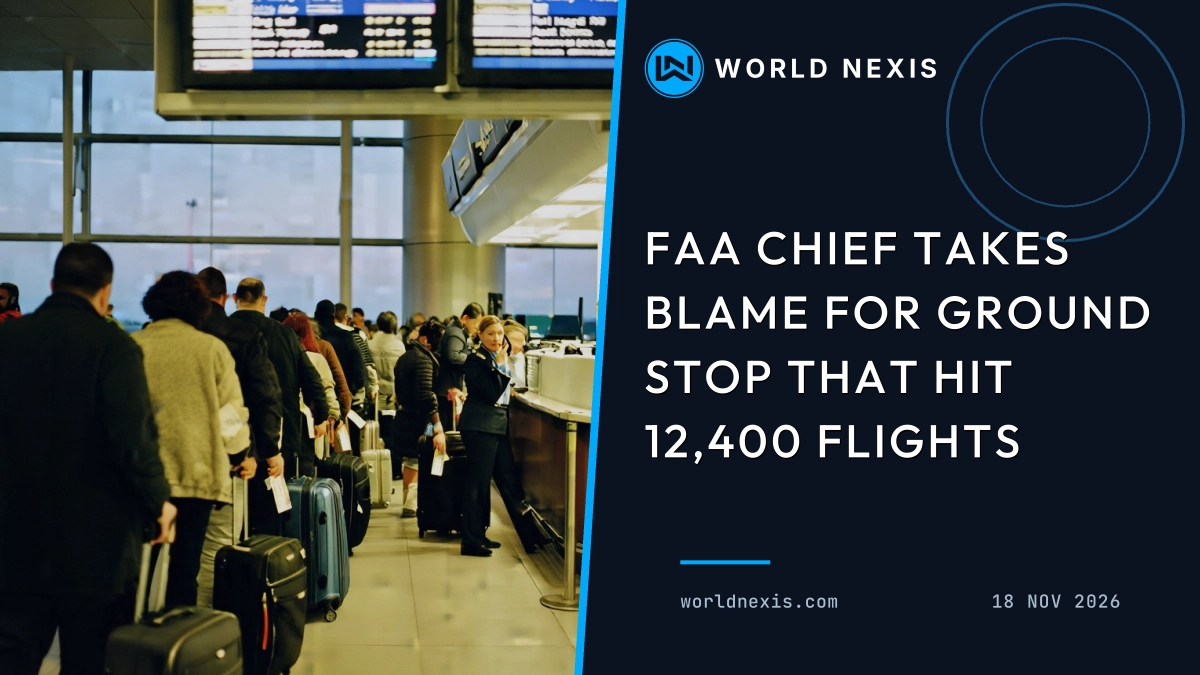
The FAA ground stop that disrupted more than 12,400 flights now has a named owner. Bryan Bedford, the agency’s administrator, said on Wednesday that he takes full responsibility for Friday’s nationwide shutdown and told critics to “lay off” Transportation Secretary Sean Duffy.
“I take full responsibility for it,” Bedford said at an aviation event in Washington. “I wish people would lay off the secretary. He’s got a lot of work to do, but I’m the guy they hired to get this done. So blame me if we need to blame somebody. Blame me.”
The intervention came as Homeland Security Secretary Markwayne Mullin faced his own questions in Congress about the four-hour shutdown, the second nationwide ground stop since the September 11 attacks.
Key points
- Bedford said he, not Duffy, should carry the blame for Friday’s FAA ground stop, which affected more than 12,400 flights.
- The agency says a newly installed router at a site in Arkansas flooded its communications network with data and destabilized aircraft and radar links.
- Duffy has criticized contractor L3Harris for failing to isolate the fault quickly, and the administration wants $50bn to modernize air traffic control.
- Mullin defended flying to a college football game during the disruption, saying he “wanted to be a good uncle”.
Inside the FAA ground stop: a router, a flood of data and four lost hours
Friday’s FAA ground stop began with a single piece of equipment. According to the agency, a newly installed router flooded its communication systems, breaking the links between aircraft systems and radar feeds.
The Federal Telecommunications Infrastructure network became unstable as data poured in, with devices trying to connect about 1,000 times every four to five seconds. The result, the agency said, was “instability with aircraft communications and radar feeds”.
The fault was traced to Arkansas, where engineers were replacing legacy copper cables with fiber optics. Duffy has said the work was routine modernization until the router communication failed.
L3Harris Technologies, the contractor that owns the network carrying air traffic control traffic, runs a network operations center in Melbourne, Florida, built to report outages in real time. A person familiar with the investigation says it took the company several hours to work out where the fault was originating, delaying the decision to lift the stop. Duffy has since turned on the contractor. “They didn’t identify and isolate. That concerns me,” he told reporters on Capitol Hill on Tuesday. L3Harris said in a statement that it works “in close coordination with the FAA” on modernization, has completed more than 70% of the conversion from copper to fiber, and supports the agency’s investigation.
The money fight behind the FAA ground stop
Duffy and the White House have asked Congress for $50bn to upgrade the air traffic system, more than double the original estimate, and some Republican lawmakers have told reporters the justification for that sum is thin. Bedford defended the request, saying President Donald Trump and Duffy treated the outage as a “call to action” to “fix the system” and “return to the gold standard”.
On Capitol Hill, the political argument arrived faster than the funding paperwork. At a House Homeland Security Committee hearing titled “Worldwide Threats to the Homeland: 25 Years After 9/11”, Mullin was pressed about the disruption and about his Saturday attendance at the LSU-Texas football game while thousands of flights were cancelled.
Ranking member Bennie Thompson displayed placards quoting Mullin’s weekend comments. Mullin hit back, saying the congressman was “making political points by holding up posters that are completely inaccurate”. He said he “wanted to be a good uncle”, that the trip had been scheduled weeks earlier, and that he would reimburse the government as required by law. He also said cancelling could have sent the wrong message.
Director of National Intelligence Jay Clayton told the same hearing there is no indication the week’s disruptions came from a malicious actor. “I understand the timing of these incidents can raise questions, and it should. The American people should ask us these questions. But based on what we know today, after a great deal of diligence, these are separate service outages associated with maintenance and technical changes,” he said.
Why it matters
For travelers, the damage is counted in missed connections, hotel bills and refund claims heading into the busiest flying week of the year. AAA expects nearly 6 million people to take domestic flights for Thanksgiving, and a nationwide stop ripples for days.
For taxpayers, the central question is whether a $50bn modernization bill is priced properly or inflated by crisis. Either way, the outage exposed how much of the system still runs on copper wire and how closely the contractor’s monitoring is supervised.
Analysis
Having covered congressional oversight for World Nexis News, I look first at who is answerable, and Bedford’s instinct to put his own name on the failure is the right one. In Washington, agency heads usually let a contractor and a press release absorb the blame. Saying “blame me” in public buys the department something rare: room to argue about the fix rather than the fallout.
I think the facts support the lawmakers and senators who want a thorough investigation before the money moves. Duffy’s own account, of a new router, a flood of traffic and a contractor that could not say quickly where the fault sat, points to a monitoring and change-control failure rather than simply aging cable. A blank cheque would not fix that. The strongest counter-argument is fair: Congress has underfunded aviation infrastructure for years, and delay carries its own cost, which is why I would fund the upgrade against an itemized plan rather than reject it.
What I would watch is whether the football trip stays the story. Mullin’s travel is a legitimate annoyance, but the $50bn and the contractor’s performance decide whether the next FAA ground stop lands in a holiday week.
What happens next
Congress must decide whether to pass the $50bn request, and the committees overseeing aviation and homeland security are expected to keep questioning Duffy, Bedford and L3Harris. A group of senators led by Maria Cantwell, and including Tammy Baldwin, is seeking a thorough investigation into the FAA ground stop.
Thanksgiving travel begins within days, leaving little time for reassurance beyond the agency’s own account of what failed.
What we don’t know yet
It is not clear how much of the $50bn has been itemized line by line, or whether Congress will approve it in this session. Nor has a full timetable for the modernization work been published.
Related coverage
- FAA ground stop: Trump denies blame for 12,000-flight crisis
- FAA ground stop: 12,000 flights cut as Duffy vows urgent fix
- FAA ground stop: Mullin defends jet trip as 1.5m stranded
Further reading
- FAA chief urges critics to ‘lay off’ Sean Duffy for flight stoppage: ‘Blame me’
- Got a canceled flight? 7 clever ways to get rebooked fast
About the author: Ayesha Rahman is the Senior Political Correspondent & Columnist at World Nexis News (WNN), covering politics & opinion. The analysis section reflects the writer’s view.

Ayesha Rahman
Ayesha Rahman covers politics and opinion for World Nexis News from London, focusing on elections, legislatures and the policy choices that shape everyday life in the US and UK. She writes analysis and columns that separate what is confirmed from what is claimed, working from…



