WWII cookbook turns recipes into acts of resistance
A new WWII cookbook pairs survival stories from the camps and battlefields with the dishes that gave prisoners hope, and asks readers to cook them.
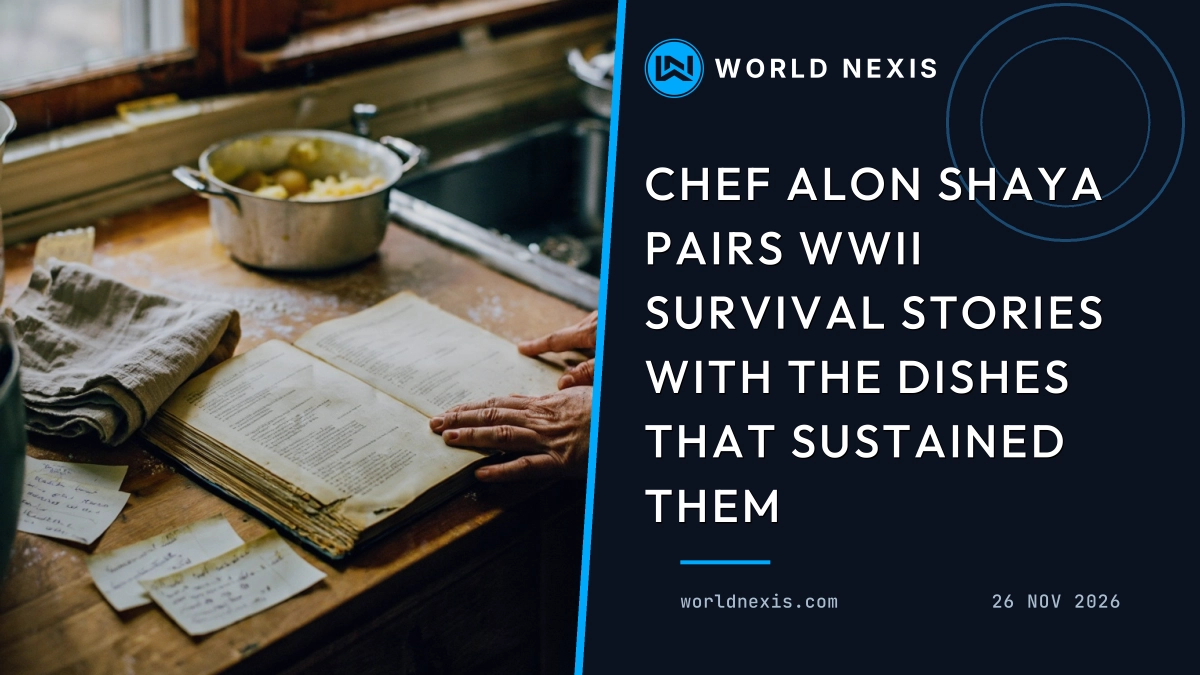
Alon Shaya’s new WWII cookbook asks readers to do something unusual with a recipe: talk about it out loud. The Israeli American chef, who runs the New Orleans restaurant Saba, has published Memories of a Good Meal, which pairs dishes with stories of survival from the Second World War. It is built for the dinner table, not the coffee table.
The book grew out of the Rescued Recipes initiative Shaya led at the United States Holocaust Memorial Museum. That work pushed him to examine how food functioned in prisoner-of-war camps, partisan bunkers and barracks. He has now gathered those accounts with the food historian and writer June Hersh.
Key points
- The WWII cookbook matches recipes with first-hand stories of survival from the Second World War.
- Chef Alon Shaya developed it from his Rescued Recipes work at the United States Holocaust Memorial Museum.
- June Hersh, who worked with Shaya, describes a remembered meal as something captors cannot take away.
- Subjects range from U.S. prisoners of war in Germany to Polish partisans, Navajo code breakers and incarcerated Japanese Americans.
What the WWII cookbook puts on the table
Each chapter follows a person or a group, then hands the reader the dish that kept them going. Shaya said the aim is not a history lecture. “I want people to gather and cook and eat and put their phones down, and share a meal and recount these miraculous stories of survival, resilience and heroism,” he said.
He argues the table is where barriers fall. “It’s always been the way that I can start a conversation, build a relationship, disagree about things, but still be able to come together and break bread,” he said. “When you share a meal with someone, a lot of those barriers get broken down.”
Every one of the World War II recipes is attached to a named person or community. That structure keeps the food in service of the story rather than the other way round.
Inside the Jolly Chef: how prisoners ate their way home
The most striking chapter belongs to Roddie Edmonds, a U.S. Army master sergeant whose unit was captured in the Battle of the Bulge and imprisoned in a German prisoner-of-war camp. Edmonds was posthumously awarded the Congressional Medal of Honor earlier this year for refusing to hand over his Jewish troops to be sent to concentration camps.
In the camp, he and his fellow prisoners held off the horror by talking about food from home: Sunday spaghetti sauce, hot cakes, cherry pie. They sketched detailed plans for a dreamed-of restaurant called the Jolly Chef, where candied yams with pecans and whipped marshmallow would be served. That dish became a recipe in the WWII cookbook.
“They’re eating up this idea that they were going to go home,” Shaya said. “They were going to be free, and they were going to be able to sit around and dig into that filet mignon with creamy mushroom sauce.”
Other chapters move across the war. Polish partisan fighters who lived in underground bunkers and sabotaged the Nazis by derailing trains and blowing up ammunition plants get smashed potatoes flambéed in vodka, a nod to the fires they set. “Vodka was a form of currency for them,” Shaya said. “They would use it to barter. They would use it to celebrate.”
The book also carries Hungarian Jews whose non-Jewish cook salvaged the family’s treasured cookbook as they were sent to Auschwitz. It follows a French village that took in Jewish children and hid them from the Nazis, Navajo code breakers, and Japanese Americans incarcerated in military-style camps in the United States despite being convicted of no crime.
Why food memory counts as resistance
The WWII cookbook treats a remembered recipe as defiance rather than nostalgia. Hersh, who worked with Shaya on the project, said talking about a favorite dish turned a tragic situation into something triumphant.
“You can put me in a uniform, you can make me do hard labor, you can shave my head, you can starve me if you want, but I’m not going to let go of my food memory,” she said. “It’s something you can’t take away from me.”
That framing runs through the whole collection. A recipe here is a small, portable piece of a life that a camp or a transport could not confiscate.
Why it matters
Most cookbooks sell technique or a restaurant’s signature plates. The WWII cookbook uses the recipe as a handle for a story many families find hard to start. It also widens the cast of the war beyond the battlefield, to partisans, code breakers and children in hiding.
For home cooks, it offers a practical route into remembrance: cook the dish, then explain where it came from. For households marking Holocaust remembrance, that is a lower-stakes entry point than a documentary or a museum visit.
Analysis
Food writing has a habit of turning other people’s suffering into atmosphere, and the risk with a WWII cookbook is exactly that: sticky, sentimental pages that flatter the reader. The material mostly survives the test, because the recipes are never the star. Shaya’s framing puts the meal in service of a person, and Hersh’s line about what cannot be taken away is the strongest sentence in the project.
I think Hersh has the better argument, and the evidence in the book supports her over the skeptics. The Jolly Chef sketches are the proof: the prisoners did not only dream about filet mignon, they drew plans. Designing a restaurant you may never open is a bet on a future, which is the opposite of what a camp is built to produce.
The fair objection is that a glossy cookbook can aestheticize atrocity and leave a reader feeling virtuous over a marshmallow-topped side dish. I take that seriously, because the format slips exactly when a dish outshines the testimony beside it. What I will watch is whether readers close the book remembering the recipes or the names.
What happens next
The next step sits with readers rather than with any institution. Shaya’s stated aim is that home cooks gather, cook from the recipes and use them to start conversations about the people involved, from the prisoners who designed the Jolly Chef to families whose cookbooks were saved by neighbors.
The project’s roots remain at the United States Holocaust Memorial Museum, where the Rescued Recipes initiative began. The WWII cookbook carries that work from a museum audience to a kitchen one.
What we don’t know yet
Publication details and any launch events are not part of the material available, so it is too early to say how far the book will travel beyond its first readers. It is also unclear whether the museum will build further programming around these recipes.
Further reading
- ‘Memories of a Good Meal’: How food made a difference during WWII
- ‘Memories of a Good Meal’: How food made a difference during WWII
About the author: Chloe Bennett is the Features & Lifestyle Writer at World Nexis News (WNN), covering lifestyle & features. The analysis section reflects the writer’s view.

Chloe Bennett
Chloe Bennett is Features & Lifestyle Writer at World Nexis News, covering travel, food, fashion, home life and the people shaping modern living. Based in New York, she writes features grounded in real places, real prices and real experiences, avoids manufactured trend claims and labels…