Lyrebird House: off-grid Foxground stay lists at $1.65m
Lyrebird House, the off-grid Foxground stay near Gerringong, is back on the market with a $1.55m-$1.65m guide and $50,000-$60,000 in annual bookings.
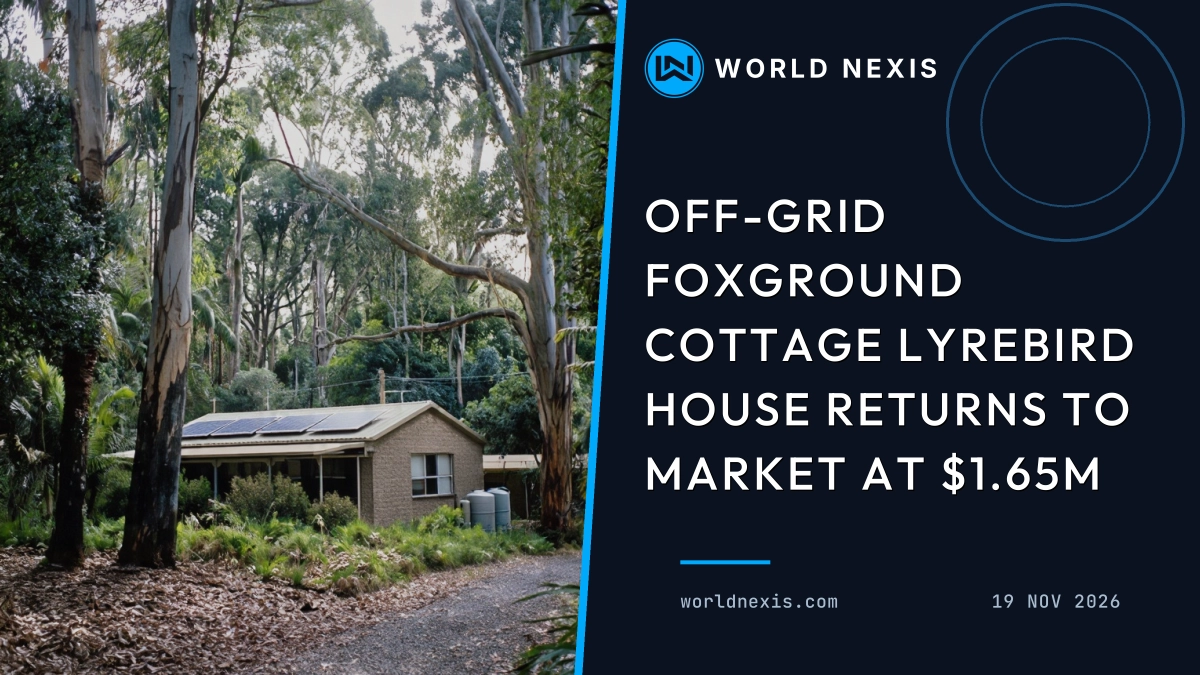
Lyrebird House, the off-grid retreat set in rainforest at Foxground near Gerringong, is back on the market with a price guide of $1.55 million to $1.65 million. The two-bedroom 1970s masonry cottage at 518 Foxground Road earns between $50,000 and $60,000 a year in booking revenue through Airbnb and direct reservations. Its owners say the only utility bill they pay is for gas.
The property is being offered for sale by expressions of interest, and it arrives on the market with an unusual provenance. For nearly 25 years it was the private retreat of Bruce Mackenzie, the landscape architect widely described as the grandfather of landscape architecture in Australia, who died in January 2024 aged 91.
Key points
- Lyrebird House at Foxground, near Gerringong, carries a price guide of $1.55 million to $1.65 million and is for sale by expressions of interest.
- The two-bedroom cottage sits on one acre and generates $50,000 to $60,000 a year in short-stay bookings.
- Power comes from rooftop solar, an Australian-made lithium battery bank and an auto-start LPG generator, backed by rainwater tanks, NBN and a satellite dish.
- The late Bruce Mackenzie removed every plant that was not indigenous to the local rainforest and recorded 145 identifiable species on the block.
Inside Lyrebird House: solar, battery and a rainforest canopy
The cottage was built in the 1970s and sits on a single acre inside hundreds of acres of bushland behind Berry and Gerringong. Current owners Nick and Vicki Robertson, who are based in Sydney, carried out a renovation intended to be sympathetic to the original footprint and to Mackenzie’s vision. They lightened the interiors, rewired the house and replaced the original off-grid set-up with a fully integrated system.
That system now runs on rooftop solar with an Australian-made lithium battery bank, an inverter and an auto-start LPG generator. Rainwater tanks supply the house, while NBN and a satellite dish keep it connected. The entire power system can be accessed and monitored remotely from a smartphone.
“Lyrebird House is probably the most progressive off-grid property on the South Coast, but you live exactly as you would in Sydney – dishwasher, Smeg fridge, Nespresso and Netflix,” Mr Robertson said.
The property has become a popular off-grid holiday let with an international guest list. Mr Robertson said it draws Sydney couples and visitors from Germany and the United States.
“People book it saying they just want to disconnect for the weekend,” he said.
Bruce Mackenzie and the rainforest he let grow
Mackenzie’s public work includes Illoura Reserve at Balmain, Yurulbin Park at Birchgrove and Sir Joseph Banks Reserve at Botany Bay. The Foxground block was his private retreat, and he treated it as a project in its own right, pulling out every plant that was not indigenous to the local rainforest and letting the forest regenerate.
His stewardship is the part of the sale the Robertsons have been keenest to protect. When they took over the property, Mackenzie walked the new owner through the block and left him with a single instruction.
“Bruce was very concerned about who was coming in,” Mr Robertson said. “On the morning we picked up the keys, he walked me through everything. His one instruction was don’t clear the leaf litter – let the rainforest do its thing. If anything, you take species out, you don’t add them.”
The Robertsons left the outdoors untouched. Mackenzie sold the retreat months before his death, and the listing now passes that inheritance to a new owner.
What the Lyrebird House price guide buys
The land around the cottage is zoned for environmental conservation and management, which restricts future development in the valley. That protection is likely to be central to the sale, because it limits what any buyer can build around the cottage.
Daniel Watt, of Christie’s International Real Estate, is the selling agent. The property is being offered through expressions of interest rather than a public auction.
Why it matters
For anyone watching the short-stay market, Lyrebird House is a test case. A two-bedroom cottage on one acre is being pitched at up to $1.65 million on the strength of $50,000 to $60,000 in annual bookings, which shows how much value buyers now place on a property that pays part of its own way.
For households thinking about energy, the detail matters more than the label. The house is not bill-free: the owners say gas is still paid for, and the comfort comes from a battery bank, a generator and a satellite connection. Off-grid living at this end of the market means a well-engineered system rather than a simpler life.
Analysis
Having written about home design and slow travel for World Nexis News, I read listings like this one for what they reveal about taste rather than what they promise about virtue. The strongest thing about Lyrebird House is not its power system. It is the quarter of a century Mackenzie spent pulling out introduced plants and letting a rainforest come back, and the fact that his instruction to the next owner was to leave the leaf litter alone. That is a real piece of conservation, and it survives the sale.
I think the off-grid framing deserves more scepticism than it usually gets. A retreat that keeps a dishwasher, a Nespresso machine and Netflix running, with a gas bill at the end of it, is a very comfortable version of self-sufficiency, and a guide of $1.55 million to $1.65 million puts it well beyond almost every household that would like lower bills. The counter-argument is fair: the system was designed and paid for privately, on land that might otherwise have been developed, and it proves the technology works at this scale. That still does not make it a model for the wider housing market.
What I would want a buyer to price in is maintenance. Batteries, inverters and generators do not last forever, and the booking income is the number most likely to change if a new owner decides to keep the house for themselves rather than let it out.
What happens next
The sale is being handled through expressions of interest, with the price guide set at $1.55 million to $1.65 million. Until a buyer is found, the cottage continues to operate as a short-term holiday stay taking bookings through Airbnb and direct reservations.
What we don’t know yet
The listing details available do not give a closing date for expressions of interest, and the final sale price is unknown. It is also unclear whether a new owner would keep Lyrebird House in the holiday-let market or move in.
Related coverage
- GTA 6 launch day: 17m preorders and 9% surge in time off
- GTA 6 launch: record reviews and 1 in 5 US staff off work
- Overdose deaths at 10-year low as White House claims credit
Further reading
- Inside the gas pipeline where Ukraine is fighting an underground war with Russia
- Inside the off-grid South Coast stay where the only bill is the gas
About the author: Chloe Bennett is the Features & Lifestyle Writer at World Nexis News (WNN), covering lifestyle & features. The analysis section reflects the writer’s view.

Chloe Bennett
Chloe Bennett is Features & Lifestyle Writer at World Nexis News, covering travel, food, fashion, home life and the people shaping modern living. Based in New York, she writes features grounded in real places, real prices and real experiences, avoids manufactured trend claims and labels…