Sutton Hoo grave: rare sand body found in month-long dig
A Sutton Hoo grave has yielded a rare 'sand body' plus beads, tweezers, a knife and a brooch, found during a month-long Time Team dig in Garden Field.
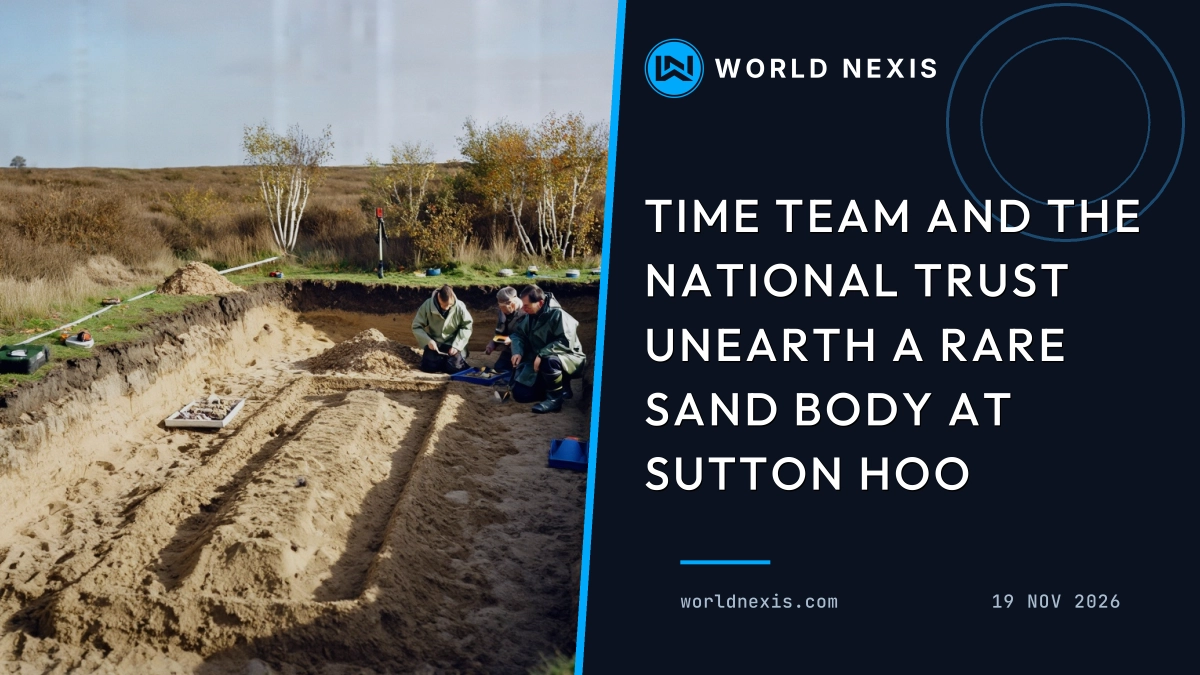
A Sutton Hoo grave has yielded a rare ‘sand body’ and grave goods after a month-long excavation at the Suffolk site. Time Team archaeologists dug in Garden Field, a cemetery separate from the royal mounds and the seventh-century ship burial, and found beads, tweezers, a knife and a brooch. The National Trust, which cares for the site, said evidence points to a second burial beneath the first.
Key points
- The Sutton Hoo grave contained a ‘sand body’, a ghost-like shape left in the soil after a body dissolved.
- Beads, tweezers, a knife and a brooch were recovered from the same burial in Garden Field.
- Archaeologists say a second grave may lie underneath it.
- The finds feature in a four-part Time Team series released on YouTube through November.
Inside the Sutton Hoo grave in Garden Field
The dig ran for about a month in 2025 and concentrated on ground that sits apart from the cemetery which made the estate famous. The Sutton Hoo grave held the ordinary kit of an early medieval life: personal ornaments, a small knife and grooming tools. Yet it is the sand body that has drawn most of the attention.
Sand bodies form in acidic soil, where bone and tissue dissolve and hard sand sets in the shape of the person who once lay there. Angus Wainwright, an archaeologist with the National Trust, said the first examples turned up in the 1980s and were among the strangest features ever found at the site. He likened them to some of the bodies at Pompeii.
Wainwright said the excavation had shifted attention away from royalty:
‘Until now, archaeologists have focused on the royal burial mounds. Yet these mounds stood in a landscape of significance to the Saxon kings, as well as one familiar to the everyday East Anglians who lived in the villages and farms of the river valley.’
He added that the work moved the focus to those people and their ancestors and descendants, and that finding another of these bodies in the Garden Field cemetery was a high point of the dig.
The objects buried with the dead are modest beside the treasures of the royal mounds, but they speak to daily life rather than status. Evidence from the trench also suggests a further grave below, a hint the team has described as tantalising.
From royal mounds to everyday East Anglians
Sutton Hoo has been excavated since the late 1930s and has been cared for by the National Trust since 1998. Its royal burials, among them the ship burial and the Sutton Hoo helmet, reshaped how historians understand early medieval England.
The Sutton Hoo grave found in Garden Field sits well outside that royal ground. Its occupants were villagers and farm workers rather than the kings they served, which makes the cemetery a rare window on ordinary life in the river valley.
Because that ground has seen so little investigation, the size, chronology and character of the cemetery all remain open questions for researchers. The royal burials remain the centrepiece of the site’s public story, and the helmet in particular has become its emblem. Garden Field has no such profile, which is precisely why the latest work matters.
The team also returned to the Bromeswell Bucket, a rare Byzantine artefact found at Sutton Hoo. Missing fragments were recovered during an earlier Time Team season at the site, and the crew went back to examine the contents and piece together its history.
Dr Helen Geake, the programme’s Anglo-Saxon specialist, said she was thrilled to locate and excavate the burial, but that many questions remained. She asked what date the bucket belongs to, why cremation and inhumation were both chosen on this part of the site, and what the hint of another grave below might mean.
Time Team Sutton Hoo series runs through November
The Sutton Hoo grave features in a four-part series on YouTube across November, fronted by Sir Tony Robinson. Tim Taylor, Time Team’s creator and series producer, said returning for a new run in partnership with the trust had produced fascinating discoveries.
‘As ever with archaeology, the more we uncover, the more questions we find ourselves asking. That’s exactly what makes it so exciting, and I can’t wait for everyone to see what the team has been up to.’
Why it matters
For Suffolk, the Sutton Hoo grave reframes a site usually told through royal treasure. It moves the story from a single king’s burial to a working landscape of farms, villages and families who left almost no written trace.
For everyone else, it is a reminder of how much early English history is still in the ground, and how thin the line is between a chance find and a national collection. The Garden Field cemetery could yet alter the chronology of the whole site.
Analysis
Having covered factual television and its streaming economics for World Nexis News, I look first at what a series like this does for the archaeology rather than the audience figures. In my view the most important line in this story is Wainwright’s: the excavation moves the focus to everyday East Anglians. The royal mounds have had a century of attention, while the cemetery around them has had far less, and the questions about Garden Field are the ones that could rewrite the site’s timeline.
That is why I side with the trust’s framing over the ‘mysterious grave’ headlines. I accept the counter-argument that the sand body is genuinely rare, photogenic and the detail most likely to pull a new audience towards the subject. But leading on an eerie image risks turning a careful reconstruction of an ordinary community into a curiosity.
The YouTube release matters as much as the trench. It puts the dig in front of people who will never read a journal paper or travel to a museum, a clear gain for a sector that depends on public goodwill. My reservation is that an episodic release rewards spectacle over method, and the method is where the value sits. The trust and Time Team will need to publish properly, not just broadcast, if the Garden Field questions are to be settled.
What happens next
Episodes of the four-part series continue to appear on YouTube through November. Specialists will keep working on the contents of the Bromeswell Bucket and on the possible second burial beneath the Sutton Hoo grave.
What we don’t know yet
Nobody has yet dated the bucket or explained why cremation and inhumation appear side by side in this part of the site. The size, chronology and character of the Garden Field cemetery remain unresolved, and the hint of a second grave has not been confirmed.
Related coverage
- Orkney sunken vessel found weeks after Kilda tragedy
- Kerch bridge attack: UK pledges 1,000 long-range strike drones to Ukraine
- National Book Award 2026: major wins for Assadi and ElGendy
Further reading
- ‘Sand body’ discovered during Time Team dig at Sutton Hoo
- ‘Mysterious’ Anglo-Saxon grave discovered at Sutton Hoo
About the author: Emily Carver is the Culture & Entertainment Writer at World Nexis News (WNN), covering culture & entertainment. The analysis section reflects the writer’s view.

Emily Carver
Emily Carver is Culture & Entertainment Writer at World Nexis News, covering film, television, music, gaming, books and the creative industries from Los Angeles. She writes about the business and craft behind the work — streaming economics, production decisions, criticism and the way culture travels…