Gary Barlow Take That fame felt like pressure at 55
Gary Barlow Take That fame in the 1990s felt like a merry-go-round he could not get off, he tells BBC Radio 2, as Howard Donald calls it a conveyor belt.
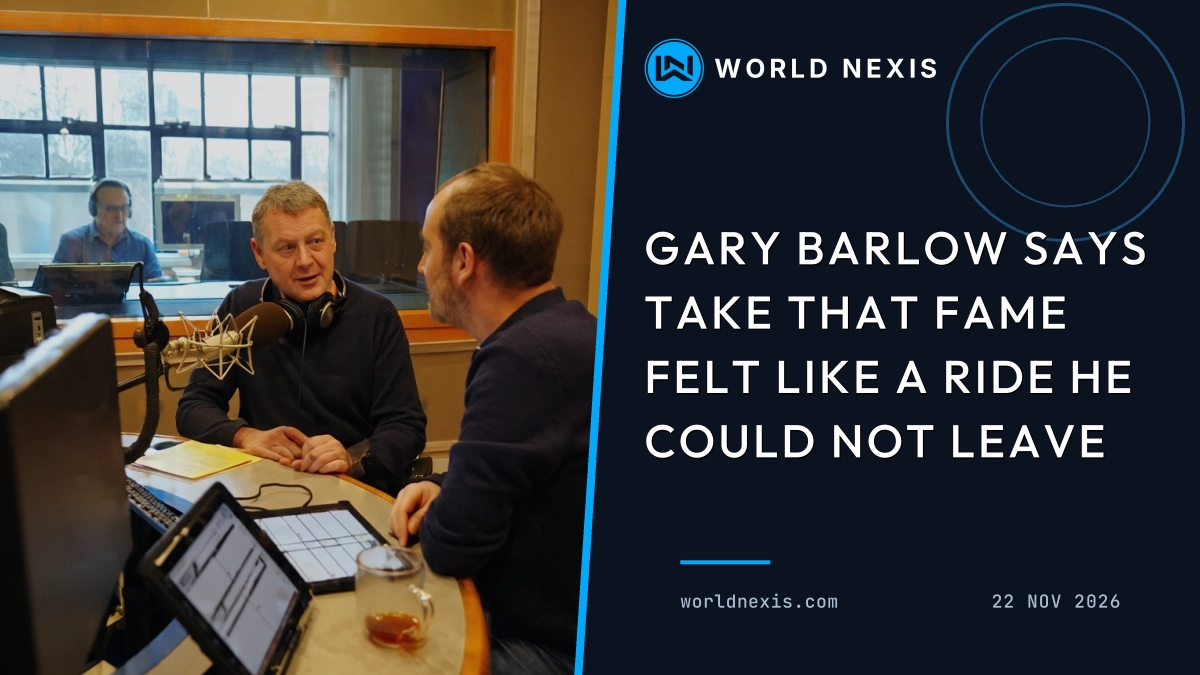
Gary Barlow Take That fame in the 1990s felt like a ride he could not step off, the singer has said, describing a decade when the weight of the band’s success sat on his shoulders. Barlow, 55, made the admission in a BBC Radio 2 interview for Vernon Kay’s Tracks Of My Years segment. He said plainly that he did not enjoy much of it.
Key points
- Barlow said he “didn’t enjoy a lot of it, the ’90s” and “really felt the pressure of the success”.
- The singer described the band’s rise as “a merry-go-round we couldn’t get off”.
- Howard Donald called the promotion schedule “a conveyor belt”, and Mark Owen said he was afraid of losing momentum.
- Take That are now Barlow, Donald and Owen, after Robbie Williams left in 1995 and Jason Orange in 2014.
Gary Barlow Take That interview: what he actually said
Barlow wrote most of the group’s music, and the songs that made the band’s name include Back For Good, Pray and Shine. He ties the strain of those years directly to that job.
“I really felt the pressure of the success and I don’t know whether it’s because it was always looked to me for the music. I really felt that. I really felt it.”
By his account, the feeling was not ingratitude. It was a sharp awareness of how easily the whole thing could break, and he reached for the same image more than once.
“It felt like we were on a merry-go-round we couldn’t get off and we were holding on with one hand or even fingers it was so fast.”
He described the anxiety as coming from the fragility of music: a fear that something precious could break, rather than simple unhappiness at success. “It’s not that oh my God, we’re doing so well, I’m not very happy, it’s more like this is so precious, it’s so fragile, because we all know how fragile music is,” he said. “The weight was on all of our shoulders I think.”
Barlow also said he felt the pressure stop “a couple of years ago”, which would place the relief nearly three decades after the group’s 1990s peak. That detail matters, because it suggests the aftermath outlasted the fame itself.
Why the Gary Barlow Take That load was his
Take That’s 1990s fame ran through Barlow’s writing, and that arrangement put him at the centre of the group’s creative output. Being the person the band’s music was “looked to” for, as he put it, is a different kind of exhaustion from the promotional schedule his bandmates describe.
The line-up that remains
Robbie Williams left in 1995 to build a solo career, and Jason Orange followed in 2014. Take That now consist of Barlow, Donald and Owen, so the three men describing the treadmill are the three who still carry the name.
Howard Donald and Mark Owen on the “conveyor belt”
Donald said in the same interview that promoting records felt mechanical, with one radio station following another and photo calls stacked between television appearances.
“It was like a conveyor belt. It was like one radio station onto the next, photoshoot, photoshoot, photoshoot, and then TV.”
He added that the days began before dawn, with breakfast television bookings meaning a 5.30am start for make-up before going on at 6.30am. “None of that was enjoyable and we actually genuinely used to get on each other’s nerves,” he said.
Owen described a different pressure altogether: the fear of the door closing. “A lot of the time I guess you were thinking, I just don’t want to let this go, I don’t want to lose it, what’s happening,” he said.
Taken together, the three accounts describe one machine with three separate stresses: the writing, the promotion and the dread of it ending. None of them calls the period simple, and none calls it purely joyful. What they describe is tension held in place by momentum.
Why it matters
For anyone who grew up with Back For Good on the radio, the Gary Barlow Take That interview changes the sound of those records slightly. The songs were built on a schedule that started at dawn and a fear that it could end at any point. The Gary Barlow BBC Radio 2 interview makes that plain in a way the singles never could.
The wider point is about who pays for a hit. Fans bought singles; the band paid in sleep and nerves and, in Barlow’s case, the responsibility for the music itself. That trade is worth remembering the next time a reunion is marketed as pure celebration.
Analysis
Having covered culture and the music business for World Nexis News, I look first at who is carrying the load, not just at who is selling the records. Barlow’s answers point to something structural. The Gary Barlow Take That account is unusually specific about where the weight sat, and it was never shared out evenly.
I think the Gary Barlow Take That version deserves more weight than the obvious counter-argument: that pop stars choose this life, are paid extremely well and can walk away whenever they like. That is fair as far as it goes. But this interview is not a complaint about money. Donald’s conveyor belt and Owen’s fear of losing it all describe young men with very little control over a machine already moving.
The weakest reading would be to file the whole thing as nostalgia. Three members of the same band are explaining why the decade audiences remember fondly felt, from the inside, like something to be survived. I side with Barlow on that, and I suspect most people who have done a job at somebody else’s pace will too.
What happens next
The remarks form part of BBC Radio 2’s Tracks Of My Years feature, the long-running segment in which guests talk through the songs that shaped them. Nothing in the Gary Barlow Take That interview announces new music, tour dates or a reunion with Williams or Orange.
What we don’t know yet
- Whether the full conversation goes beyond the excerpts now in circulation.
- Whether Williams or Orange respond publicly to the Gary Barlow Take That account.
- Whether the current three-man line-up has plans the interview did not reach.
Related coverage
- B.C. Conservatives take power as Doerkson, 63 MLAs sworn in
- Miley Cyrus wedding: private Palm Springs vows after 5 years
- Macy’s Thanksgiving parade: major Fiona tribute at 100th
Further reading
About the author: Emily Carver is the Culture & Entertainment Writer at World Nexis News (WNN), covering culture & entertainment. The analysis section reflects the writer’s view.

Emily Carver
Emily Carver is Culture & Entertainment Writer at World Nexis News, covering film, television, music, gaming, books and the creative industries from Los Angeles. She writes about the business and craft behind the work — streaming economics, production decisions, criticism and the way culture travels…